
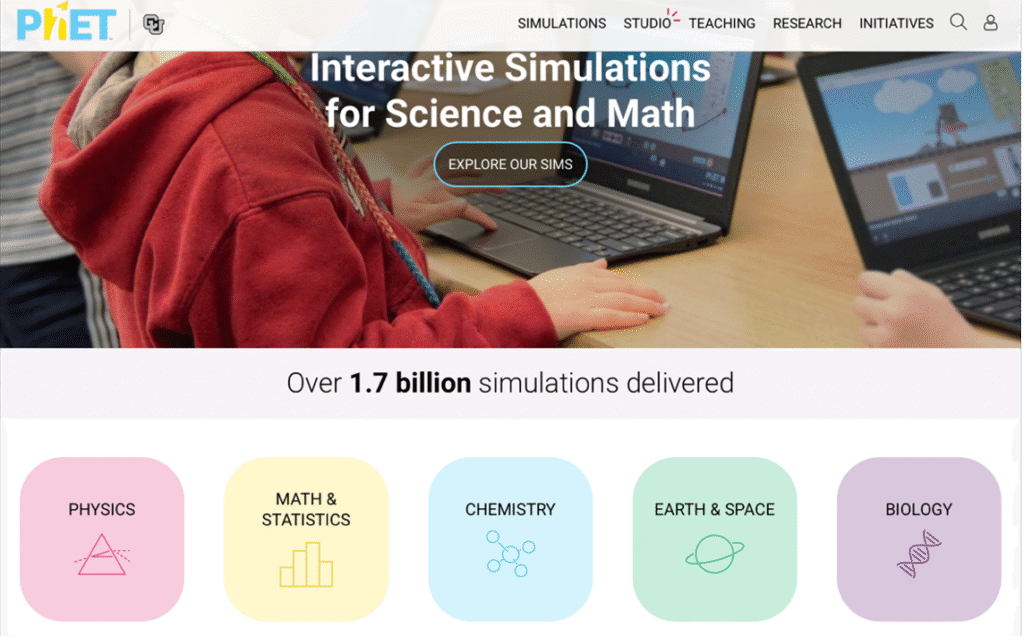
Kuala Lumpur: What if every student, regardless of their location, could conduct a science experiment at the click of a button? That is the idea behind PhET Simulations, a powerful digital tool now being used in many Malaysian classrooms. Developed by the University of Colorado Boulder, PhET simulations are helping schools overcome the pressing issues in Malaysian science education such as the digital divide and student disengagement.
One of the most significant contemporary issues in Malaysian science education is the digital divide, particularly the disparity between urban and rural schools. While students in major cities often have access to modern laboratories and expert teachers, many rural schools struggle with outdated equipment and limited resources. PhET simulations provide a cost-effective alternative by allowing students to conduct realistic experiments on basic computers or tablets. Simulations such as Circuit Construction Kit or Gas Properties enable learners to test hypotheses, change variables and observe scientific phenomena in a way that mirrors real world experimentation. For schools without proper lab facilities, this technology acts as a bridge to high quality science learning.
In addition to resource disparities, student disengagement is another growing concern. Science subjects often seen as abstract, formula heavy and disconnected from everyday life are losing student interest, especially among those who struggle with traditional teaching methods. PhET simulations tackle this issue by promoting interactive and inquiry-based learning. Students are no longer passive recipients of information. Instead, they take on the role of active investigators. For instance, in the Energy Skate Park simulation, students can manipulate gravity, friction and mass to explore the conservation of energy. These visual, hands-on experiences help students build deeper conceptual understanding and improve long-term retention of knowledge.
Moreover, the relevance of science education in today’s world requires students to engage with real world problems such as climate change, renewable energy, health and artificial intelligence. PhET simulations are increasingly being used to introduce and explore these topics. Simulations like The Greenhouse Effect or Natural Selection provide powerful platforms for students to examine how scientific principles apply to current global challenges. By integrating these tools into lessons, teachers are able to make science more meaningful and encourage critical thinking about the world around them.
However, the integration of digital tools like PhET simulation into classrooms is not without obstacles. Teacher readiness remains a key challenge. While some educators have embraced technology enthusiastically, others lack the confidence or training to use it effectively. This gap has prompted the Ministry of Education and various teacher training institutes to initiate professional development programs focused on digital pedagogy and STEM integration. These programs aim to equip teachers with the skills to design simulation-based lessons, assess student learning using virtual tools and align simulations with the national curriculum (KSSM).
As Malaysia continues to transition toward Education 4.0 an education model that embraces technology, creativity and future oriented skills tools like PhET simulations will play a crucial role in modernizing science education. They offer a scalable solution to some of the system’s most difficult problems including inequality, disengagement and outdated instructional practices. With ongoing support from educational institutions, policymakers and the broader teaching community, PhET simulations have the potential to not only enhance classroom experiences but also prepare students to solve the complex scientific and environmental challenges of the 21st century.
Authors:
Amien Amierul bin Amzzah @ Nayawai
Nurul Azliza binti Ramli
Dr Mokhzani bin Ibrahim
