SEPTEMBER 9 — When the Philippines assumes the Group Chairmanship of Asean and related summits, it will do so at a particularly turbulent time for the region. The year 2025 has already been one of Asean’s most testing periods since its founding in 1967. The re-election of Donald Trump and the return of his “MAGA tariffs” has rattled supply chains and weakened trust in multilateral trade frameworks. India and Pakistan, both Asean dialogue partners in different capacities, came close to a catastrophic war in mid-2025 before an uneasy ceasefire was brokered by the United States. Meanwhile, Southeast Asia itself is convulsed by overlapping crises: the Thai-Cambodian border conflict, Indonesia’s protracted political standoff after a disputed election, and Myanmar’s ongoing descent into civil war ahead of a fraudulent election scheduled for late 2025.
Against this backdrop, the Philippines will inherit the mantle of Asean Chair. But Manila’s assumption of this role will not be without considerable shortcomings. Unlike Malaysia, which has used its current chairmanship to convene difficult dialogues—including facilitating ceasefire talks between Thailand and Cambodia and engaging the BRICS bloc in Kuala Lumpur—the Philippines lacks both the bureaucratic depth and the diplomatic experience to manage multiple great power rivalries and intra-Asean disputes simultaneously.
Domestic distractions
The Philippines enters this chairmanship while consumed by domestic turbulence. President Ferdinand Marcos Jr. faces mounting pressures over inflation, an overstretched budget, and the volatility of Philippine-US-China relations in the South China Sea. Manila’s recurring domestic political crises, combined with its highly personalized style of governance, have historically weakened its capacity to sustain long-term institutional strategies. Asean chairmanships demand bureaucratic steadiness, strong inter-ministerial coordination, and policy continuity. Yet these qualities are often absent in Manila’s governance system, where foreign policy shifts are frequent, reactive, and shaped by leadership personalities rather than state institutions.
Uneven diplomatic capacity
Diplomatic capacity is another weakness. Manila is highly vocal on maritime disputes with China, often adopting maximalist positions that limit room for negotiation. While this may resonate with domestic audiences, it risks alienating Asean partners who prefer quiet diplomacy and consensus-building. By contrast, when Malaysia took on the role of Group Chair in 2025, it leveraged its neutrality and convening power to bring together the Gulf Cooperation Council (GCC), China, and Asean in one summit, thereby broadening Asean’s strategic options.
The Philippines, however, has rarely played the role of a neutral broker. Its foreign policy is tethered to Washington more than any other Asean member, a fact underscored by its willingness to expand the Enhanced Defence Cooperation Agreement (EDCA) with the United States. While this alignment provides Manila with security guarantees, it also undermines its credibility to act as an impartial convener within Asean. At a time when Asean must carefully balance between the US and China, Manila’s over-reliance on Washington reduces the likelihood that it can command trust across the bloc.
Economic constraints
Economically, the Philippines is also less equipped to lead Asean compared to its peers. Its GDP growth, while respectable, rests heavily on remittances and the business process outsourcing sector. It does not enjoy the manufacturing depth of Vietnam, the financial weight of Singapore, or the semiconductor capacity of Malaysia.
When Asean engages in dialogues with the United States, China, Japan, or the European Union, economic leverage matters. Manila has only limited bargaining power in trade negotiations, and this will weaken Asean’s collective position under its chairmanship.
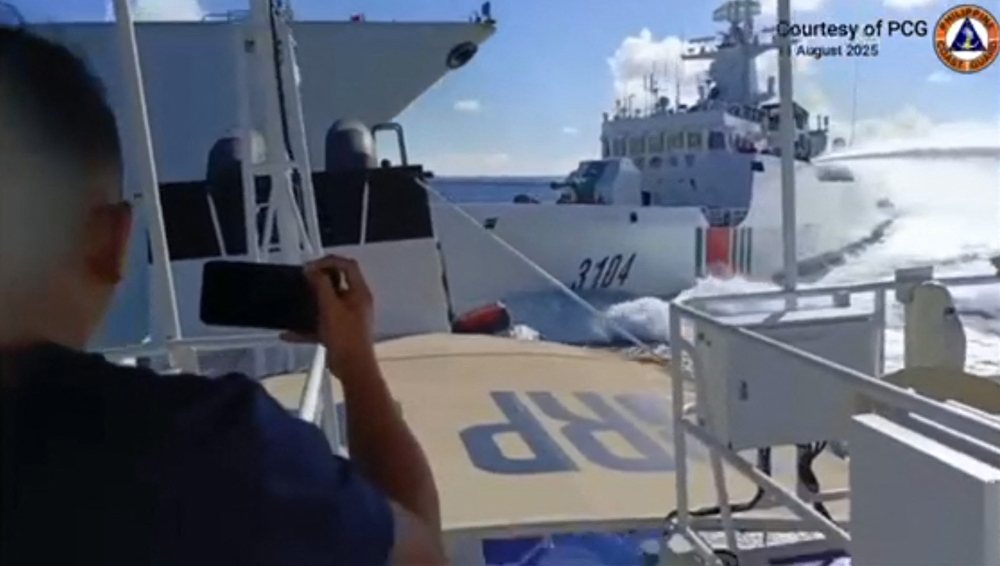
This handout video grab released and taken on August 11, 2025 by the Philippine Coast Guard shows an incident between a Chinese Navy vessel (left) and a Chinese Coast Guard ship (right) as seen from a Philippine fisheries boat near Scarborough Shoal in the disputed South China Sea. — AFP pic/Philippine Coast Guard Handout
Institutional continuity
Institutional continuity is another Achilles’ heel. Asean Chairmanship requires at least three layers of leadership: at the summit level, at the ministerial level, and at the senior officials’ level. While the Philippines has experienced diplomats, it often lacks the institutional machinery to coordinate effectively across all three levels. This contrasts with Indonesia, which has a tradition of institutional memory in Asean affairs through its Jakarta-based Ministry of Foreign Affairs.
Manila’s foreign policy bureaucracy is smaller, more overstretched, and often caught between populist pressures at home and diplomatic expectations abroad.
Asean’s needs versus Manila’s limits
Asean today needs a chair that can navigate complex overlapping crises: the South China Sea disputes, escalating great power rivalry, the humanitarian catastrophe in Myanmar, and the uncertain global economy. It also needs a chair that can provide intellectual leadership in shaping Asean’s future vision—whether through the RCEP framework, the Kuala Lumpur 2045 Vision, or the sustainability agenda that Malaysia has been promoting for 2026.
The Philippines, unfortunately, comes to this task with a more limited toolkit. It will be expected to lead dialogues on regional security while being one of the most directly entangled parties in those disputes. It will be asked to coordinate on humanitarian responses while struggling with its own governance challenges. It will be tasked with managing Asean’s external partnerships while over-dependent on Washington for its own security.
The risk of a weak chairmanship
If Manila fails to rise to the occasion, Asean risks losing coherence in 2026 and beyond. The bloc has weathered crises before, but its strength lies in the ability of the chair to serve as a convener, bridge-builder, and honest broker. A weak chairmanship by the Philippines could embolden external powers to divide the bloc further—whether by driving wedges over South China Sea disputes, splitting Asean states on US tariffs, or exploiting internal differences over Myanmar.
What Manila must do
The Philippines can still avoid these pitfalls, but only if it invests in three key areas. First, it must strengthen bureaucratic coordination by empowering its Ministry of Foreign Affairs to lead consistently across Asean tracks. Second, it must temper its foreign policy rhetoric, focusing less on confrontation and more on consensus-building within Asean. Third, it must leverage its chairmanship to advance concrete deliverables that benefit all Asean members—such as joint initiatives on disaster relief, digital economy, and maritime connectivity—rather than merely advancing its own disputes with China.
Manila must recognize that Asean chairmanship is not simply about hosting summits. It is about shaping the strategic environment in which Southeast Asia operates. Failure to do so risks reducing Asean to an arena of great power rivalry, rather than a community with agency and unity.
As Myanmar heads toward a fraudulent election, as Thai-Cambodian tensions simmer, and as US-China rivalry intensifies, Asean cannot afford a chair that is distracted, divided, or diplomatically limited. The Philippines, therefore, faces a stern test: to rise above its shortcomings and to prove that it can lead Asean at a time of unprecedented turbulence.
If it succeeds, Manila may surprise sceptics and demonstrate that even middle-tier Asean states can provide leadership in difficult times. If it fails, Asean will drift, leaving Malaysia’s efforts in 2025 and Indonesia’s tradition of stewardship in the past, and casting doubt on Asean’s relevance in the very decade it must prove its resilience.
* Phar Kim Beng is a professor of Asean Studies and director of the Institute of International and Asean Studies (IINTAS) at International Islamic University of Malaysia
** This is the personal opinion of the writer or publication and does not necessarily represent the views of Malay Mail.