SEPTEMBER 28 — The latest iteration of proposals to stabilise Gaza after years of war and destruction is not just a diplomatic talking point. It is a reflection of how deeply the international community has struggled to break the cycle of violence while balancing the imperatives of sovereignty, security, and humanitarian urgency.
Reports that former British Prime Minister Tony Blair may be tapped to head a five-year international transitional authority for Gaza should not be dismissed as idle speculation. They represent an attempt to answer the most pressing question of our time in the Middle East: how to rebuild Gaza while giving Palestinians a credible horizon toward self-governance and peace.
The idea itself is not entirely new. In fact, versions of a “Gaza International Transitional Authority” have circulated in Washington, Brussels, and New York for months. The Guardian recently revealed that Trump’s advisers, echoing Blair’s own thinking, favour an international body that would hold supreme political and legal authority over Gaza for five years, with benchmarks tied to reconstruction, reform, and security.
During this period, Israel would gradually withdraw. An international stabilisation force would secure the territory. Palestinian security forces would be trained externally before assuming responsibilities at home. The ambition is to create breathing space for rebuilding Gaza’s shattered infrastructure while keeping spoilers at bay.
The advantages of such a plan are not trivial. First, it could address the crisis of legitimacy. After years of conflict, neither Hamas nor the Palestinian Authority enjoys uncontested credibility among Palestinians, while Israel’s continued military footprint only deepens resentment.
An international transitional body, if backed by the United Nations and major Arab states, might offer a neutral framework to restore trust. By separating immediate humanitarian needs from the endless stalemate of final-status negotiations, the plan could deliver tangible improvements — housing, water, electricity, healthcare — that ordinary Gazans desperately need.
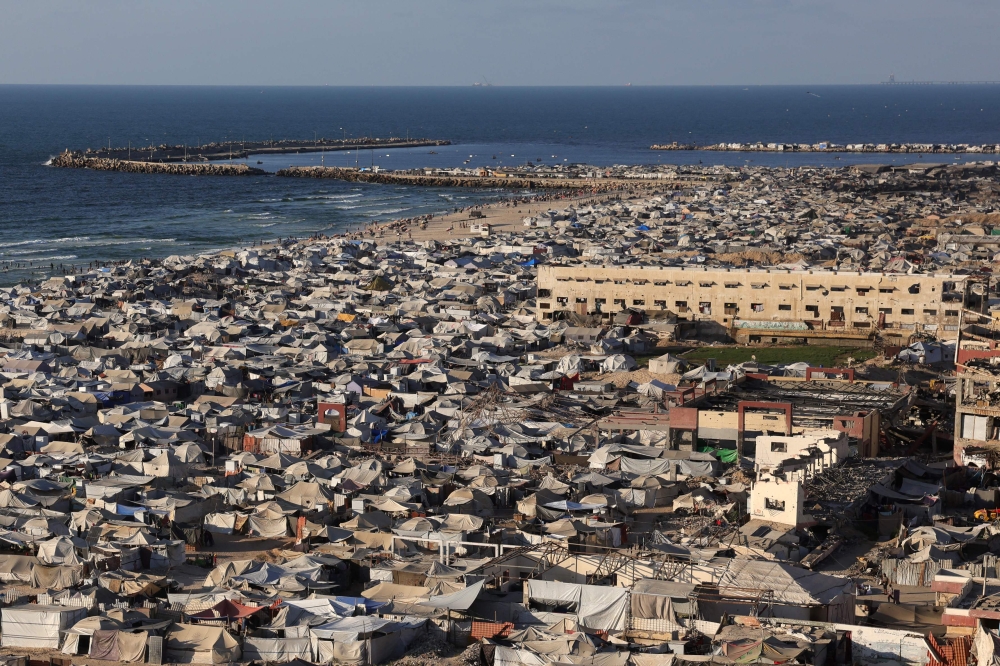
This picture shows tents housing displaced Palestinians in Gaza City on September 1, 2025. Almost two years since Israel began its campaign in Gaza after Hamas’ October 7, 2023 attack, swathes of the Palestinian territory have been reduced to rubble and the vast majority of its population has been displaced at least once. — AFP pic
Second, the presence of an international head, such as Blair, signals a seriousness of purpose. Blair has experience in the region, however controversial, through the Quartet, and has maintained extensive networks among Gulf states, the United States, and Israel.
He embodies the kind of high-level convening power that could unlock donor funding and enforce accountability mechanisms. For reconstruction to succeed, billions of dollars must flow into Gaza, and only a credible international leadership structure will persuade donors to release such funds.
Third, the five-year horizon gives structure to what is otherwise an amorphous transition. Too short a mandate would yield chaos. Too long risks turning the authority into a form of external occupation.
Five years strikes a balance between urgency and sustainability, offering time to rebuild institutions, retrain civil services, and prepare for genuine Palestinian elections. It also allows international actors to sequence reforms: first stabilising security, then rebuilding infrastructure, then enabling governance.
Yet optimism must be tempered with realism. For all its appeal on paper, the obstacles are formidable. The first and most glaring problem is legitimacy.
Palestinians may perceive an externally imposed transitional body as a neo-colonial project, one that robs them of their right to self-determination. Unless the authority is carefully anchored in Palestinian participation — through advisory councils, grassroots consultations, and a clear timetable to hand over power — it risks rejection from the very population it is supposed to serve.
History shows that transitional administrations, from Kosovo to East Timor, can only succeed when they actively empower local actors rather than dictate terms from above.
Second, Israel’s role looms large. Even if Jerusalem formally accepts a transitional authority, it is unlikely to surrender control of borders, airspace, and security oversight.
Israel has long insisted on maintaining veto power over movements of goods, people, and funds into Gaza. If the international authority is shackled by Israeli red lines, its effectiveness will be crippled. Worse still, Palestinians will see it as a fig leaf for continued occupation, draining the project of legitimacy.
Third, the benchmarks for transition are deeply contentious. Who decides when Gaza is “ready” to return to Palestinian self-rule?
If the criteria are too stringent — requiring complete disarmament of all militant groups, for instance — then the five-year period may stretch indefinitely. Mission creep has haunted similar projects elsewhere. What begins as a temporary measure risks hardening into a semi-permanent status quo, a danger that would only breed new waves of frustration and violence.
Fourth, the security dimension is fraught with danger. Deploying an international stabilisation force in Gaza is easier said than done. Which countries would contribute troops? Would Arab states, Nato members, or neutral Asian states step forward?
What happens if militants attack the force, drawing them into direct conflict? The risk of casualties could erode international political will quickly. Moreover, external training of Palestinian security forces in Egypt or Jordan raises its own questions about loyalty, capacity, and eventual integration.
Fifth, there is the challenge of financing. Rebuilding Gaza will require massive investments, estimated in the tens of billions. Donor fatigue is real, especially in a world where Ukraine, climate disasters, and domestic fiscal crises compete for resources.
Without binding pledges, the transitional authority could become a hollow shell. Worse, if corruption seeps into reconstruction funds, as it has in previous rounds of aid to Gaza, the authority’s credibility will collapse.
Finally, one must ask whether Blair himself is the right figure to lead such an initiative. His reputation in the Arab world remains controversial, shaped by his role in the Iraq War and his perceived closeness to Israel.
For some Palestinians, Blair symbolises Western duplicity rather than neutrality. Even if his diplomatic skills are considerable, his appointment might polarise opinion from the start.
An alternative could be a figure drawn from the Global South, perhaps a respected Asian or African statesman with no colonial baggage, thereby projecting a more balanced image of international stewardship.
The ultimate question, then, is whether such a plan is a breakthrough or a diplomatic mirage. It may be both. On the one hand, it reflects genuine recognition that the status quo is untenable. Gaza cannot rebuild itself under siege and intermittent war.
An international transitional authority offers a practical mechanism to stabilise the territory and give Palestinians hope.
On the other hand, without clear guarantees, political will, and legitimacy, the plan risks becoming another exercise in buying time — a mirage that fades once the hard realities of occupation, sovereignty, and power politics resurface.
This is where Asean and the East Asian Summit (EAS) must do more than simply issue statements. They can formally back such an initiative as a humanitarian and diplomatic necessity. Asean has long upheld the Bali Declarations that reject the use of force in international relations, while the EAS brings together all major Asia-Pacific powers, including the United States, China, India, Japan, and Russia.
If Asean and the EAS lend their endorsement, they broaden the legitimacy of the plan beyond a Western or Arab initiative.
Their backing would make it a genuinely global project, rooted not only in the UN system but also in Asia’s collective voice for peace. By aligning with such a plan, Asean and the EAS would show that regional organisations are willing to shoulder responsibility for ending genocide, starvation, and war wherever they occur.
Malaysia’s role as Asean Chair in 2025 is especially pivotal. Prime Minister Anwar Ibrahim has consistently argued that Asean must play a moral role under the UN Charter’s provisions for regional security. Backing a transitional authority for Gaza would be a natural extension of this principle.
Moreover, East Asia’s endorsement would unlock credibility in the Global South. By supporting the international community’s plan for Gaza, Asia can demonstrate solidarity with Palestine while signalling that reconstruction, dignity, and sovereignty must go hand in hand.
The international community should not reject the idea of a transitional authority outright. Instead, it must refine it. Any such authority must be time-bound, backed by UN legitimacy, funded by binding commitments, and inclusive of Palestinian voices at every stage.
Israel must be pressed to allow genuine autonomy within the framework, while Arab states and Asian partners alike must step up both financially and politically. Only then can such a plan avoid the fate of so many previous diplomatic experiments in the Middle East: big headlines, little substance.
For Gaza, the stakes could not be higher. Reconstruction is not just about bricks and mortar. It is about restoring dignity and sovereignty to a people long denied both.
If an international authority under Blair or another figure can lay the foundations for that dignity, then it may be worth the gamble.
But if it becomes another excuse for delay and external control, it will be remembered as yet another mirage in the desert of Middle Eastern diplomacy — one Asean and the East Asian Summit should make clear they will not allow.
* Phar Kim Beng, PhD is the Professor of Asean Studies at International Islamic University of Malaysia and Director of Institute of International and Asean Studies (IINTAS).
** This is the personal opinion of the writer or publication and does not necessarily represent the views of Malay Mail.