FEBRUARY 7 — China is a country long accustomed to handling big politics. It thinks in decades rather than election cycles, and in structural terms rather than political soundbites.
For this reason, any major electoral victory by Takaichi Sanae should not be misread in Beijing as a deliberate provocation, much less a strategic insult.
China is not a great power driven by one-upmanship; even though it is locked into a systemic rivalry with the US.
It does not recalibrate its grand strategy based on who wins a single election in Washington or Tokyo.
Campaign rhetoric—especially in democratic systems—is understood for what it is: domestic signalling shaped by ideological positioning, factional competition, and coalition arithmetic.
Beijing has repeatedly shown that it can separate electoral language from governing reality; especially those in US and Australia.
Even sharper remarks on Taiwan, when voiced during political contests, are rarely taken at face value.
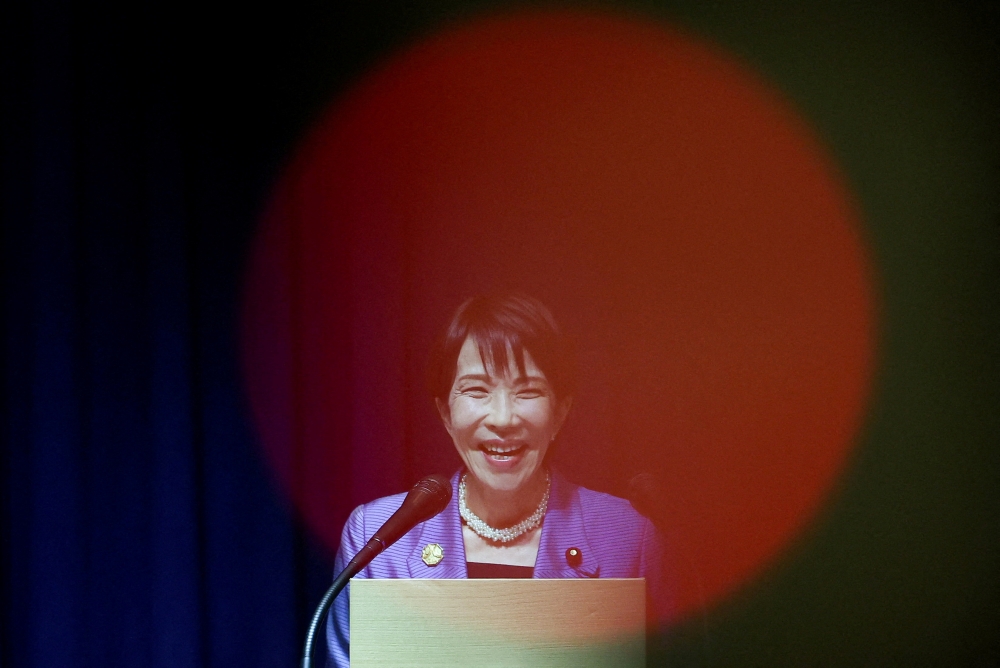
Japan’s Prime Minister Sanae Takaichi. — Reuters pic
China’s leadership understands that campaign language often fades once leaders confront the constraints of office, bureaucracy, alliance politics, and economic interdependence. In this sense, shifts in Japanese domestic politics do not automatically translate into strategic escalation.
This does not mean, however, that everything is negotiable.
There is one red line that is neither elastic nor symbolic. Taiwan occupies an existential position in China’s conception of sovereignty, national rejuvenation, and post-war order.
Beijing can tolerate rhetoric, absorb diplomatic signalling, and reinterpret intent—but it will not accept actions that materially cross this boundary.
As long as Japan’s posture remains within the realm of words rather than deeds, China will continue to respond with restraint rather than reaction.
Such restraint should not be mistaken for passivity.
It reflects the behaviour of a state sufficiently confident in its long-term position to avoid being dragged into short-term emotional spirals.
A decisive political outcome in Tokyo, therefore, is not a geopolitical earthquake in Beijing. China is too seasoned a power to confuse electoral outcomes with strategic realignment.
It has lived through far more consequential shifts—from bipolar confrontation to unipolar dominance and now a fragmented global order—without losing sight of its core priorities.
The broader lesson is simple but often overlooked: China does not overreact unless it believes the underlying structure of the system is being altered against its fundamental interests. Until that threshold is crossed, Beijing will continue to play the long game—absorbing change, recalibrating quietly, and waiting.
Words may travel fast. Strategy, however, moves slowly.
* Phar Kim Beng is a professor of Asean Studies at the Institute of International and Asean Studies, International Islamic University of Malaysia.
** This is the personal opinion of the writer or publication and does not necessarily represent the views of Malay Mail.