FEBRUARY 9 — Thailand’s general election on February 8 — delivering 193 seats to Prime Minister Anutin’s party, followed by the People’s Party (118), Pheu Thai (74), Kla Tham (58), the Democrats (22), Thai Ruam Ralang (6), Palang Pracharath (5), Prachachart (5), and the Economic Party (3) — should not be reduced to a simplistic referendum on Cambodia, border tensions, or constitutional politics alone.
While all of the above featured prominently in campaign rhetoric — particularly amid sensitivities over borders, migrant labour, and historical grievances — the deeper and more consequential undercurrent was Thailand’s growing anxiety over scams, cybercrime, and transnational criminal syndicates that have turned parts of mainland Southeast Asia into global fraud hubs. They are now scams in Cambodia, Laos, Myanmar even parts of Thailand that need to be looked into by the law enforcement agencies of the eleven member states of Asean.
This election was, in many ways, a national reckoning with the costs of state weakness in the digital age. One that is fuelled by Artificial Intelligence too.
For years, Thailand has found itself uncomfortably positioned between being a victim, a transit point, and — at times — an inadvertent facilitator of cross-border scam networks.
These operations are no longer small-scale phone frauds. They are industrialized criminal enterprises involving human trafficking, digital manipulation, cryptocurrency laundering, and psychological coercion.
The victims are global — ranging from East Asia to Europe and North America — but the operational geography is regional, concentrated along porous borders and special economic zones.
Cambodia, Myanmar, Laos, and parts of southern China are frequently mentioned in this ecosystem, but Thailand’s role is structurally pivotal.
It is the region’s logistical hub: transport, banking, telecom infrastructure, and labour flows converge there.
As a result, Thai voters increasingly recognize that national security today is not only about tanks and borders, but about servers, SIM cards, shell companies, and corrupt enablers.
This explains why the election discourse went beyond foreign policy symbolism and into questions of governance capacity.
Scams have become a kitchen-table issue in Thailand.
Families worry about relatives lured abroad and forced to work in scam compounds. Middle-class professionals fear financial ruin from increasingly sophisticated online fraud.
Businesses worry about reputational damage and capital flight.
Tourism — one of Thailand’s economic lifelines — suffers when the country is associated with cybercrime networks and human trafficking routes.
Against this backdrop, Cambodia became less a singular “other” and more a proxy for a larger regional governance failure.
The issue was not Phnom Penh per se, but what happens when borders are weak, enforcement uneven, and cooperation politicized.
Voters were effectively asking whether Thailand would continue to manage scams episodically — or finally confront them systemically.
This distinction matters.
Past approaches across the region have relied heavily on ad hoc crackdowns: periodic raids, high-profile arrests, and temporary border closures.
These generate headlines but rarely dismantle networks. Scam syndicates simply relocate, rebrand, and resume operations elsewhere. The election revealed public fatigue with this performative enforcement.
Instead, Thai voters signalled a preference for sustained institutional reform: tighter financial oversight, real-time intelligence sharing, professionalized cybercrime units, and credible prosecution of domestic accomplices.
Importantly, this includes confronting corruption within Thailand itself — something no serious anti-scam strategy can avoid.
The Cambodia angle thus reflects a broader demand for Thailand to lead, rather than posture.
As one of Asean’s most capable states, Thailand is expected — by its own citizens and its neighbours — to push for deeper regional mechanisms. This includes operational cooperation, not just declarations.
Joint investigative teams, synchronised financial regulations, extradition clarity, and shared digital forensics are no longer optional luxuries; they are prerequisites for credibility.
Here, the election outcome matters for Asean as a whole.
Scams are not merely criminal issues; they are strategic liabilities.
They erode trust in digital economies, undermine financial inclusion, and feed narratives that Southeast Asia is unsafe for innovation.
Left unchecked, they will constrain Asean’s ambitions in fintech, e-commerce, and digital integration — areas critical for competing in a fragmenting global economy.
Thailand’s electoral signal therefore aligns with a wider regional need: moving scams from the margins of “law-and-order” discussions into the core of national and regional security planning.
There is also a moral dimension that voters increasingly recognise.
Scam compounds are sustained through coercion, abuse, and modern forms of slavery.
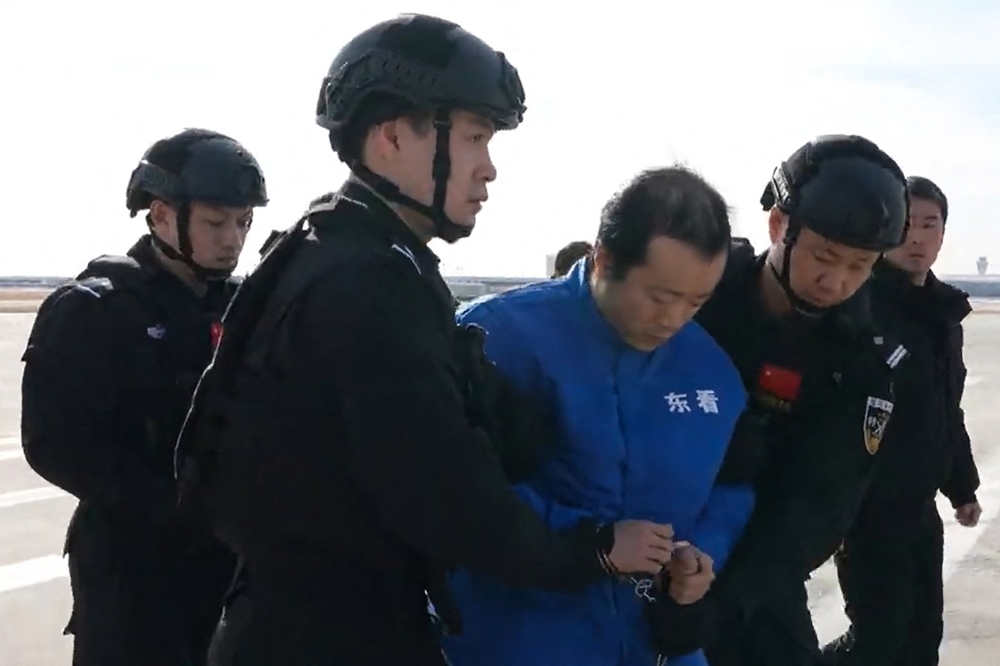
This frame grab taken from undated handout video footage released by China’s Ministry of Public Security on January 8, 2026 shows guards escorting alleged scam boss Chen Zhi (centre) off a China Southern plane in Beijing. Chen has been extradited to China from Cambodia, Beijing confirmed on January 8, after he was indicted by the United States over alleged multibillion-dollar fraud. — AFP pic/China’s Ministry of Public Security handout
Addressing scams is inseparable from addressing human trafficking. A government that claims legitimacy must show it can protect both its citizens and those exploited within its territory or supply chains.
Seen this way, Cambodia’s prominence in the election discourse was less about blame and more about urgency. Borders do not absolve responsibility when crimes are transnational.
Nor can sovereignty be used as a shield against cooperation. Thai voters appear to understand this reality better than many elites.
The challenge now is delivery.
An election mandate creates expectations, not outcomes.
Thailand’s next government will be judged not by rhetoric, but by whether scams measurably decline, victims are repatriated, and networks are dismantled rather than displaced.
Success will require political courage, especially when enforcement touches powerful interests and entrenched corruption.
It will also require diplomacy of a different kind — quiet, persistent, and technical. Public megaphone diplomacy toward neighbours may satisfy nationalist impulses, but it rarely builds the trust needed for sustained cooperation.
What is needed instead is patient statecraft: shared databases, liaison officers, and institutional memory that survives electoral cycles.
In that sense, Thailand’s election offers a lesson beyond its borders. Democratic accountability can force governments to confront uncomfortable, complex problems that technocratic drift often postpones.
Scams are no longer invisible crimes affecting “others”. They are central to how citizens judge state competence.
Thailand’s voters have spoken clearly: confronting scams is no longer secondary to foreign policy — it is foreign policy, domestic security, economic strategy, and moral governance rolled into one.
If the next government understands this — and acts accordingly — Thailand can help pull mainland Southeast Asia back from becoming the world’s scam corridor.
If it fails, the election will be remembered not for what it promised, but for the opportunity it squandered.
* Phar Kim Beng is a professor of Asean Studies and director of the Institute of International and Asean Studies, International Islamic University of Malaysia.
** This is the personal opinion of the writer or publication and does not necessarily represent the views of Malay Mail.