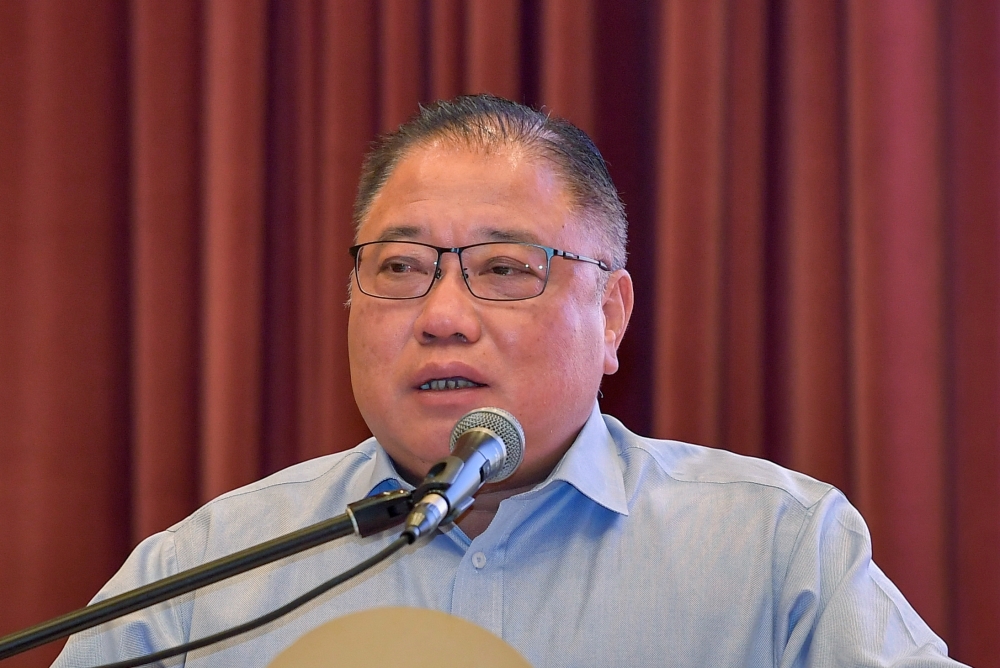
SIBU, Feb 20 — More buildings in Sibu could collapse unless the Sibu Municipal Council (SMC) implements urgent and comprehensive flood mitigation measures to prevent structural failures, warned Minister for Tourism, Arts and Culture Datuk Seri Tiong King Sing.
He said that following the collapse of a corner-lot building at Jalan Pahlawan on February 13, he had received numerous queries from the public about the possible causes.
“This incident was by no means a sudden accident but rather the inevitable result of prolonged underground erosion,” he said in a Facebook post.
The Bintulu MP and Dudong assemblyman explained that the area has long suffered from persistent water accumulation and poor drainage, with water gradually seeping underground and washing away the sand beneath the surface.
“Given that parts of the underlying soil consist of sandy sediment, the foundation was gradually ‘hollowed out’, eventually leading to visible subsidence and structural instability, forming what is commonly referred to as soil degradation or soft ground phenomenon,” he added.
Tiong stressed that this was a structural failure caused by long-term underground erosion and declining load-bearing capacity, not merely a surface collapse.
He clarified that the problem arose from years of water stagnation rather than the area being naturally soft ground.
He said he is familiar with the area, as his late mother once lived there.
“I frequently accompanied her to eat out, stroll around, visit the old town area and had personally witnessed the persistent flooding, poor road conditions and visibly uneven surfaces.
“This is certainly not an isolated issue. Many areas in Sibu have already experienced house subsidence, water pooling on roads, and softening soil, indicating a systemic geological degradation — commonly referred to as ‘soft ground’.
“This is a process of underground structural erosion caused by water, not merely a flooding issue.
“If flood mitigation policies are not fundamentally reformed, risks will continue to accumulate and eventually erupt at a critical point,” he said.
Tiong criticised the authorities for relying for many years on pumping stations as a temporary solution.
While such measures remove surface water, they do not address underground water, which continues to seep into and erode surrounding soil.
“This approach treats the symptoms but not the root cause. The pumped water cannot outpace the rate of return flow, and in some cases even flows back into affected areas, creating a vicious cycle,” he said.
He highlighted similar unresolved flooding issues in areas such as Nangka, where structural problems continue to worsen over time.
Tiong also criticised the State Ministry of Public Health, Housing and Local Government under Deputy Premier Datuk Amar Dr Sim Kui Hian for ignoring calls to improve drainage and carry out desilting works.
He said he had alerted SMC about drainage concerns before the last state election, but no substantial action has been taken.
“The root of the problem lies in the insufficient carrying capacity of the Igan River and the Rajang River.
“Several stretches of the riverbeds have become severely silted, preventing effective water discharge and forcing the city to remain in a prolonged high-water-level condition,” he said.
He said sedimentation is particularly serious at the mouth of the Igan River, where the silted area is reportedly as large as a football field.
“Only through systematic desilting operations, deepening of riverbeds, restoration of river discharge capacity, and comprehensive restructuring of drainage systems to channel water directly into the rivers can the issue be fundamentally resolved.
“In addition, areas already showing signs of subsidence must undergo thorough geological assessments by the Public Works Department (JKR), with targeted solutions rather than superficial patchwork repairs,” he said.
Tiong expressed regret that despite repeatedly raising these proposals, comprehensive implementation has yet to be seen as his term nears its end.
“If flood mitigation strategies continue to focus solely on pumping rather than addressing riverbed sedimentation and underground structural erosion, similar collapses will occur again — it is only a matter of time and location,” he said, adding that he would hold himself accountable if flooding persists after proper riverbed deepening.
“The voices of the people must be heard. Flood management cannot be cosmetic or piecemeal — it must confront riverbed sedimentation and aging drainage structures head-on.
“If these critical factors continue to be ignored, it will ultimately be the grassroots communities and ordinary citizens who pay the price,” said Tiong. — The Borneo Post