FEBRUARY 28 — The Federal Constitution is a living document. It cannot therefore remain static.
Changes or amendments to the provisions of the Federal Constitution are inevitable, as duly recognised by Federal Court Judge Raja Azlan Shah (as His Highness then was) in the Federal Court case of Loh Kooi Choon v Government of Malaysia [1977] in the following words:
“[T]he framers of our Constitution prudently realised that future context of things and experience would need a change in the Constitution, and they, accordingly, armed Parliament with ‘power of formal amendment’.
“They must be taken to have intended that, while the Constitution must be as solid and permanent as we can make it, there is no permanence in it. There should be a certain amount of flexibility so as to allow the country’s growth.
“In any event, they must be taken to have intended that it can be adapted to changing conditions, and that the power of amendment is an essential means of adaptation. A Constitution has to work not only in the environment in which it was drafted but also centuries later.”
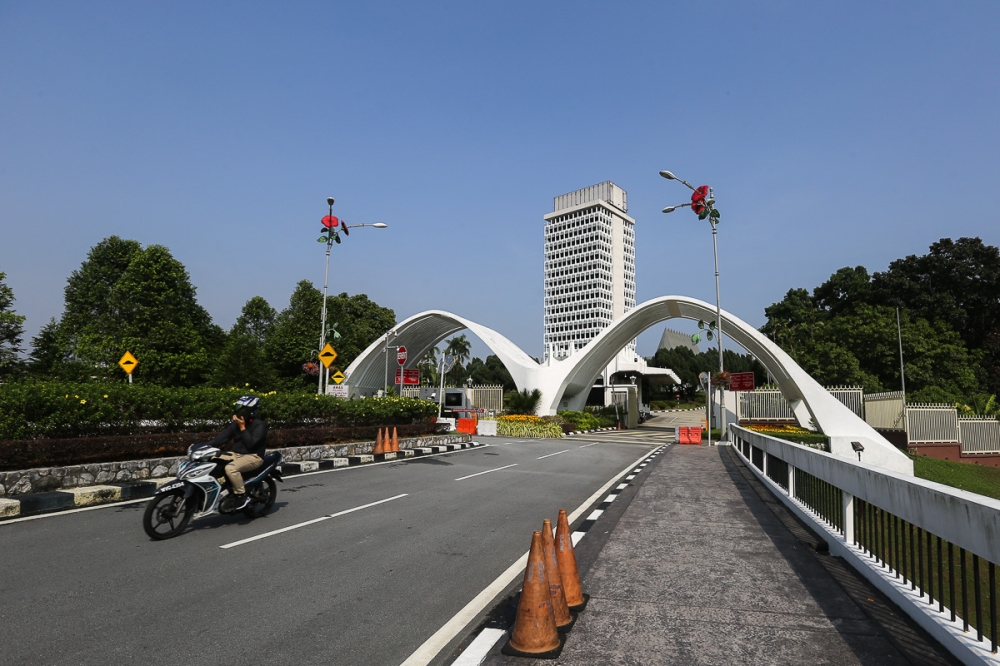
A general view shows the Parliament building in Kuala Lumpur on March 19, 2021. — Picture by Yusof Mat Isa
Earlier, the learned judge said:
“Our Constitution prescribes four different methods for amendment of the different provisions of the Constitution:
(1) Some parts of the Constitution can be amended by a simple majority in both Houses of Parliament such as that required for the passing of any ordinary law. They are enumerated in clause (4) of Article 159 and are specifically excluded from the purview of Article 159;
(2) The amending clause (5) of Article 159 which requires a two-thirds majority in both Houses of Parliament and the consent of the Conference of Rulers;
(3) The amending clause (2) of Article 161E which is of special interest to East Malaysia and which requires a two-thirds majority in both Houses of Parliament and the consent of the Governor of the East Malaysian State in question;
(4) The amending clause (3) of Article 159 which requires a majority of two-thirds in both Houses of Parliament.”
The most common method used to amend the Federal Constitution is the fourth method above where a majority of two-thirds in both Houses of Parliament is required.
If no change whatsoever may be made to the Federal Constitution, Article 159 will be rendered superfluous.
If the living document cannot be changed or altered or amended in any way, it is as if it has been carved in granite. Lord President Suffian put it succinctly in the following words:
“If our Constitution makers had intended that their successors should not in any way alter their handiwork, it would have been perfectly easy for them to so provide; but nowhere in the Constitution does it appear that that was their intention, even if they had been so unrealistic as to harbour such intention.
“On the contrary apart from Article 159, there are many provisions showing that they realised that the Constitution should be a living document intended to be workable between the partners that constitute the Malayan (later Malaysian) polity, a living document that is reviewable from time to time in the light of experience and, if need be, amended.”
Since its inception in 1957, the Federal Constitution has undergone various changes and amendments – more than 57 times, according to former minister, senior lawyer and adjunct professor at the Faculty of Law, UKM Tan Sri Datuk Seri Dr Syed Hamid Albar writing in 2022. (See “Hallmarks of the Federal Constitution: Constitutional Supremacy and the Rule of Law” [2022] 4 MLJ clxiv)
Among the most important are the amendment to Article 66 vide the Constitution (Amendment) Act 1984 (Act A584), where the Yang di-Pertuan Agong (YDPA) was given a legislative role for the first time, and the amendment to Article 181 vide the Constitution (Amendment) Act 1993 (Act A848), which removed the immunity of the YDPA and other Rulers from suit when acting in a personal capacity, and gave exclusive jurisdiction to the Special Court to try all offences committed in the Federation by the YDPA or the Ruler of a State and all civil cases by or against the YDPA or the Ruler of a State.
So, it cannot be said the proposed amendments to the Federal Constitution seeking to limit the prime minister’s tenure may be unconstitutional as undermining the powers of the YDPA or the Conference of Rulers.
The Federal Constitution is a living document and cannot remain static.
* This is the personal opinion of the writer or publication and does not necessarily represent the views of Malay Mail.