MARCH 1 — While riding my motorcycle along a long, noisy highway on my way home, I noticed a large billboard advertising TIME Fibre Home Internet, 200Mbps at only RM 99/month!
It was bright, eye-catching with an easy to understand message: faster speed at a low price, stable connection, and better online experience.
At that moment, I realised something interesting. Most people were introduced to optical fibre because of the internet.
If the internet is fast, they are happy; if it is slow, they get frustrated. But beyond that, only a few people know about what optical fibre can really do, or how deeply it can assist many things in our lives.
For someone like me, who has been working with optical fibres for several years, what makes optical fibres special is actually very simple.
Unlike traditional electrical wires that send signals using electric current flowing through metal, optical fibre sends signals using light travelling through glass.
Instead of moving electrons, it uses tiny packets of light energy, known as photons.
This difference may sound small, but it completely changes how information can be transmitted, making it faster, more stable, and less affected by electrical interference.
And because of this simple shift, from current to light, optical fibre is now helping to power not only our internet connections, but also sensing technologies, industrial monitoring systems, and even advanced medical procedures.
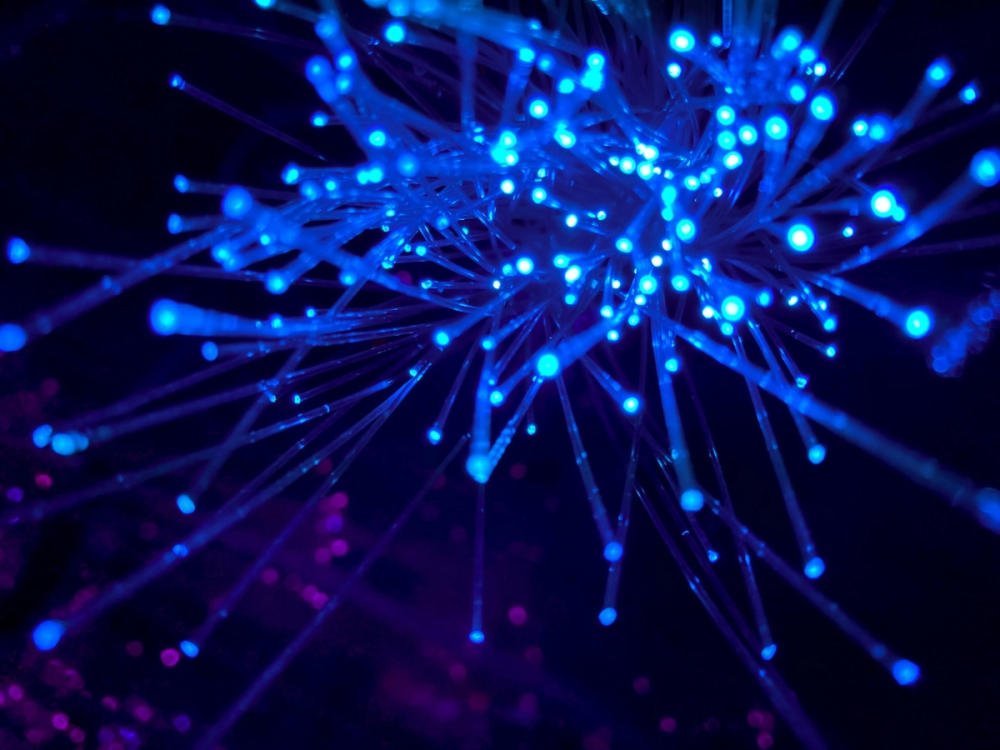
Optical fibre sends signals using light travelling through glass. Instead of moving electrons, it uses tiny packets of light energy, known as photons. — Unsplash pic/JJ Ying
Electrical systems work in a way that we are familiar with, where electricity flows through metal wires, carried by moving electrons.
However, optical fibre works very differently. Instead of electricity, it carries light, which is guided through glass fibres that are thinner than a human hair. This simple difference forms the foundation of a field known as photonics.
In Malaysia, there is a research centre in a public university that has been working in the field of photonics for decades, i.e., Photonics Research Centre, Universiti Malaya (PRCUM).
Here, optical fibre is more than just a communication tool; it serves as a research platform that has grown and evolved over time.
What began as a laser laboratory in 1979 was later recognised as a Higher Education Centre of Excellence (HICoE) by the Ministry of Higher Education in 2014.
Over the years, the centre has helped train students to become experts in photonics, develop new technologies, and contribute to the presence of Malaysia in the global photonics field.
Today, photonics has been applied in many industries like manufacturing, data centres, healthcare, computing, and automotive technology.
One of the important applications of optical fibre is in sensing technology. It can detect many parameters such as temperature, strain, vibration, chemical analytes, and many more, depending on the design of the sensor.
But people will start asking why we want to use optical fibre-based sensors, although a lot of commercial electrical sensors are already available in the market?
To understand this, imagine an electrical sensor is like a walkie-talkie. The signal works well until there is interference. Electrical noise, lightning, or strong electromagnetic fields can distort or even block the signal.
Optical fibre sensors work differently. A better way to imagine them is like shining a torchlight through a long, protected tunnel.
The light travels safely inside the fibre, shielded from external disturbances. Even in environments with strong electrical interference, the signal remains stable.
This makes optical fibre sensors very useful in harsh environments like industrial plants, power stations, and long-distance monitoring systems.
Safety is another major advantage. Electrical sensors carry current, which can be risky in flammable environments such as oil and gas facilities or chemical plants.
Even a small spark can be dangerous. But optical fibre sensors carry only light, removing the risk of sparks entirely.
Beyond sensing, researchers at PRCUM are also developing high-power fibre lasers that operate at extremely short pulse durations, in the femtosecond range.
These very short pulse lasers are important for cutting and material processing. But why are femtosecond lasers better than the nanosecond, microsecond, or continuous-wave (CW) lasers?
To picture this, imagine cutting meat with two different knives. A blunt knife requires more force, causing the meat to compress and the cut to spread beyond where you intended.
A very sharp knife slices cleanly, with minimal force and minimal damage to the surrounding area.
Femtosecond lasers behave like that sharp knife. They allow extremely precise cutting with minimal heat damage to the surrounding material. This is especially important in medical and surgical procedures, where clean cuts can help improve healing and recovery.
Another interesting property of light is that different wavelengths interact differently with different materials.
A simple way to imagine this is by thinking about materials exposed to sunlight.
For example, metal, fabric, and plastic placed under the same sunlight will heat up at different rates because each material absorbs and reflects light differently.
This characteristic becomes important in medical applications. Light at wavelengths around 2000 nanometres is strongly absorbed by water.
Since the human body contains a high percentage of water, lasers operating in this range can cut tissue efficiently with minimal bleeding.
This improves precision and safety in surgical procedures and supports faster patient recovery.
For many years, photonics was a term unfamiliar to the public. Today, it is slowly becoming part of the technologies that support modern life.
This interesting field should be introduced earlier to students, especially secondary school students who are interested in science and STEM, as well as undergraduate students who may be considering postgraduate studies.
PRCUM can be the place where students can explore this field further, where research and development in photonics technology have been carried out for decades.
By exposing more young talents to photonics, Malaysia can develop its own photonics-based technologies, nurture local experts, and reduce dependence on foreign expertise and imported technologies.
To be more optimistic, PRCUM could one day become the place where Malaysia nurtures its first Nobel Laureate in Physics!
And perhaps, in the bigger picture, the real story of photonics is not just about replacing electricity entirely. It is about giving us another way to solve our problems.
* Dr Muhammad Khairol Annuar Zaini is a research officer at the Photonics Research Centre, Universiti Malaya, and may be reached at [email protected]
** This is the personal opinion of the writer or publication and does not necessarily represent the views of Malay Mail.