MARCH 1 — Empires always believe they are writing history. More often, they are repeating it.
The reported killing of Iran’s Supreme Leader has been greeted in some Western capitals with the language of destiny – the sense that a 46-year-old revolution has finally reached its expiration date, that a single strike in the night can achieve what sanctions, sabotage, assassinations and shadow wars could not.
Regime change.
Liberation.
A new Middle East.
It is a familiar script. We watched it under the desert sky of Baghdad. We watched it in the ecstatic early hours of Tripoli. We watched it in Kabul as the last aircraft clawed its way into the air, abandoning two decades of certainty.
Each time, the removal of a man was mistaken for the birth of a nation.
Iran is not Iraq. It is not Libya. It is not Afghanistan.
But the illusion is identical.
There is a persistent belief in Washington that political systems in the Global South are pyramids – that power sits neatly at the top, and that once the head is removed the structure collapses into something softer, friendlier, more accommodating to the liberal imagination.
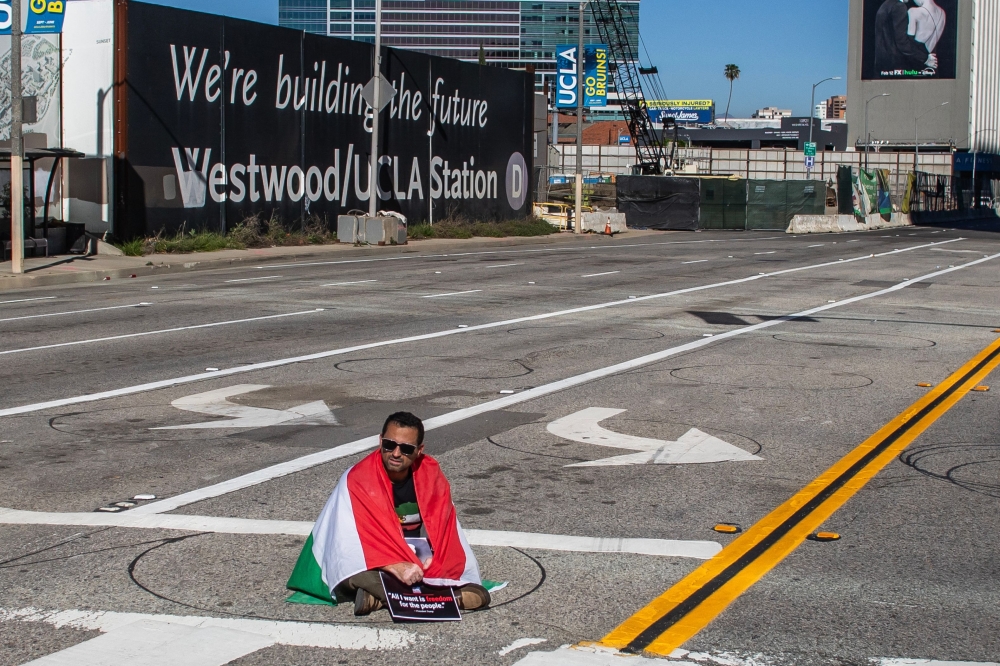
A man wrapped in an Iranian pre-1979 Islamic Revolution flag sits in the middle of the road while members of the Iranian community celebrate in Los Angeles, on February 28, 2026, the same day the US and Israel launched an attack of unprecedented scale against Iran, reportedly killing more than 200 people, with Tehran launching a retaliatory missile barrage that sent people running for cover across the Middle East. — AFP pic
Iran does not work that way.
The Islamic Republic is not a pyramid. It is an ecosystem.
It is a clerical establishment fused with a military-commercial empire. It is an intelligence state layered over a revolutionary mythology. It is an economy that has survived siege conditions for two generations and, in doing so, has learned how to metabolise pressure.
This system was designed to outlive Ayatollah Khomeini in 1989. It has spent 35 years preparing to outlive the next man.
Which is why the most dangerous question is not whether the Supreme Leader is dead.
It is what comes after the celebration.
Because wars are always sold on their opening night.
Shock and awe is theatre. It flatters the machinery of power. It polls well. It produces photographs that look like victory.
But geopolitics begins in the morning.
Who controls the streets of Tehran?
Who commands the Revolutionary Guard?
Who speaks for the state when the symbolism is gone and only institutions remain?
If there is no clear answer, power does not disappear.
It fractures.
And when power fractures in a country of nearly 90 million people sitting beside the most important energy corridor on earth, the consequences are not ideological. They are mathematical.
For the United States, Iran is a strategic adversary.
For Asia, Iran is an oil price.
Every missile fired across the Gulf eventually arrives in our economies as inflation. It arrives in the weakening of our currencies, in the recalculation of our growth forecasts, in the quiet panic of finance ministries from Jakarta to New Delhi.
The West debates democracy.
We calculate the cost per barrel.
This is the fundamental asymmetry of modern conflict.
There is another illusion embedded in the language of liberation – that a population which despises its government will welcome external force.
History suggests something far more complicated.
Iranians have demonstrated, again and again, that they are capable of holding two contradictory emotions at once: contempt for the men who rule them, and fury toward those who attempt to rule them from outside.
Nationalism is the last refuge of wounded regimes.
Nothing revives it faster than a foreign strike.
And if this moment produces not a democratic transition but a security consolidation – if the Islamic Revolutionary Guard Corps, already the most powerful economic and military institution in the country, steps into the vacuum – the result will not be a Western-aligned Iran.
It will be a harder, colder, more explicitly militarised state.
This is not speculation. It is the most common political outcome of sudden decapitation.
We have seen it across the Middle East.
We have seen it in Africa.
We have seen it in parts of Latin America.
Institutions with guns and money do not negotiate for power.
They inherit it.
Yet this crisis is not unfolding in the world of 2003.
Iran today is not an isolated revolutionary outpost. It is woven into the emerging architecture of a post-Western economic order. It sells energy into China’s long-term security calculus. It trades under the protective shadow of Russian sanctions networks. It is a member, formally and psychologically, of a bloc that believes the era of unchallenged American primacy is ending.
Which means this is not simply a Middle Eastern drama.
It is a move on a global chessboard.
There is, too, a profound historical irony in the figure at the centre of this moment.
A political movement that rose to power in the United States on the promise of ending “forever wars” now stands at the threshold of authoring another. Not out of ideological zeal, but out of an enduring faith in the redemptive power of force – the belief that overwhelming military superiority can compress time, skip the slow work of politics, and produce a new reality by sheer velocity.
Military power can destroy a state.
It cannot build legitimacy.
It cannot manufacture institutions.
It cannot choreograph the emotional reconciliation of a society that has lived through revolution, war, sanctions and isolation.
Those things are built – painfully, unevenly, over years – by the people who must live inside the outcome.
From where we sit in South-east Asia, the question is not whether the Islamic Republic has been repressive. It has.
The question is whether external intervention has ever produced stable, sovereign, democratic states in our part of the world.
The honest answer is uncomfortable.
What it has produced, with tragic consistency, are power vacuums, militia economies, refugee flows and lost decades of development.
And the costs of those failures do not remain in the countries where the bombs fall.
They travel.
They arrive in our food prices, our fuel subsidies, our fiscal deficits, our election cycles.
The Global South pays for the geopolitical experiments of the Global North.
The most dangerous outcome in Iran is not failure.
It is partial success.
A regime that survives a direct assault emerges more paranoid, more repressive, more dependent on asymmetrical warfare. It does not moderate. It radicalises.
That is how long wars begin.
Not with defeat – but with wounded survival.
History does not judge interventions by the brilliance of their opening strikes. It judges them by the political orders they leave behind.
If this moment leads to a sovereign Iran at peace with its people and its region, it will be remembered as a turning point.
If it leads to fragmentation, militarisation and a permanent oil shock that ripples through the developing world, it will join the long ledger of wars that mistook destruction for transformation.
The missiles have already flown.
Now comes the only question that has ever mattered in the Middle East, in Asia, in every post-colonial landscape where outside powers believed they could rearrange history from the air:
Who owns the morning after?
Because that – not the strike in the night – is where the future is decided.
* This is the personal opinion of the writer or publication and does not necessarily represent the views of Malay Mail.