
KUALA LUMPUR, March 17 — Lawyers should be encouraged to do free legal work to help Malaysians who cannot afford legal fees get access to justice, former Federal Court judge Tan Sri Nallini Pathmanathan said.
She highlighted the importance of legal aid for those who face financial challenges in going to the courts.
“That’s a hurdle, that’s why legal aid comes in, a lot of lawyers do work pro bono, and all of that should be encouraged greatly,” she said in a recent interview with Malay Mail.
In her August 2021 paper titled “Access to Justice in the Time of Covid-19 Pandemic from the Judiciary’s Perspective”, she highlighted how there are certain groups who cannot afford to hire a private lawyer but also do not qualify to receive free legal aid from the government or Malaysian Bar.
These groups are, for example, those who are just on the poverty line, in the lower middle class and middle class, who earn more than the income threshold to be eligible for legal aid.
Nallini added that access to justice would first require an individual to recognise or understand that their problem is a legal problem.
“Some people won’t understand that the problem that they have is a legal problem. But to even comprehend they have a legal problem, there must be somebody to advise them, somebody to tell them where to go to resolve the problem, to be heard on their grievance, and to be given an effective remedy,” she said.
“What I would like to see in Malaysia as we move along, is greater access to justice for all.
“The ideal that one would hope to achieve is that members from all levels of society can resolve their legal problems by either mediation or having access to the courts with ease, such that they obtain a remedy within a reasonable time. That is access to justice,” she said.
While the justice system may seem intimidating or confusing for those who do not understand it, Nallini said the legal stakeholders – including the Legal Affairs Division of the Prime Minister’s Department, lawyers, judiciary – are working very hard to make it more accessible.
“With the new laws that have been introduced, and with greater legal aid being made available, it would appear that we are working towards greater access to justice,” she said.
For example, Malaysia last month gazetted a new law called the Legal Aid and Public Defence Act 2026 that is aimed at improving access to justice.
The Malaysian Bar in December 2025 launched the MyBar Pro Bono Hub to encourage lawyers to do pro bono work for areas normally not covered by legal aid, such as constitutional and public interest cases.
Nallini added that artificial intelligence (AI) “may be used to provide access to justice for the population as a whole”, an idea which she had highlighted in her article in the Journal of the Malaysian Judiciary’s July 2025 edition.
She has over the years written on many different areas of the law that she is interested in, such as admiralty and maritime dispute resolution; legal professional privilege; environmental law; the redefining of corporate responsibility as ESG and the law; and the rise of Asia in global dispute resolution.
“I’m very interested in the law as it develops now, because I think we are on the cusp of going into a really interesting time in the law, because of the advent of AI and a lot more cross-border work,” she said.
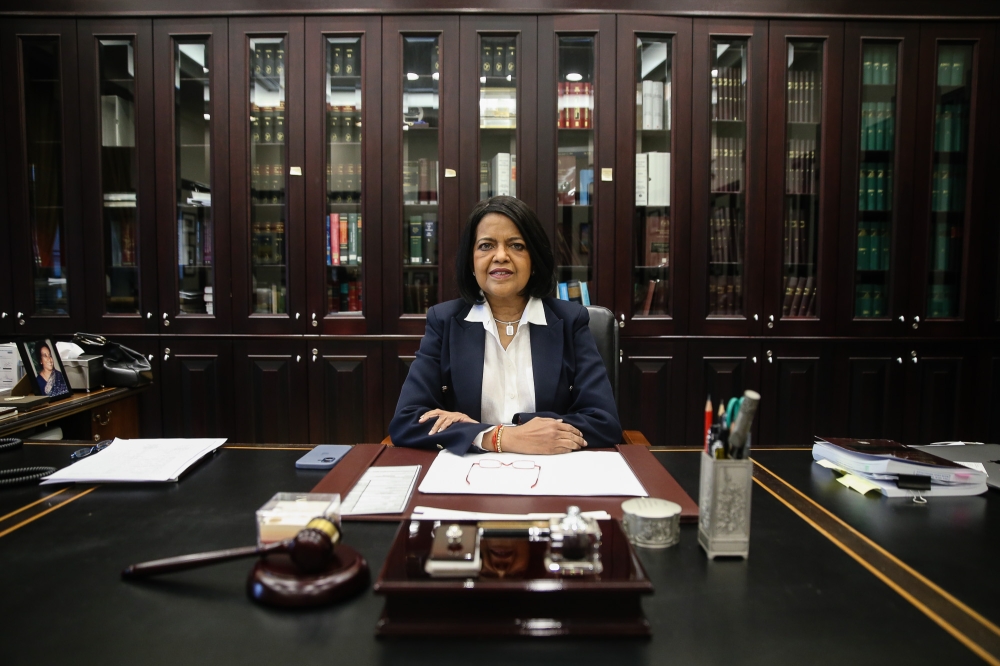
In her more than seven years as a Federal Court judge, Nallini said some of the memorable cases included those which dealt with judges’ sentencing discretion in drug cases, compensation over custodial deaths, and contempt of court. — Picture by Yusof Isa
Memorable cases
Nallini said her two favourite areas of the law while serving as a judge were commercial and Constitutional law.
What sparked her interest in Constitutional cases was when she decided on habeas corpus cases which involved the liberty of persons detained without trial, with Nallini also citing cases involving damages or compensation over prisoners’ deaths in custody as being memorable.
When asked about the many cases she had decided on as a Federal Court judge, she mentioned three memorable ones where she had been the sole dissenting judge:
- The Letitia Bosman case (2020): Her minority judgment said the mandatory death penalty for drug trafficking offences is unconstitutional, as judges should have the discretion to decide whether to impose the death sentence or imprisonment, depending on the case’s circumstances.
(This was before Malaysia changed its laws to enable judges to have discretion in sentencing in such cases.)
- The Santanasamy Muthiah case (2024): Her minority judgment said a convicted person’s caning should also be concurrent instead of consecutive, if the court had ordered the convicted person’s jail term for several offences to be carried out concurrently or at the same time.
(The majority ruling maintains the current practice in Malaysia where convicted persons undergo consecutive whipping or separate whippings for each offence, which meant Santanasamy would be whipped 20 times instead of 10 times.)
- The Malaysiakini case (2021): The majority found the news portal guilty of contempt of court over comments by its readers on the judiciary, while Nallini in her minority ruling disagreed as she said the news portal had no knowledge of the comments and had removed the comments within minutes after being alerted.
“It was memorable to me because it was legally challenging, because we are dealing with contempt, which is a very serious matter,” she told Malay Mail.
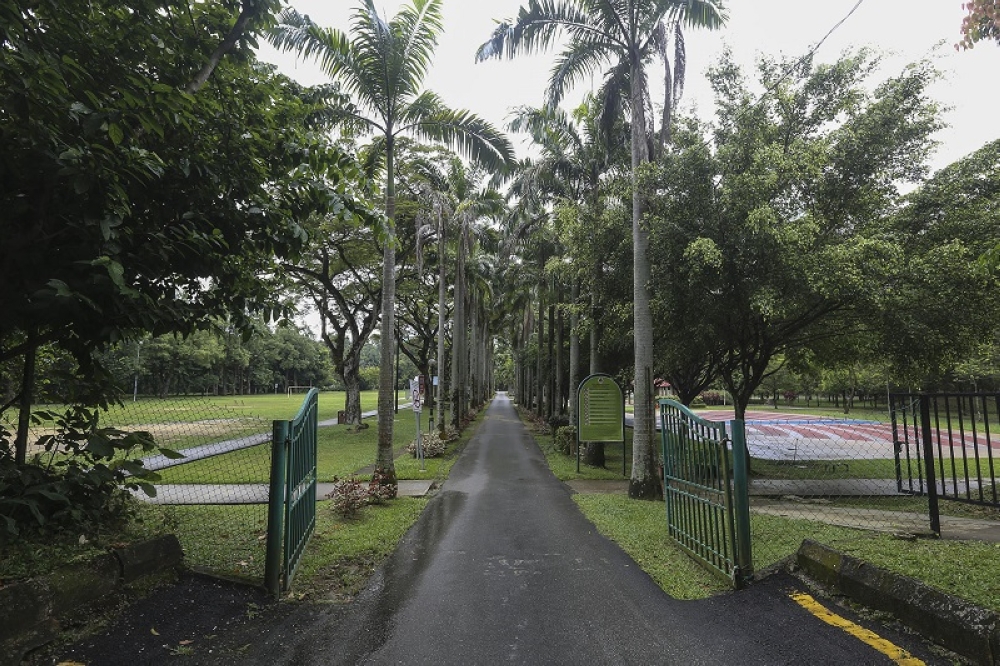
A general view of Taman Rimba Kiara in Taman Tun Dr Ismail, Kuala Lumpur, where the proposed apartment blocks were to be built on part of the public park’s land. — Picture by Yusof Isa
Another memorable case was the Taman Rimba Kiara case where Nallini wrote the judgment for the Federal Court’s 2023 unanimous decision to cancel Kuala Lumpur City Hall’s (DBKL) approval to build apartments on parts of the public park.
She found this case to be both interesting and challenging, as she had to look at different areas of the law.
“We all want development but it has to be done in a sustainable fashion and in accordance with the law. Our laws are very good, in terms of town councils and planning,” she said.
She said the Taman Rimba Kiara case was also important in terms of environmental law, and in terms of town planning.
She said the case was also significant because it involved municipal councils’ functions and their duties to the public – such as being transparent, facilitating living conditions with proper planning, sufficient environmental protection and sufficient green lungs.
The Taman Rimba Kiara decision enabled more Malaysians to have legal standing to bring their grievance to court, especially when it involves the environment and living conditions in relation to development.
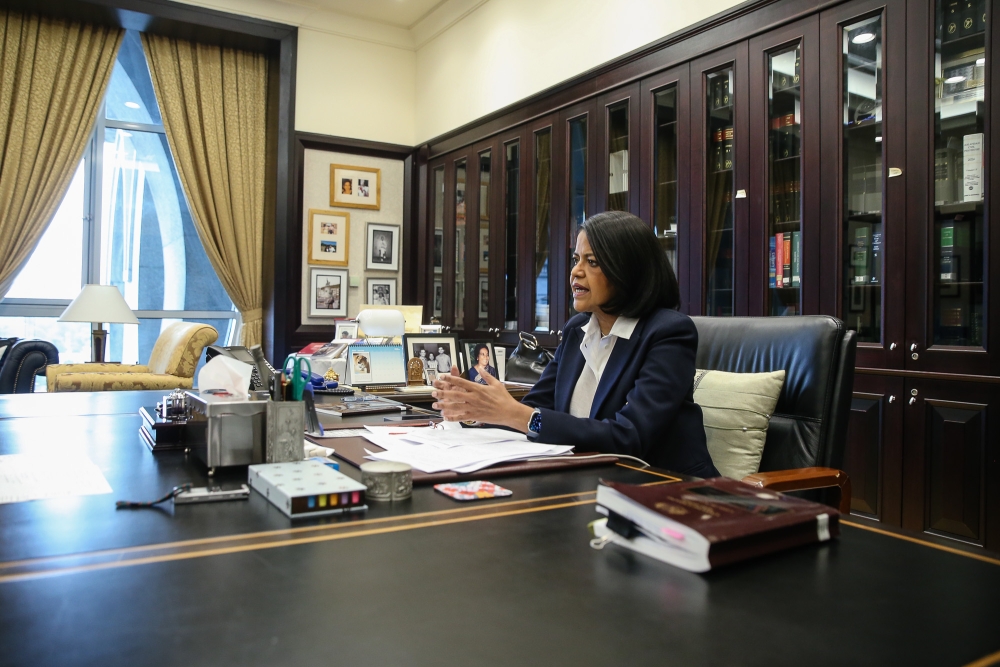
Nallini is seen here at her office at the Palace of Justice, Putrajaya, which features artwork and paintings, as well as photographs of her family including her grandfather Dr K. Thillyampalam. — Picture by Yusof Isa
Discovery of nearly century-old link
While doing research on town planning laws in the Taman Rimba Kiara case, Nallini “stumbled upon” an interesting discovery – her paternal grandfather Dr K. Thillyampalam had been involved in advising on an earlier version of the law that later evolved to be the Town and Country Planning Act.
Nallini said he had as a doctor sat in the colonial-era Kuala Lumpur Sanitary Board, and that he did not draft laws but had contributed to the development of laws related to town planning.
“In the early days when they had to build towns and ensure that there was sewage and drainage, they needed medical personnel. He was a member of the Sanitary Board, so they actually advised on sanitation, street maintenance and town planning at the time,” she said.
“That was nice to know, that somebody in the family had worked on a related matter, but almost a century ago – my grandfather,” she said.
Malay Mail’s search of Singapore’s online archive of newspapers NewspaperSG and the local Ceylonese community’s Jaffnese Cooperative Society’s journal Pathfinder showed Dr Thillyampalam had been a KL Sanitary Board member for several years in the early 1930s and had also operated a private clinic known as the People’s Dispensary along Kuala Lumpur’s Foch Avenue (now known as Jalan Tun Tan Cheng Lock).