MARCH 17 — The latest political development surrounding Khairy Jamaluddin’s attempt to return to Umno is more than a personal political comeback story.
It reflects deeper currents within Malaysian politics, particularly the evolving dynamics of Malay political competition, the identity crisis within Umno, and the broader question of how political parties adapt in a fragmented post-2018 landscape.
At the most immediate level, Khairy’s move signals a moment of political recalibration.
After being expelled from Umno in 2023, his political future had appeared uncertain.
Yet his appeal to rejoin the party, framed without demands for positions or influence, suggests a strategic attempt to reconnect with the political platform that once shaped his career.
This is not merely about returning to a party structure; it is about re-entering the centre of Malay political discourse.
For Umno, the possibility of Khairy’s return raises fundamental questions about its direction.
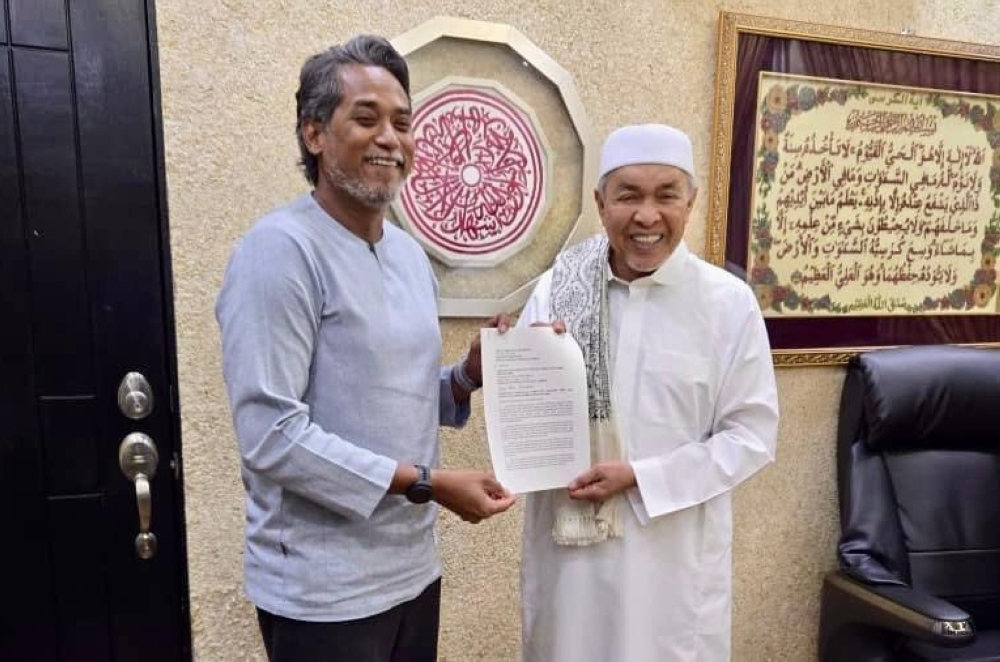
Umno president Datuk Seri Ahmad Zahid Hamidi receives an appeal letter from former Youth chief Khairy Jamaluddin (left) after a meeting on Sunday. — Picture via Facebook/Zahid Hamidi
Over the past decade, the party has faced a series of shocks such as electoral defeat in 2018, internal factional struggles, and the rise of rival political coalitions that increasingly compete for Malay support.
In this context, the discussion around Khairy’s return is less about an individual and more about whether Umno is prepared to reconcile with figures who once represented alternative voices within the party.
Khairy has long symbolised a different strand of Umno politics. Compared to many within the party’s traditional hierarchy, he projected a more modern, policy-oriented and outward-facing political style.
He was often able to speak across generational and ideological divides, engaging younger voters and urban constituencies that Umno has struggled to retain in recent elections.
Bringing him back into the party could therefore be interpreted as an attempt to broaden Umno’s appeal and demonstrate that the party is willing to evolve.
Yet the implications go beyond electoral strategy. The discussion around reconciliation within Umno reflects a deeper recognition that internal purges and factional fragmentation have weakened the party’s ability to remain politically competitive.
In the current political landscape, Malay political support is no longer consolidated under a single dominant party.
Instead, it is contested among several actors with different ideological narratives and political strategies.
In that environment, Umno faces a delicate balancing act. On one hand, it must maintain its traditional political base, which remains sensitive to issues of identity, representation and political authority.
On the other hand, it must demonstrate that it can still attract a new generation of voters who increasingly demand policy competence, transparency and forward-looking leadership.
Khairy’s political persona fits into this tension. He represents a bridge between the old and the new; someone deeply embedded in Umno’s political tradition but also capable of articulating a more contemporary political language.
His return could help Umno reconnect with segments of society that feel politically detached from both the party’s old guard and the more polarised rhetoric of its competitors.
However, it would be a mistake to assume that Khairy’s return alone can transform Umno’s political fortunes. The party’s challenges are structural rather than personal.
Malaysian voters today are far more fluid in their political loyalties than they were in previous decades.
Electoral competition is sharper, political narratives are more contested, and public expectations of governance have evolved significantly since the political transition of 2018.
In this sense, a political comeback no matter how symbolic cannot substitute for deeper institutional renewal. Umno’s long-term relevance depends on whether it can address broader questions about leadership credibility, internal reform, and its role within Malaysia’s evolving coalition politics.
Without these changes, even the most recognisable political figures will struggle to reshape public perceptions of the party.
There is also another dimension to consider. Khairy’s attempt to return to Umno reflects the enduring strength of legacy political parties within Malaysia’s political system.
Despite the emergence of new alliances and political movements over the past decade, traditional party structures continue to exert a powerful gravitational pull on political careers.
Reintegration into these structures often provides more stability and organisational resources than attempting to build a political path outside them.
This reality speaks to the resilience of Malaysia’s party system. While the country has experienced significant political volatility since 2018, the underlying institutional foundations of party politics remain remarkably durable.
Political actors may move across coalitions or factions, but the influence of established party institutions continues to shape the boundaries of political possibility.
Looking ahead, the real significance of this moment lies in how both Umno and Khairy choose to move forward.
If the party accepts his return, the decision should ideally be framed as part of a broader effort to rebuild internal cohesion and expand the party’s leadership pool.
Political reconciliation, if managed thoughtfully, could help restore some degree of unity within a party that has been deeply divided in recent years.
For Khairy himself, the challenge would be to translate symbolic return into meaningful political contribution. His political relevance will depend on whether he can help articulate a vision for Umno that speaks not only to its traditional supporters but also to Malaysians who are increasingly searching for politics that prioritises governance, policy innovation and inclusive national narratives.
Ultimately, the discussion surrounding Khairy Jamaluddin’s return is a reminder that Malaysian politics is entering a new phase of recalibration.
Parties are rethinking strategies, political actors are repositioning themselves, and the electorate is becoming more discerning in its expectations.
Whether this development marks the beginning of genuine political renewal within Umno or simply another episode in the cyclical reshuffling of political elites remains to be seen.
What is clear, however, is that the stakes extend far beyond one individual’s political future.
The real question is whether moments like this can push Malaysian politics toward deeper institutional maturity, or whether they will simply reinforce the familiar patterns of elite political recycling that have long characterised the country’s political landscape.
* Khoo Ying Hooi, PhD is an associate professor at Universiti Malaya
** This is the personal opinion of the writer or publication and does not necessarily represent the views of Malay Mail.