APRIL 6 — Oil spills in seawater rarely begin as dramatic disasters. More often, they start as small leaks that go unnoticed. A minor discharge near a port, a leak from offshore equipment, or a release during transport may not look serious at first. But once oil begins to spread in seawater, the consequences can escalate quickly. Marine ecosystems may be affected, cleanup costs rise, operations may be disrupted, and in severe cases, lives and assets can be placed at risk. That is why early detection matters so much.
Our research is driven by a simple question: how can we detect hydrocarbon pollution in seawater early enough for action to be taken before a small incident becomes a major problem?
At present, this remains a difficult challenge. Seawater is not a simple medium to test. It contains salts, natural organic matter, and many other substances that can interfere with sensor performance and make readings harder to interpret. On top of that, not all oil-related chemicals produce a quick or obvious signal in field conditions. In many situations, the most reliable approach is still to collect samples and send them to a laboratory for analysis. While this provides accuracy, it also introduces delay. By the time results are available, the spill may already have spread much further.
We believe this delay is one of the key problems in oil spill response. When responders have to wait for laboratory confirmation, valuable time is lost. In marine environments, time is especially important because currents, tides, and weather can rapidly carry pollutants across wide areas. A leak that might have been contained early can become far more costly and damaging if detection comes too late.
This is where our work comes in. We have been exploring a more practical way to screen for hydrocarbons directly in saline water and seawater. Our approach uses something already found in marine environments: a naturally bioluminescent bacterium known as Photobacterium leiognathi. These bacteria emit light as part of their normal biological activity. When exposed to different hydrocarbon-related substances, their behaviour changes. In some cases, the light signal becomes stronger. In others, it weakens. Those changes can serve as an indicator that hydrocarbons are present.
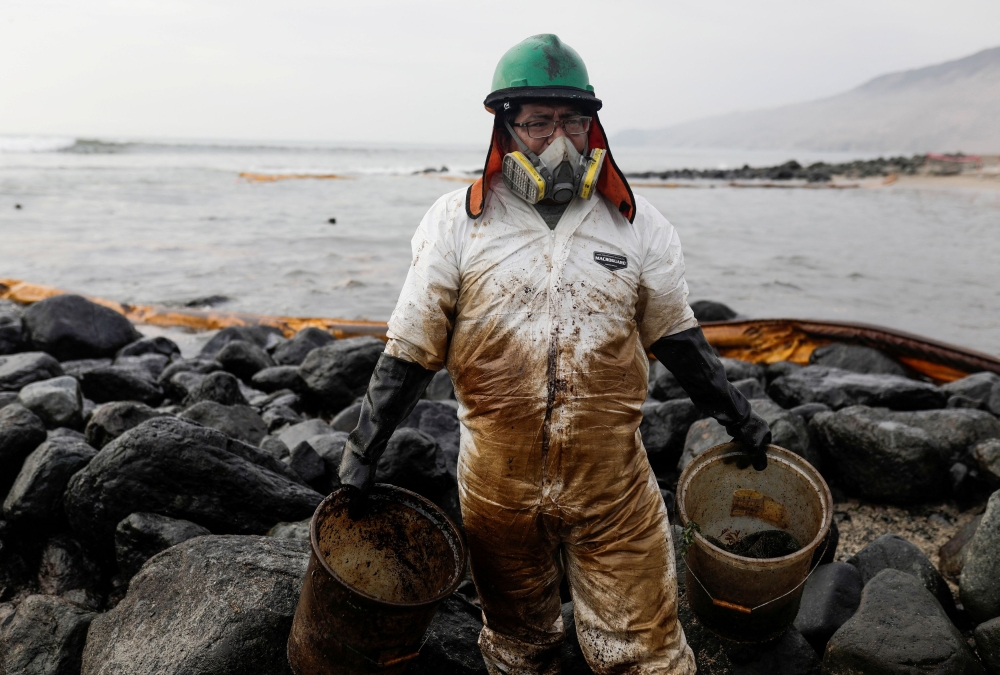
A worker cleans up an oil spill at a beach in Ventanilla, Peru. The authors argue that early detection is critical in preventing small oil leaks from escalating into major environmental crises, highlighting how faster, on-site screening using bioluminescent bacteria could significantly improve response times and reduce damage to marine ecosystems and coastal economies. — Reuters pic
What makes our system different is that we do not rely on only one signal. We developed a dual-mode sensor that reads both the bioluminescence response and an electrochemical response. In simple terms, the bacteria provide one signal through changes in light, while a modified gold-screen printed electrode converts changes in bacterial activity into a second, electrical readout. By combining these two responses, we can obtain a clearer and faster picture of what may be happening in the water.
For the public, the important point is not the technical complexity of the sensor, but what it allows us to do. It offers the possibility of quicker, on-site screening. Instead of depending entirely on laboratory instruments and trained personnel far from the incident site, this type of approach can support rapid field decisions at offshore facilities, ports, coastal monitoring stations, or spill-response locations. In other words, it can help tell us sooner when there may be a problem.
We also think there is another important strength in using living bacteria as part of the sensing process. Many conventional methods are designed to answer a chemical question: is a certain substance present or not? That remains important. But living systems can tell us something slightly different and, in some ways, more meaningful. Because the signal comes from living bacteria, it reflects whether the pollution is affecting biological activity, not just whether a chemical compound exists in the water. This gives the method added relevance for environmental monitoring.
The wider significance of this work goes beyond the laboratory. Faster screening could help reduce the impact of spills on marine ecosystems, fisheries, aquaculture areas, ports, and coastal tourism. For operators in oil and gas or maritime industries, earlier warning can also mean faster isolation of the source, lower operational losses, and reduced cleanup costs. For regulators and environmental responders, it can strengthen the first stage of decision-making when every hour matters.
We do not suggest that a sensor like this should replace laboratory analysis altogether. Confirmatory testing will still be needed for detailed reporting and investigation. But we do believe there is value in having a practical first line of screening that works directly in seawater and provides an early warning before damage escalates.
In the end, our work is about improving the speed and quality of environmental response. Oil spills are harmful not only because they occur, but because they are often detected too late. If we can shorten the time between leak and response, we stand a better chance of protecting marine life, coastal livelihoods, and the wider environment. That is the real purpose behind this research.
* The authors Arash Rasti and Assoc Prof Khor Sook Mei are from the Department of Chemistry, Faculty of Science, Universiti Malaya, and may be reached at [email protected]
** This is the personal opinion of the writer or publication and does not necessarily represent the views of Malay Mail.