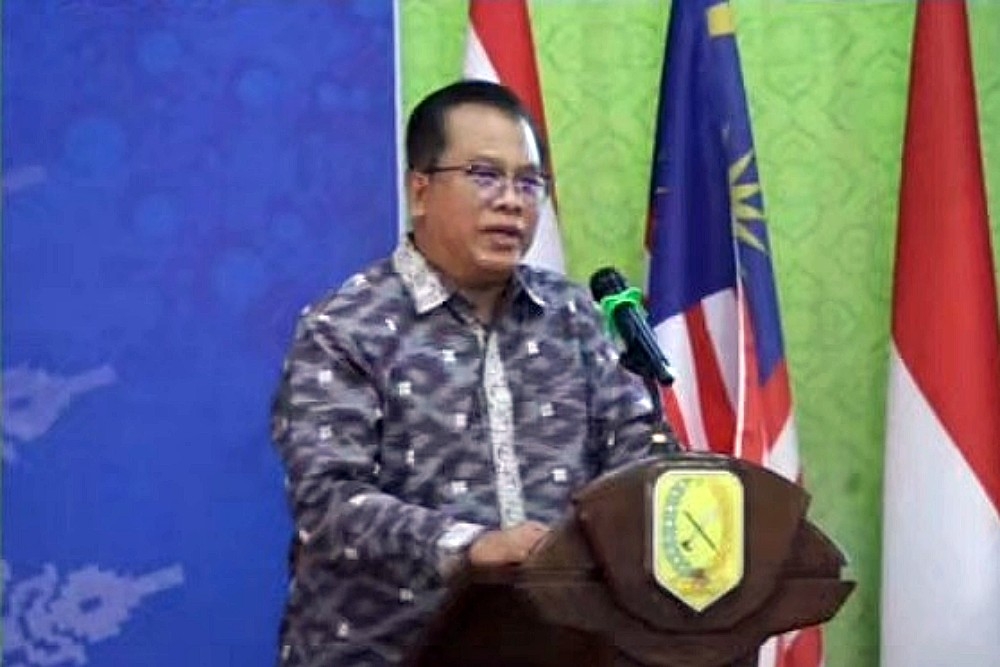
KUCHING, April 11 — Stronger and more coordinated efforts between Sarawak and Indonesia are needed to advance the development of border regions, said Indonesian Consul General in Kuching Dr Abdullah Zulkifli.
Presenting a paper on strategic collaboration at an international seminar in Sambas on April 8, he said discussions among participants highlighted the need for enhanced coordination to address shared challenges, particularly in food security.
“Border cooperation can be implemented to tackle major issues such as food security.
“With better coordination, both sides can optimise resources and strengthen resilience,” he said in a statement.
He highlighted existing collaboration in the energy sector as a key example of effective cross-border cooperation.
“Indonesia and Sarawak have established energy cooperation that contributed to energy security.
“This demonstrates how such collaboration can work and why it should be expanded to other strategic sectors,” he said.
Abdullah noted that border regions such as Sambas play a strategic role as agricultural hubs with surplus production that could support food security efforts.
He also pointed out that the land border on the island of Borneo stretches about 1,881km, with more than 800km shared between West Kalimantan and Sarawak, making coordinated planning essential.
The seminar also discussed the role of key border crossings — Entikong-Tebedu, Aruk-Biawak, Badau-Lubok Antu and Jagoi Babang-Serikin — in facilitating movement and trade.
Trade between Indonesia and Sarawak has surpassed US$1 billion (RM3.96 billlion), driven by commodities such as agricultural produce, fisheries and mineral resources, he said, adding that tourism cooperation is also growing, with notable international arrivals via land crossings into West Kalimantan.
On investment, Abdullah highlighted major projects involving Sarawak Energy Berhad, including its participation in a hydropower project in Kalimantan and industrial ventures such as a bauxite smelter in Sanggau.
He said Sarawak currently exports about 190 to 200 megawatts of electricity to West Kalimantan through existing grid interconnections.
At the same time, participants acknowledged ongoing challenges such as illegal cross-border activities, regulatory differences and infrastructure gaps, which require closer bilateral coordination.
The seminar, held on April 7 and 8 in Sambas, brought together regional stakeholders and served as a platform to strengthen ties and chart future collaboration.
It was also attended by Sarawak Minister for Food Industry, Commodity and Regional Development Datuk Seri Dr Stephen Rundi Utom. — The Borneo Post