MAY 9 — Judicial review is a two-stage process at the High Court.
The first stage is called the leave stage. At this stage, the High Court sieves out frivolous and vexatious cases.
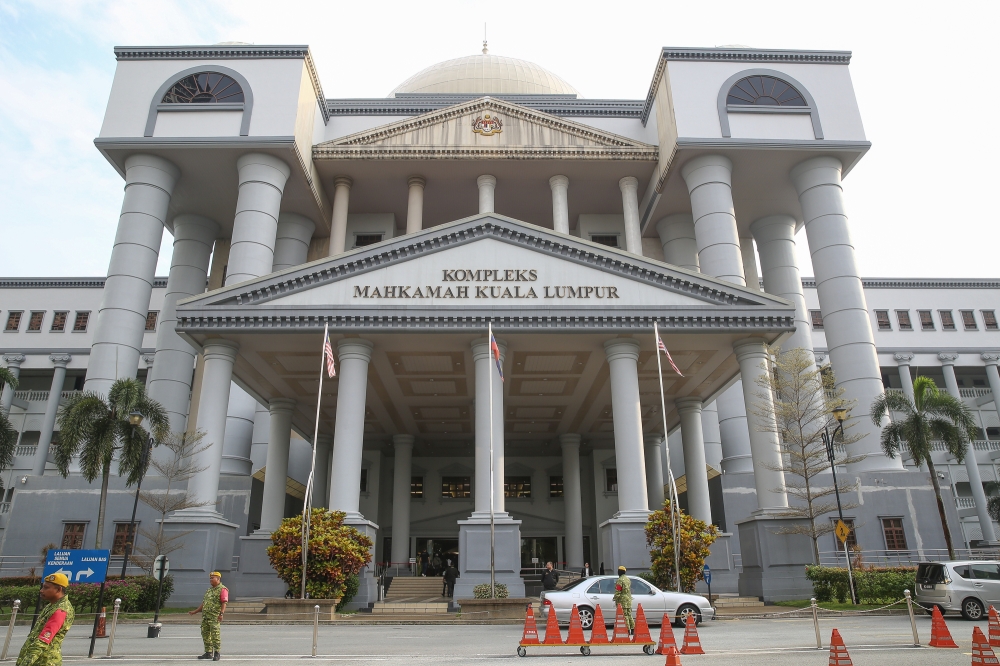
Judicial review is a two-stage process at the High Court. — Picture by Yusof Mat Isa
The second stage is the substantive stage. This is where the full merit of the case for judicial review gets ventilated and decided by the High Court.
In the case of Shashi Kumar a/l Shanmugam (Presiden Global Human Rights Federation) & Ors v Ketua Polis Negara, Polis DiRaja Malaysia & Anor [2023], an application for leave for judicial review under Order 53 of the Rules of Court 2012 by five applicants (the Applicants) seeking reliefs of an order of certiorari and an order of mandamus, among others, came before the High Court.
After hearing the parties, High Court judge Ahmad Kamal (now Court of Appeal Judge) dismissed the application. According to the learned judge, at the leave stage, it was incumbent on the Applicants to satisfy a two-step threshold.
First, an applicant needs to show he has the legal basis to challenge the decision of the Attorney General (AG) on the traditional grounds of judicial review which among others includes illegality, procedural impropriety, irrationality and mala fides. The burden of proof lies on the applicant.
Second, the applicant needs to adduce compelling and prima facie proof that the decision or omission of the AG falls within one of the grounds or any one of them. Once the threshold is crossed, the burden lies on the AG to justify his actions or inactions in court.
So, while the AG’s power under Article 145(3) was ruled to be reviewable, it was subject to a high threshold of scrutiny. On the authority of the Federal Court decision in Sundra Rajoo particularly, Justice Ahmad Kamal ruled as follows:
- An application for judicial review of the decision of the AG was subject to a higher standard of review.
- The exercise of the prosecutorial power of the AG under Article 145(3) was cloaked with the presumption of legality.
- In order to succeed in the application for judicial review, the Applicants had to rebut the strong presumption of legality with compelling prima facie evidence of grounds within the recognised reasons for judicial review.
- The Applicants must provide more than police reports and excerpts of speeches to challenge the strong presumption of legality. Police reports and edited videos uploaded on social media, without more, did not constitute compelling prima facie or convincing evidence to rebut the presumption of legality.
- Another way to rebut the presumption of the legality of the AG in exercising his discretion under Article 145(3) was to demonstrate that the AG acted with mala fide (bad faith) when making a decision. However, the Applicants had also failed to show that the AG made the decision with mala fide.
As the nature of application required a higher standard of review, the learned judge said the Applicants had failed to cross the high threshold.
Nine months later, in the case of Bar Malaysia v Peguam Negara Malaysia & Anor, the High Court also dismissed an application for leave for judicial review filed by the Malaysian Bar that sought to challenge the AG’s exercise of discretion to discontinue the criminal proceedings against Datuk Seri Ahmad Zahid Hamidi under Article 145(3) of the Federal Constitution.
Independent of the decision in Shashi Kumar, which was not referred to, High Court judge Amarjeet Singh (now Court of Appeal Judge) ruled that on the authority of the Federal Court decision in Sundra Rajoo, a challenge against the AG’s discretion under Article 145(3) – that is, to institute, conduct, and discontinue a prosecution – must pass the two-step threshold at the leave stage of the application for judicial review.
The learned judge took to reminding himself that the decision made by the AG under Article 145(3) was cloaked by the presumption of legality and therefore the burden was on the Malaysian Bar to rebut the presumption.
According to the learned judge, the Malaysian Bar had failed to meet the two-step threshold at the leave stage.
The Malaysian Bar appealed against the decision. Two of the five questions for determination by the Court of Appeal are as follows:
- Does the law recognise a leave threshold for judicial review challenges to prosecutorial discretion under Article 145(3) of the Federal Constitution that differs from the ordinary leave threshold under Order 53 of the Rules of Court 2012?
- If not, should a single leave threshold be applied, albeit with greater discipline, caution and restraint in light of the constitutional status of the Attorney General’s function as Public Prosecutor?
Having considered at length the law at the leave stage and Sundra Rajoo, the Court of Appeal on Thursday (May 7) unanimously held as follows:
- Order 53 does not prescribe different leave thresholds. It prescribes a single test for leave.
- The test is whether the application for judicial review discloses an arguable case that is not frivolous.
- Where the application for judicial review concerns the exercise of prosecutorial discretion under Article 145(3), the single leave test under Order 53 must be applied with particular discipline, caution and restraint, having regard to: (i) the constitutional status of the AG; (ii) the presumption of legality; (iii) the doctrine of separation of powers, and (iv) the principle that judicial review in prosecutorial discretion is confined to appropriate, rare and exceptional cases.
Accordingly, leave was granted to the Malaysian Bar to commence judicial review against the AG’s impugned decision, and the matter was remitted to the High Court for the substantive stage.
The High Court decisions are therefore no longer good law. Judicial review is a one-step threshold (at leave stage) and two-stage process (leave stage and substantive stage).
* This is the personal opinion of the writer or publication and does not necessarily represent the views of Malay Mail