KUALA LUMPUR, March 24 — For cable thieves, it has become a high-risk, high-reward crime but weak legal deterrence has allowed them to grow bolder and continue to thrive even after being caught — a trend rail authorities say will persist unless laws are strengthened.
One key challenge is the difficulty of securing heavier charges, as proving intent to sabotage critical infrastructure requires a higher burden of proof, often resulting in offenders being charged with minor offences instead.
“Law enforcement like the Royal Malaysia Police has been very helpful in curbing cable theft but their hands have been tied for a long time.
“Because the burden of proof to show they performed sabotage is very high, and the evidence requires photographic proof of the perpetrators with their tools cutting the cables.
Operating with speed and precision, the thieves often leave authorities little time to catch them in the act as breaching an access point from ground level typically takes 10 to 15 minutes.
Low penalties
“From a legislative point of view, it is easier to charge them under criminal trespass or possession of stolen goods instead and that is not a sufficient deterrent,” Prasarana Group chief health, safety, security, environment and sustainable development officer Idzqandar Abu Bakar told Malay Mail in an interview recently.
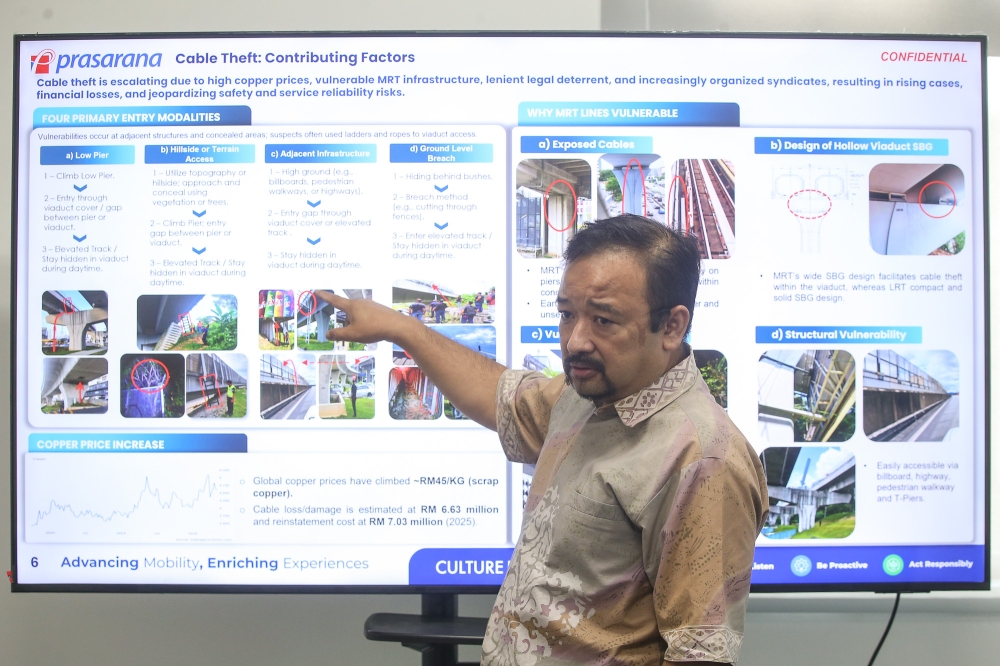
Idzqandar said lenient legal deterrence has resulted in rising cases of cable thefts and repeated offenders. — Picture by Yusof Mat Isa
Idzqandar said law enforcement authorities typically investigate cable theft incidents under Section 379 of the Penal Code for theft, but suspects are often ultimately prosecuted under Sections 447 for criminal trespass instead.
In certain instances, suspects are also charged under Section 29(1) of the Minor Offences Act for possession of stolen goods which provides a maximum fine of RM1,000 or imprisonment for up to one year or both if convicted.
The difference in penalties is stark: theft carries a jail term of up to seven years, a fine or both, while criminal trespass carries a jail term of up to six months, a fine of up to RM3,000 or both.
“So if you consider the scrap value (of the stolen cables) to be RM50,000 to RM60,000 per night and every time you get caught you only receive a fine up to RM3,000 or several months in jail, that is not enough of a deterrent.
“It’s a worthwhile effort for them,” he said, adding that each incident results in approximately RM90,000 in replacement costs for Prasarana.
Dangerous but lucrative
Idzqandar recalled a suspect risking his life to evade capture, underscoring the crime’s high-risk, high-reward nature.
“There was a case where our patrol discovered a suspect traversing the elevated tracks and decided to corner him on both ends of the rail which the suspect later realised.
“He then decided to jump down when we started pursuing and managed to escape. Later, during another theft incident, we caught a suspect walking with a crutch who admitted to being the same person from before.
“But this time he was on the ground (in charge of) collecting the stolen cables thrown down by his accomplice from the tracks above,” he said.
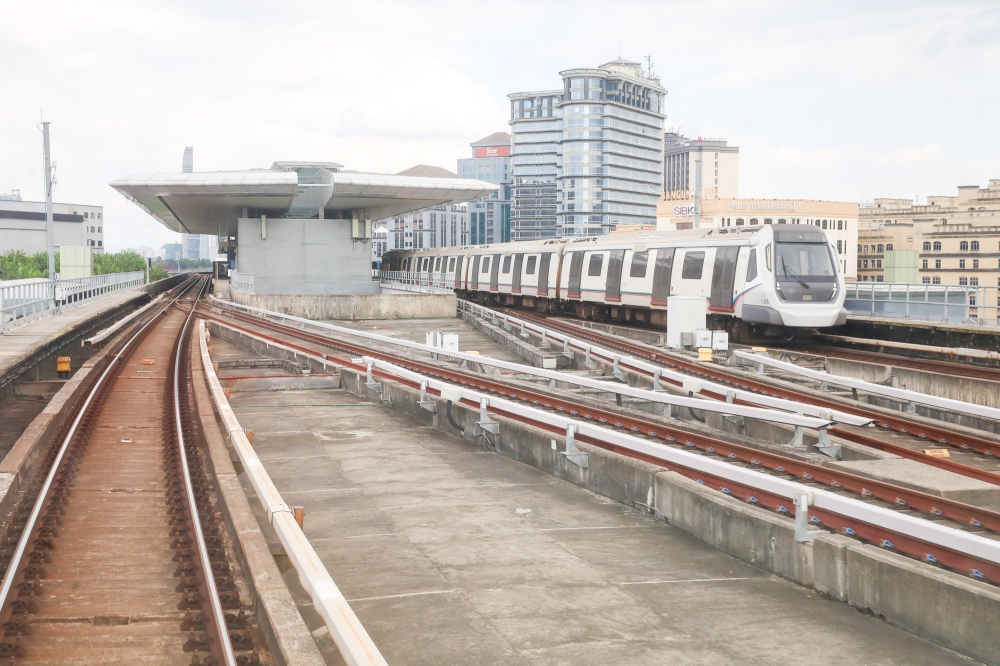
The 48km-long MRT Kajang Line is one of the two most frequent targets of coordinated cable theft syndicates, with 25 such cases reported in 2025 alone. — Picture by Choo Choy May
Increasingly syndicated as law reform lags
Recently, Transport minister Anthony Loke said a proposal has been submitted to the Home Ministry to amend existing laws, imposing harsher penalties on individuals involved in cable theft.
Loke was quoted saying cable theft cannot be treated as a normal theft, as it has the potential to endanger public safety and disrupts the operation of the public transport system.
Career crime
“If you look at the pattern (of thefts), some involve the same person we arrested several times in the past, so it has become a career for them.
“And we sort of know who (the usual suspects are) because we later found out they were a group comprising a father, his son and his son’s cousin,” Idzqandar said, noting that most were locals.
There were also instances of arrested foreigners, but Idzqandar said they were mostly hired help with local syndicates being the masterminds.
According to Idzqandar, there have been no reported electrocution cases or fatalities, reflecting the suspects’ degree of planning and preparation despite the inherent dangers.
Therefore, a stricter form of punishment must be introduced to effectively deter what has evolved into a highly coordinated criminal operation possessing technical skills, specialised tools and detailed knowledge of the rail alignment.
When asked whether any incidents involved inside jobs, Idzqandar said it cannot be ruled out, but nothing has been proven to date.
“That is why one of the things we are proposing is to prosecute people with the intent to sabotage if they are found trespassing with the right tools rather than waiting until they are caught red-handed,” Idzqandar said.