

JANUARY 1 — Discussions regarding issues related to halal are a topic that is highly synonymous with and close to the hearts of the Malaysian community.
As a nation that establishes Islam as the religion of the Federation, awareness regarding aspects of consumerism based on Islamic law has expanded so broadly that it has become a form of culture representing the identity of the society.
Reports from the Global Islamic Economy Indicator (GIEI) in mid-2025 showed that Malaysia continues to dominate the Islamic economic sector since 2013, particularly through the halal industry and Islamic finance.
In the context of the pluralistic society in this country, the concept of halal, especially in the term of food, is now increasingly well-received by various layers of society including the non-Muslim community.
Halal is now seen as a symbol of quality, integrity, hygiene levels, and safety in consumer products, specifically food.
Furthermore, the existence of robust laws and acts, world-recognized halal standards, as well as the establishment of specialized institutions such as the Halal Division of the Department of Islamic Development Malaysia (Jakim) and halal research bodies that constantly ensure the integrity of such certifications is preserved, has stimulated the sustainability of the halal ecosystem.
In other words, the existence of these factors has also indirectly become a catalyst for the process of cultivating a halal culture to continue flourishing within society.
Nevertheless, this positive development also presents certain challenges, particularly from a social aspect.
For example, issues constantly circulating within the community such as halal certification, the misuse of halal logos, and the use of doubtful terms are among the social issues triggered by the cultivation of halal culture.
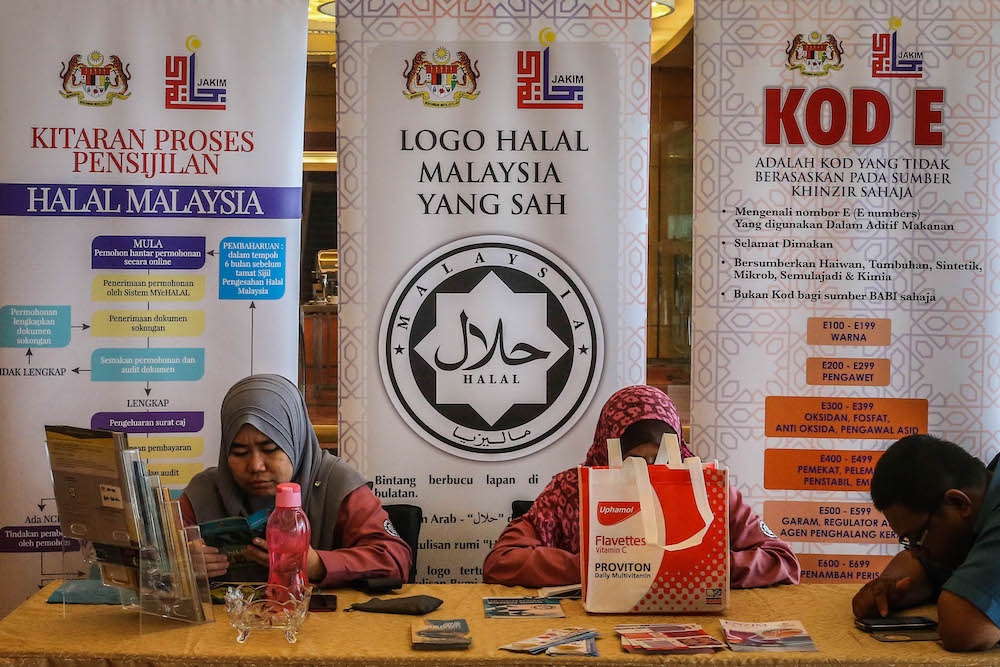
The author says halal should not be used as a tool to oppress or boycott without a solid foundation. — Picture by Firdaus Latif
Recently, social media trends have often become a “public court” for commenting on current issues, which also includes issues related to halal.
Some of them adopt an overly aggressive approach toward halal issues to the point of causing public panic.
Negative perceptions are frequently cast upon food premises that do not possess a halal logo without considering the actual situation of those premises, whether they are experiencing certain problems resulting in delays or are still in the application process.
Outwardly, these actions may be driven by noble intentions aimed at preserving Muslims from falling into the abyss of syubhah (doubt), especially when involving premises owned by non-Muslims.
The desire to ensure every mouthful is pure aligns with the requirements of the nas (textual evidence) of the al-Quran and al-Sunnah, which emphasize the consumption of food that is halal and tayyib (good/wholesome).
However, we must realize that an approach that is too aggressive and excessive in “judging” without first conducting due investigation can leave negative implications for the sanctity of the halal concept itself.
This is even more so when it is tainted by irresponsible acts such as spreading false news, slander, defaming the dignity of others, and judging without prior investigation.
In reality, such actions contradict the morals (akhlak) and etiquette (adab) outlined in Islamic law.
On the contrary, Islamic law emphasizes the principles of justice, tolerance, and moderation in every aspect of life.
Halal should not be used as a tool to oppress or boycott without a solid foundation.
From the perspective of fatwa (legal rulings), the issuance of a law related to food aims to provide guidance and solutions to resolve the confusion of the Ummah.
The issuance of a fatwa, conversely, is not an instrument to collapse an individual’s business. In fact, a fatwa is guidance for the people and not a weapon to stifle the economic potential of others.
This halal approach in the context of fatwa should also be applied at the societal level.
If the community perceives elements of doubt in a particular product or premise, the appropriate action to be taken is to report directly to the authorized parties in the field of halal.
This is because the authorities possess specific jurisdiction in the matter and are more empowered to take enforcement steps that are valid from a legal standpoint.
Additionally, the authorities also possess more authentic data and information regarding the background of the premises and products.
It is undeniable that the public also has the right to speak up or give reminders if there are doubts regarding a product or premise.
This is especially true in taking the responsibility to prevent a wrongdoing (munkar) from continuing to occur, as suggested in Islamic law.
However, the reality is that this country has legal channels and procedures that ought to be respected.
Consequently, neglecting this aspect will subsequently trigger other side effects. It may even highlight a negative side toward the sanctity of the religion of Islam itself.
On the contrary, the commitment to halal and haram returns to the integrity of the individual.
From another perspective, we still see a segment among Muslims who take a lackadaisical or complacent attitude regarding food consumption.
This indifferent attitude indicates that the agenda of dakwah (outreach) and education related to halal still needs to be empowered.
The community must continue to be educated that the concept of halal and haram is broad.
Halal is not limited only to avoiding pork, dogs, or alcohol. Rather, it encompasses various other aspects such as the supply chain, source of acquisition, hygiene, and overall Shariah compliance.
Therefore, a wise approach in cultivating the concept of halal is the main key.
A moderate, factual, and polite approach is not only capable of increasing the level of public awareness but is also able to develop Malaysia’s halal ecosystem to a higher level.
More importantly, when halal is managed with wisdom (hikmah), it will become a reason for the respect of the multi-ethnic society toward the beauty of Islamic law itself. It may even knock on the doors of hearts to receive guidance from Allah SWT.
Let us be wise consumers who are firm in holding to principles, yet adopt a wise approach in every action.
* Muhammad Ammar Harith Idris is an Islamic Affairs officer in Unit Buhuth (Research Unit) of the Federal Territories Mufti’s Office.
** This is the personal opinion of the writer or publication and does not necessarily represent the views of Malay Mail.


