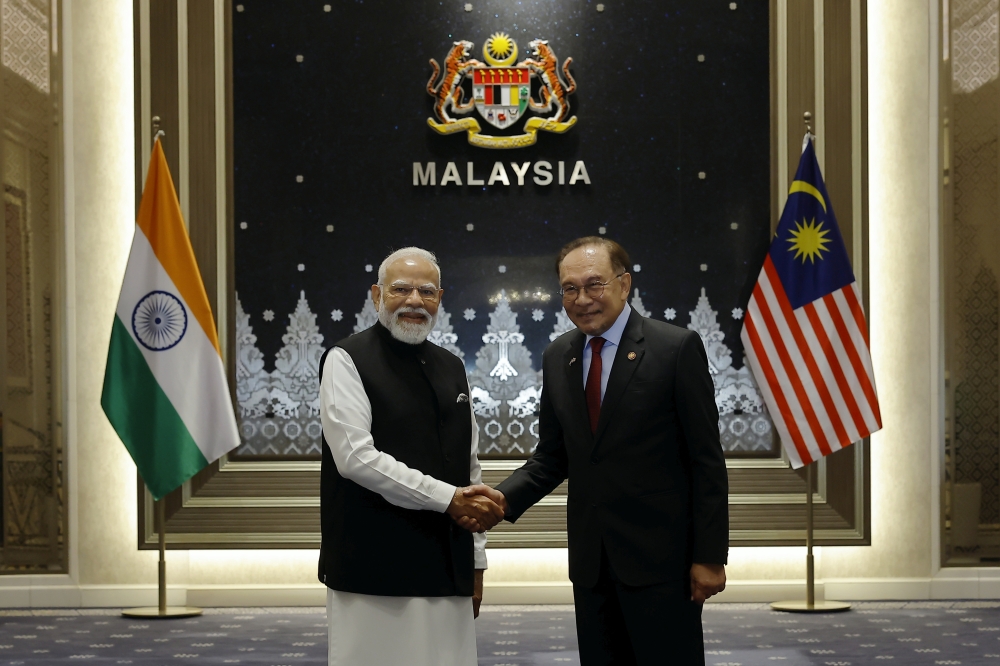
FEBRUARY 8 — The most important geopolitical developments in the past week in the Asia-Indo-Pacific today are not always driven by superpowers.
Increasingly, it is medium-sized powers – states with significant economic weight, diplomatic reach, and regional influence – that are quietly shaping a more workable international order.
The recoupling of Australia and Indonesia, alongside the reinforcement of ties between India and Malaysia, illustrates a crucial point: cooperation among medium-sized powers is not only feasible, it is increasingly necessary in a fragmented global system.
Rather than aligning reflexively with competing great powers, these states are recalibrating their relationships with one another – guided by realism, economic pragmatism, and a shared desire to preserve strategic autonomy.
Australia and Indonesia: pragmatic re-engagement among equals
Australia and Indonesia are natural partners separated not by distance, but by history and perception.
Their relationship has oscillated for decades between cooperation and mutual suspicion.
What distinguishes the current phase is not the absence of disagreements, but the deliberate decision to prevent those disagreements from becoming structural obstacles.
Canberra now recognizes that Indonesia is not merely a neighboring state but a regional heavyweight – demographically, economically, and diplomatically. Jakarta, meanwhile, understands that Australia remains a critical medium-sized power with deep capabilities in education, energy transition, maritime security, disaster relief, and institutional governance.
This recoupling is sober rather than sentimental.
It is grounded in concrete cooperation: supply chains, food security, defense dialogue, climate adaptation, and people-to-people exchanges.
Crucially, it does not force Indonesia into rigid alignments nor reduce Australia to a proxy of external strategic agendas.
It is medium-power diplomacy at its most mature – transactional, respectful, and forward-looking.
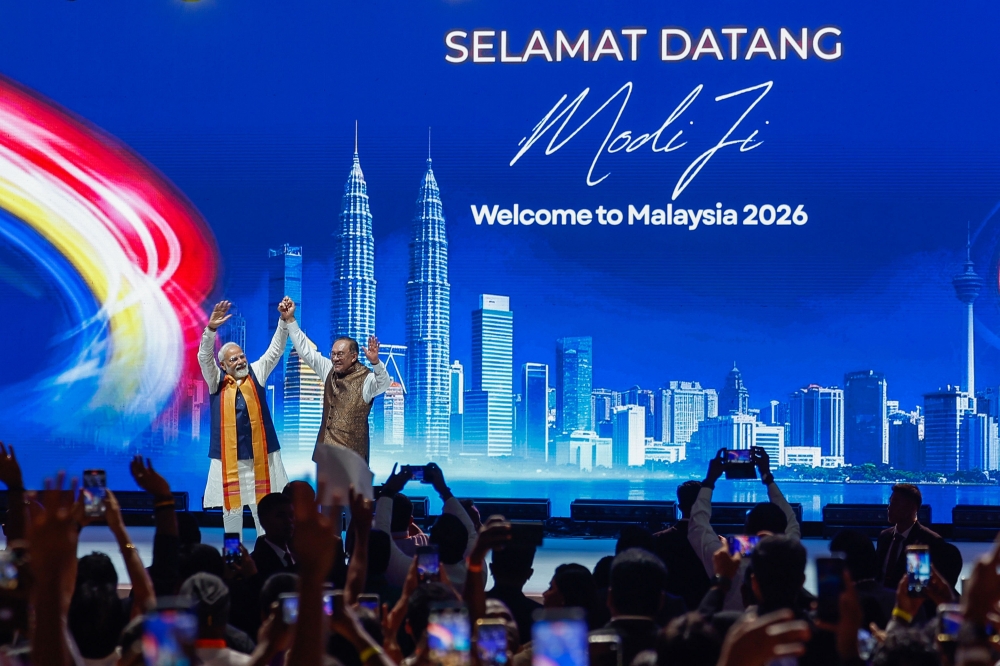
The author says Malaysia’s relationship with India reflects growing cooperation among medium-sized powers across regions. — Bernama pic
India and Malaysia: reinforcement through strategic complementarity
If Australia–Indonesia reflects geographic necessity, India–Malaysia demonstrates strategic complementarity among medium-sized powers operating across regions.
India’s external posture has evolved.
It is no longer content to remain a continental power focused inward. Its economic growth, digital ambitions, and maritime interests have pushed it toward deeper engagement with South-east Asia.
Malaysia, positioned at the heart of maritime Asean, offers India a stable, institutionally anchored, and politically balanced partner.
Trade diversification, digital technology, education, defense cooperation, and diaspora ties now anchor the relationship.
Equally important is the diplomatic tone: both sides emphasize sovereignty, non-interference, and policy independence.
This reinforcement is not driven by ideology. It is driven by mutual benefit and strategic foresight – hallmarks of medium-power cooperation.
Beyond blocs and binary choices
Too often, contemporary geopolitics is framed as a binary contest between major powers, forcing other states into artificial camps.
Medium-sized powers are increasingly rejecting this logic.
Australia, Indonesia, India, and Malaysia do not seek to overturn the international system. Nor do they accept a world in which their choices are dictated by external rivalry.
Instead, they are constructing overlapping partnerships that reduce vulnerability and expand strategic options.
This is not non-alignment in its Cold War sense. It is strategic diversification – working with multiple partners while avoiding excessive dependence on any single one.
Malaysia’s quiet strategic advantage
For Malaysia, these trends are especially consequential.
As a central Asean state with strong ties across East Asia, South Asia, the Muslim world, and the West, Malaysia is well placed to benefit from stronger cooperation among medium-sized powers.
When Australia and Indonesia stabilize their relationship, Asean cohesion is strengthened.
When India deepens its engagement with South-east Asia through partnership rather than dominance, Asean’s relevance is reinforced rather than diluted.
Malaysia’s advantage lies not in choosing sides, but in encouraging convergence among peers.
Strategic autonomy without isolation
Medium-sized powers understand a key truth: strategic autonomy does not mean disengagement. It means retaining the freedom to cooperate widely while safeguarding national interests.
The Australia–Indonesia recoupling shows that historical frictions can be managed without paralysis.
The India–Malaysia reinforcement demonstrates that cross-regional cooperation can be institutionalized without surrendering sovereignty.
Together, they point toward a future in which medium-sized powers act as stabilizers rather than spectators.
A realistic template for a fragmented world
As global institutions strain under pressure and great-power rivalry hardens, medium-sized powers offer a more realistic template for cooperation.
Their partnerships are modest in ambition but rich in substance. They privilege function over form and outcomes over rhetoric.
In a world increasingly defined by uncertainty, the lesson is clear: stability will not come solely from the actions of superpowers. It will emerge from the cumulative choices of medium-sized powers willing to work together – quietly, pragmatically, and with strategic patience.
Australia–Indonesia and India–Malaysia show that this path is not theoretical. It is already underway.
* Phar Kim Beng is a professor of Asean Studies and director of the Institute of International and Asean Studies, International Islamic University of Malaysia.
** This is the personal opinion of the writer or publication and does not necessarily represent the views of Malay Mail.