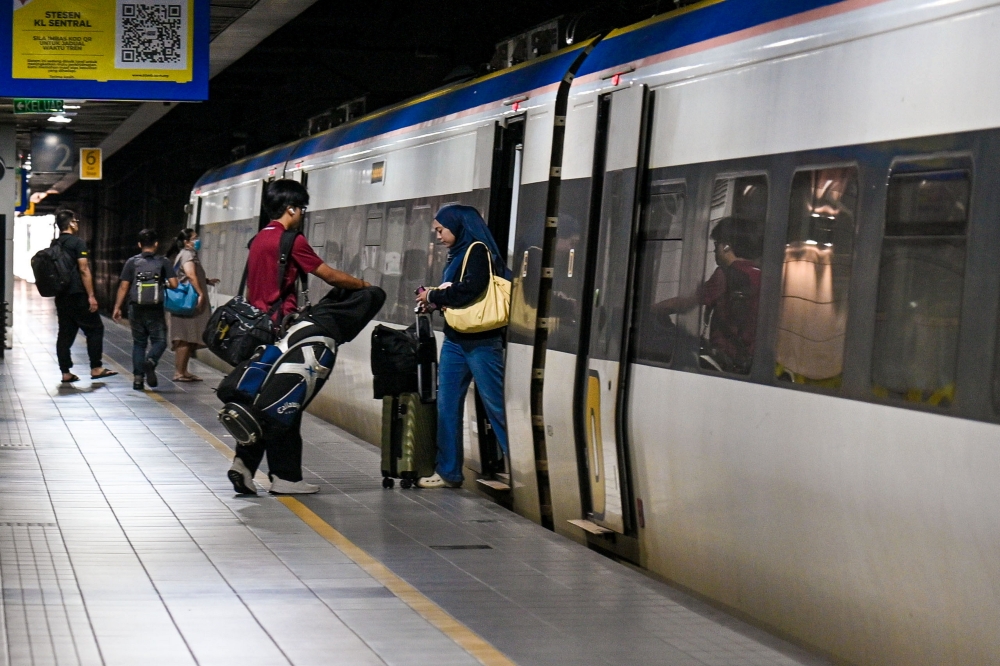
SEGAMAT, April 19 — The Ministry of Communications will adopt the principle of ‘di mana ada tren, di situ ada internet’ (where there is a train, there is internet) in efforts to improve internet coverage along the KL Sentral-Segamat Electric Train Service (ETS) route.
Communications Minister Datuk Fahmi Fadzil said this is an extension of the previously used principle, ‘di mana ada jalan, di situ ada internet’ (where there is a road, there is internet).
Accordingly, he said the Malaysian Communications and Multimedia Commission (MCMC) and telecommunications companies have been asked to resolve internet connectivity issues along the ETS route within one month.
“This is among the efforts being taken, and I hope that Keretapi Tanah Melayu Berhad (KTMB) service users will feel more comfortable staying connected or working while travelling to their destinations,” he said during an internet speed testing session on the KL Sentral-Segamat ETS service today.
Also present were Communications Ministry secretary-general Datuk Abdul Halim Hamzah and MCMC managing director Abdul Karim Fakir Ali.
Fahmi said the internet speed tests for the 4G and 5G networks were conducted by MCMC, in collaboration with six major mobile network service providers, namely CelcomDigi, Maxis, U Mobile, TM Tech, YTL Communications, and Digital Nasional Berhad (DNB).
He said that it is not only internet coverage for the ETS service that needs to be improved, but the entire KTMB service spanning 1,700 kilometres up to Tumpat, Kelantan.
For this purpose, Fahmi has requested that MCMC, KTMB, the Railway Assets Corporation (RAC), and all six telecommunications companies hold a workshop in the near future to identify internet coverage issues and blind spots across the entire KTMB network.
He said the relevant parties need to identify immediate solutions as well as long-term measures that can be taken.
He had also been informed that RAC and KTMB provide certain services, including WiFi, but that a more holistic, carrier-agnostic approach is needed.
“We are not concerned about which company it is, as long as there is shared passive infrastructure such as towers or other equipment that can be utilised. Therefore, all telecommunications companies should make use of what has already been provided,” he said.
During the journey from KL Sentral to Segamat, Fahmi conducted two internet speed tests at Kajang Station and Pulau Sebang/Tampin Station.
Meanwhile, MCMC, in a separate statement, said the purpose of the tests was to assess coverage performance and the speed of 4G and 5G networks in real time along the rail route, which is one of the country’s main transportation corridors.
“Various technical parameters were measured, including download and upload speeds, data connection stability, and continuity of coverage without interruption.
“The tests used specialised equipment and network monitoring applications to ensure accurate and comprehensive findings,” the statement said.
At present, MCMC said that 71 per cent of coverage areas have been equipped with 5G services, and this expansion will continue in stages.
However, there are several locations experiencing a decline in coverage quality and download speeds, particularly in rural areas around Negeri Sembilan, Melaka, and northern Johor, which require further improvement and optimisation by service providers. — Bernama