MARCH 7 — In the past few days, almost everyone around the world has been watching closely the unfolding tension in the Middle East, the conflict involving the United States (US), Israel and Iran, which has led to the effective closure of one of the most important straits in the world, the Strait of Hormuz.
The Strait of Hormuz is a narrow (20-52 nautical miles wide) but crucial international waterway between Iran and Oman, and it is governed by the United Nations Convention on the Law of the Sea (UNCLOS).
The Strait of Hormuz is not merely a geographical conduit but also a geopolitical flashpoint in the global economy. Its waters fall under the sovereignty of two states: Iran and Oman.
This strait is considered highly important, as 88 per cent of the oil extracted in the Gulf region, which accounts for 40 per cent of all oil transported by sea, flows through its waters.
Thus, there is a risk of a global economic crisis and destabilisation of international relations if the coastal states temporarily close the Strait, as has been repeatedly threatened (and is now occurring during this conflict).
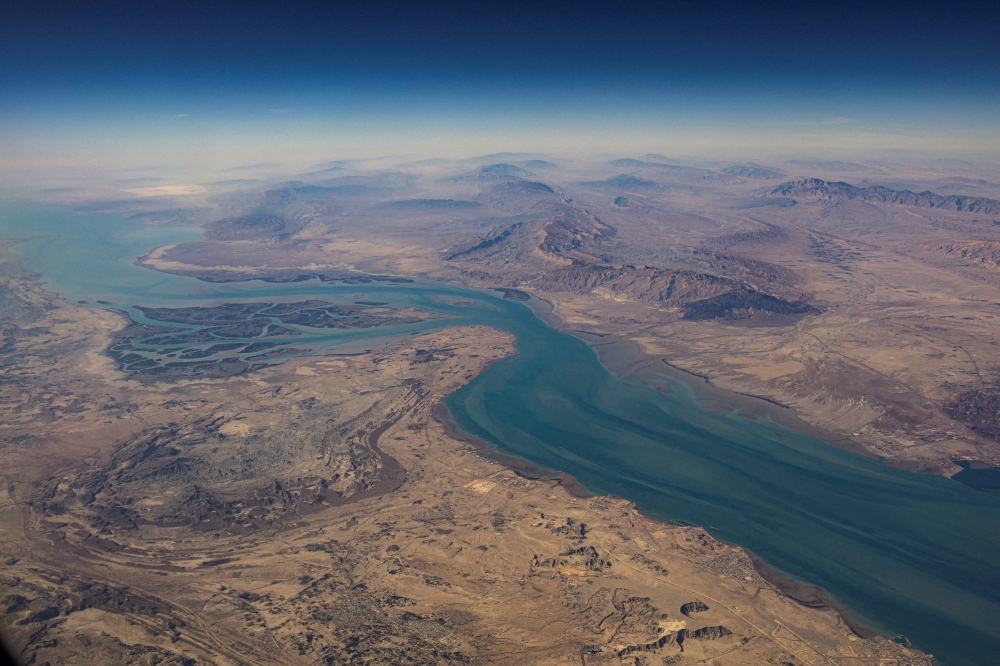
An aerial view of the island of Qeshm, separated from the Iranian mainland by the Clarence Strait, in the Strait of Hormuz. The author argues that Iran’s effective closure of the Strait of Hormuz amid escalating conflict with the US and Israel risks violating international maritime law and could trigger severe global economic and geopolitical repercussions. — Reuters pic
Iran has long regarded the management of the Strait of Hormuz as a strategic tool in international politics.
In 2025, Iranian officials, with parliamentary approvals, argued that the US attacks on Iranian nuclear facilities constitute acts of aggression, thereby entitling Iran to undertake proportional countermeasures, including closure of the Strait.
Such a closure would be particularly detrimental to China and other Asian economies that rely on crude oil and natural gas shipped through the waterway.
In the past, the Foreign Minister of China stressed the importance of the Persian Gulf and its surrounding waters for international trade, stating that maintaining security and stability in the region serves the common interests of the international community and diplomacy at its best.
Due to the intensification of attacks by the US and Israel on Iran over the past weekend, Iran has effectively closed the Strait of Hormuz to oil and gas exports over the past four days through a combination of drone strikes and threats, which have halted several commercial maritime activities despite continued US attacks on Iran’s navy.
On Monday (March 2, 2026), Brig Gen Ebrahim Jabbari, a senior adviser to the Commander-in-Chief of Iran’s Revolutionary Guards, stated: “We will attack and set ablaze any ship attempting to cross”.
The question now is whether the Iranian authorities can legally close the Strait of Hormuz.
The legal power governing the Strait of Hormuz is found in UNCLOS, which classifies international straits as maritime spaces allowing “transit passage” between parts of the high seas or exclusive economic zones (Articles 37 to 44, UNCLOS).
Under this regime, the transit of passage of vessels and even aircraft must be continuous and expeditious, and it cannot be impeded or suspended by coastal states, even during times of heightened security concerns (Article 44, UNCLOS).
Although Iran has signed the UNCLOS, it has not ratified the Convention and has repeatedly issued declarations rejecting the automatic application of the transit passage regime to all states.
In its 1993 Act on Marine Areas of the Islamic Republic of Iran, Iran requires prior authorisation for foreign warships and military aircraft to enter its territorial waters, a position that directly contradicts Article 44 of UNCLOS.
Since the navigational shipping lanes in the Strait are fully contained within the 12-nautical-mile territorial seas of Iran and Oman, Iran’s legal position effectively reverts the regime of transit of passage to that of innocent passage, governed by Articles 17-32 of UNCLOS.
In the precedent case of the International Court of Justice (ICJ), Corfu Channel (1949), the ICJ reaffirmed that warships possess the right of transit through international straits, even when those straits pass through territorial waters, provided that the passage is peaceful and non-threatening.
In short, while Iran has the right to defend itself and may invoke domestic legal grounds and national security to justify restrictions on navigation, such actions, if carried out, would likely be viewed as violations of UNCLOS and customary international laws.
At the end, the whole world is paying the price. According to Brent crude futures, the international benchmark, energy prices have risen, pushing the prices of oil and liquefied natural gas higher than usual.
This could also antagonise China, as China is the world largest importer of crude oil and the biggest buyer of Iranian oil, which may lead to a global economic crisis and destabilisation of international relations among Iran and other countries.
* Redza Zakaria is the Head Unit of Maritime Law, Policy and Governance at the Institute of Ocean Earth and Sciences (IOES) and a Senior Lecturer at the Faculty of Law, Universiti Malaya, and may be reached at [email protected]
**This is the personal opinion of the writer or publication and does not necessarily represent the views of Malay Mail.