FEBRUARY 26 — I watched Modi in Jerusalem the way you watch a childhood home being turned into a themed café — the walls still standing, the soul replaced by lighting design.
Standing ovation.
Netanyahu’s embrace.
That slow, deliberate language of “civilisational partnership” — the kind of phrase that sounds profound until you remember who used it first and why.
And somewhere, in the humid archives of the Global South, Bandung folded its flag.
Because for those of us raised on the mythology of post-colonial dignity, India was never just a country. India was the elder sibling who survived the beating and still walked upright. The one that taught us that you could be looted, starved, partitioned, humiliated — and still speak in your own voice.
And now that voice is echoing inside the Knesset, talking about shared security architecture and zero tolerance, while Gaza burns in every television in the developing world like a historical rerun we did not ask to see again.
Don’t tell me this is diplomacy.
This is identity.
Yes, I know the defence.
Chanakya.
“The enemy of my enemy is my friend.”
China on the border.
Pakistan next door.
Technology gaps.
Missile shields.
AI wars of the future.
I understand realpolitik. I know that morality does not stop hypersonic weapons.
But Chanakya was not a man of amnesia.
Chanakya did not say: erase your memory to gain an ally.
He said: understand power without losing your centre.
And what I saw in Jerusalem was not strategy.
It was a civilisation stepping into a ready-made security ecosystem and calling it destiny.
Look at the shopping list.
Joint defence production.
Air-defence systems wired into future battle networks.
Cyber cooperation.
Artificial intelligence.
A free-trade agreement.
A corridor that runs from India through the Middle East into Europe like a 21st-century East India Company route, only this time we are told we are shareholders.
India is no longer buying from Israel.
India is integrating with Israel.
That is not a transaction.
That is a rewiring of geopolitical DNA.
Here is the part that hurts.
No country on earth understands colonial extraction like India.
The deindustrialisation of Bengal.
The famines that were managed like accounting exercises.
The wealth drain that built another continent’s modernity.
Trillions in today’s language.
We grew up with that story not because we are historians, but because our grandparents spoke of it the way you speak of a flood that took the house away.
And now the political inheritors of that memory stand under the bright lights of Jerusalem and speak the language of alignment with the very global order that was built on that extraction.
Not cautiously.
Not tactically.
With warmth.
What wounds is not the relationship with Israel. That existed long before this moment.
What wounds is the timing.
This visit happened when the Global South is watching Gaza and seeing familiar images:
Checkpoints.
Collective punishment.
The bureaucratic vocabulary of security used to explain why some lives move and others wait.
And in that precise moment, the country that once spoke for us chose to speak the language of power instead of the language of memory.
When Modi framed everything around terrorism, he did something larger than policy. He merged two national narratives into one. Kashmir and Gaza entered the same sentence. Occupation left the room. History left the room. The old anti-colonial dictionary was quietly replaced with a counter-insurgency manual.
That is not foreign policy.
That is a psychological migration.
India will say this is the price of becoming a great power.
And maybe it is.
Great powers do not carry emotional luggage. Great powers build corridors and missile shields and strategic partnerships. Great powers get standing ovations in foreign parliaments.
But India was never supposed to be just another great power.
India was supposed to be the proof that power could remember.
That you could rise without becoming a mirror image of those who once ruled you.
Across Africa, across Southeast Asia, across Latin America, people do not read defence agreements. They read symbols. They read posture. They read who stands where when the moral temperature rises.
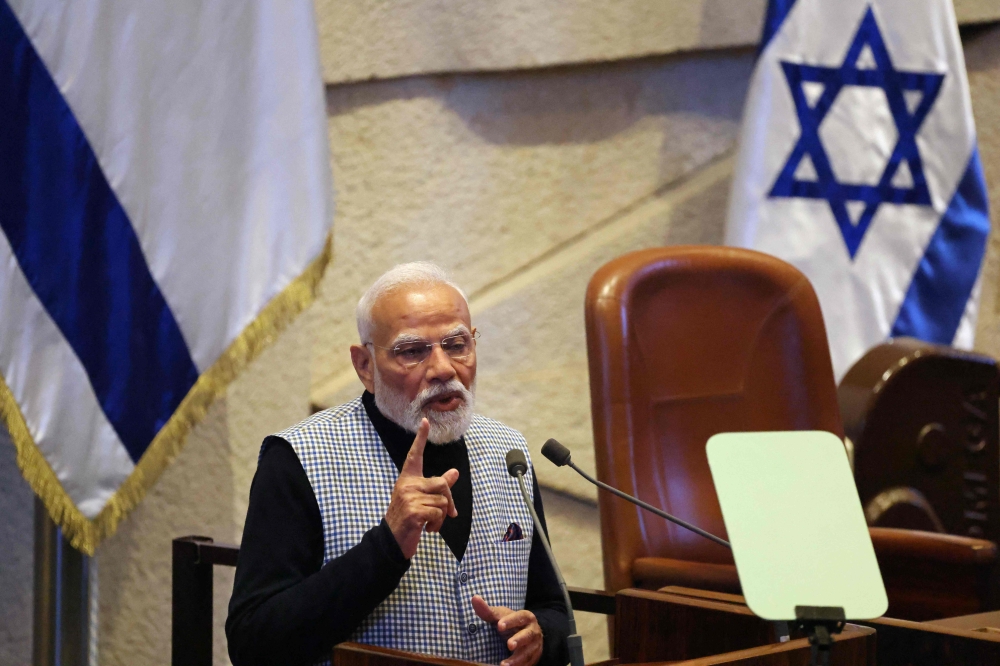
When Modi framed everything around terrorism, he did something larger than policy. He merged two national narratives into one. — AFP pic
And this week, India moved.
Not geographically.
Civilisationally.
Chanakya taught that alliances are temporary.
Identity is not.
You make a friend to defeat a threat.
You do not become the friend.
That is the difference between strategy and transformation.
And what we are watching is transformation.
India — the old, wounded, defiant India of non-alignment — is fading into a new India that sits comfortably inside a grid of power, efficient and respected and strategically indispensable.
Which, in the cold language of geopolitics, is success.
But in the emotional language of the post-colonial world, feels like being left alone at the table.
Because when that standing ovation ended, when the cameras cut, when the agreements moved into implementation and the speeches into archives, something larger than a bilateral relationship had shifted.
A chapter closed.
Not with a war.
Not with a treaty.
But with applause.
And for those of us who still carry the memory of empire in our bones, it sounded less like celebration and more like the door shutting on an era that once promised we would not have to choose between power and soul.
*This is the personal opinion of the writer or publication and does not necessarily represent the views of Malay Mail.