

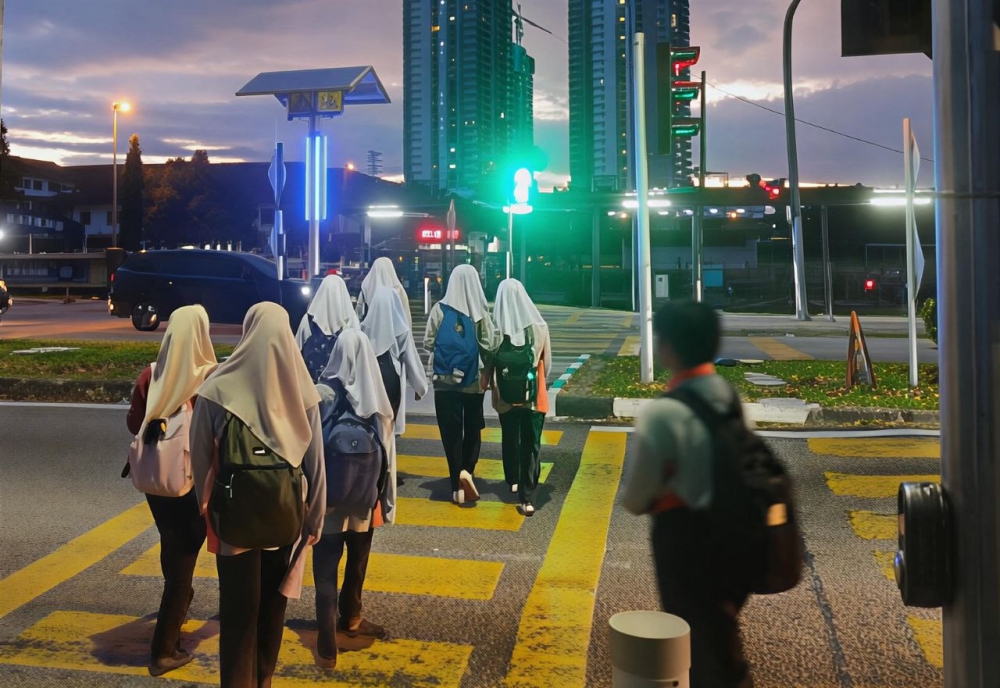
PUCHONG, March 22 — Just before the morning bell at SMK Puchong Permai, groups of students gather at a pedestrian crossing along the busy road outside their school, chatting and greeting one another as they wait for the light to turn green.
Some arrive on foot from nearby flats, while others push their bicycles beside them.
When the signal changes, about 30 students cross the road together, with a few carefully wheeling their bikes by hand.
Cars and motorcycles slow to a stop for roughly 20 seconds, which was long enough for the group to cross safely.
Overhead, trains on the LRT Kelana Jaya Line rumble along the elevated tracks nearby as the morning rush continues below.
The crossing is now overseen by a newly installed smart pedestrian safety system known as Sensa, an initiative by the Subang Jaya City Council (MBSJ) aimed at strengthening road safety in school zones and pedestrian areas with heavy traffic.
A crossing once considered risky
SMK Puchong Permai was selected as the pilot site after concerns were raised about student safety along the busy road outside the school.
Road bumps have also been installed around the school, with two on one side and one on the other, to slow down traffic near the pedestrian crossing.
In a statement to Malay Mail, MBSJ said the location was chosen following requests to improve pedestrian safety and feedback from the school as well as MBSJ Zone 14 councillor Kamarul Hafiz Kamaruddin about previous road crash incidents involving pedestrians in the area.
“An assessment conducted found that the area is among locations with a high safety risk for students when crossing the road, as the road in front of the school is a main thoroughfare with heavy traffic flow, particularly during school arrival and dismissal times,” the council said.
Many of the students live within walking distance in nearby housing areas such as Pangsapuri Aman, Desa Impiana and Pangsapuri Lili.
With about 1,600 students across its morning and afternoon sessions, the crossing sees heavy use during peak school hours.
As early as 6.45am, when it was still quite dark, students can already be seen gathering at the crossing, often arriving in small groups after meeting friends in their neighbourhoods before walking to school together.
Some of them greet each other enthusiastically at the traffic light, exchanging quick hugs before the signal changes.
Apart from students, pedestrians heading to nearby LRT stations also use the crossing during the morning rush.
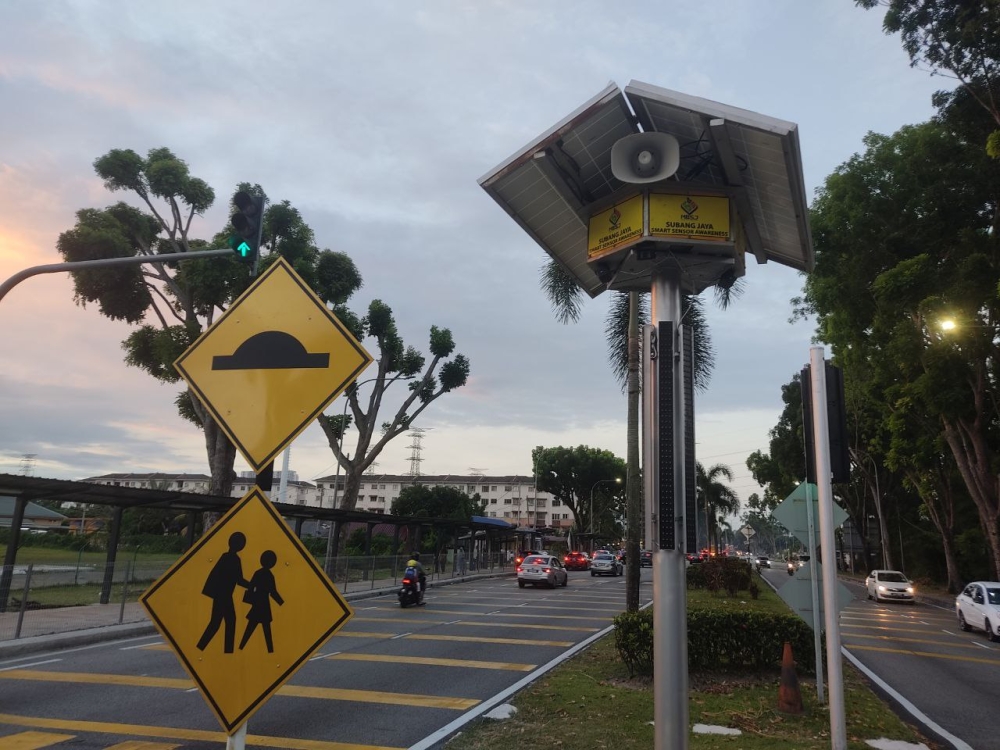
The newly installed Sensa smart warning system by MBSJ enhances road safety in front of SMK Puchong Permai. — Picture by Muhammad Yusry
How it works
The system, developed by MBSJ’s IT Department, uses smart cameras combined with artificial intelligence technology to detect pedestrians at crossings.
“When the system detects pedestrian movement, visual and audio alerts are activated in real time to remind both drivers and pedestrians,” MBSJ said.
This means when someone approaches or begins crossing the road, visual and audio warnings are triggered to alert motorists and pedestrians and they no longer need to press the button on the pole to activate the pedestrian crossing.
At the site, a speaker is designed to broadcast safety reminders, accompanied by a blinking blue light, such as:
“Mohon perhatian, sila beri laluan kepada pejalan kaki yang sedang melintas. Hentikan kenderaan dan utamakan keselamatan mereka. (Attention please, kindly give way to pedestrians who are crossing. Stop your vehicles and prioritise their safety.)”
“Pejalan kaki sila melintas dengan segera dan sentiasa peka dengan keadaan trafik. (Pedestrians, please cross immediately and remain alert to the traffic conditions.)”
However, on the day Malay Mail visited, only a faint rustling sound could be heard from the speaker instead of the full announcement.
The system is also equipped with a 24-hour camera monitoring facility connected to a dashboard, allowing authorities to continuously monitor the crossing and ensure safety conditions remain at an optimal level.
According to the council, Sensa is among the earliest initiatives in Malaysia to integrate artificial intelligence technology to improve pedestrian crossing safety.
Changes already noticeable
School staff say the system has already helped reduce risky driving behaviour near the school.
One teacher, who asked not to be named, said speeding vehicles had previously posed a serious danger to students crossing the road.
“Previously, cars used to speed along the main road and there were several cases where students were hit. Now it’s much less frequent, it rarely happens,” the teacher said.
Traffic also appeared largely compliant with the crossing during Malay Mail’s observation.
Motorists generally stopped during the roughly 20-second crossing phase, although a few motorcycles were seen accelerating through the light just moments before it turned green.
Two motorcyclists were also seen using the pedestrian crossing area to make a U-turn after all the students had safely crossed the road.
The signal then took about one minute and nine seconds before allowing pedestrians to cross again.
Nearby, a security guard stationed at the school gate keeps a watchful eye on the crossing each morning while also ensuring students who arrive on motorcycles dismount and push their bikes to the designated parking area.
The guard said the Sensa system had been installed about three months ago and began operating when the new school term started this year.
Students, he added, adapted quickly.
Old habits remain
Some students still press the old pedestrian button mounted on the pole — even though it no longer appears to function following the installation of the automated system.
Out of habit, they tap the button before waiting for the signal to change.
At around 7.30am, the school guard partially closes the gate, which was a signal to latecomers that the school day has begun.
For the hundreds of students crossing the road every morning, however, the new system now adds an extra layer of safety to a routine journey many of them make on foot.


