APRIL 2 — “Ignorance of the law is no excuse. We study law, we read law, and we practise law—the learning never truly ends,” — Chief Justice Wan Ahmad Farid Wan Salleh.
The world is constantly evolving. The law must keep pace with these changes, and those who practise it must evolve with it. In a world under strain, continuous learning has never mattered more, because the law is no longer tested only in courtrooms, but in a reality shaped by conflict, complexity, and technology.
Hence, acquiring new knowledge can never stop.
That idea—that the study of law is continuous, lived and evolving—runs through the very purpose of the Commonwealth Legal Education Association Conference (CLEA) under the banner of “Lawyering 2030”.
Founded in 1971, the CLEA was built on a vision that remains strikingly relevant today: that legal education must be more than an academic pursuit—it must be socially responsive and professionally transformative across the Commonwealth.
Over the years, CLEA has played a role beyond education, contributing to foundational frameworks such as the Latimer House Principles, which underpin the balance between the Executive, Legislature, and Judiciary. In doing so, it has reinforced a central idea—that strong, meaningful legal education is essential to upholding judicial independence and the rule of law.
The foundation of CLEA was the context within which Tan Sri Datuk Nallini Pathmanathan, Patron of Lawyering 2030, laid the framework for the discussions ahead at the two-day conference (April 2–3).
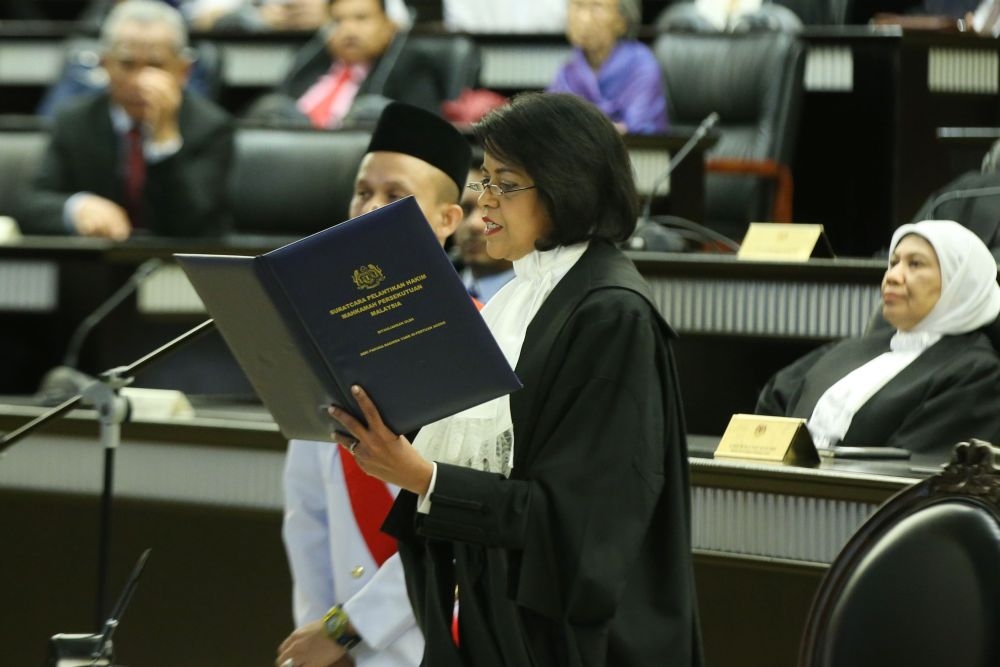
Tan Sri Nallini Pathmanathan is seen here taking her oath upon her appointment as a Federal Court judge at the Palace of Justice in Putrajaya November 26, 2018. — Picture by Azinuddin Ghazali
“I urge you to look beyond the black letter of the law over the coming days. Let us discuss how we can bridge the gap between the classroom and the courtroom, ensuring that legal education and legal practice remain the bedrock of a fair and courageous judiciary.
“This conference is a testament to that shared heritage. It is a space to debate, to disagree with grace, and to refine the tools we use to protect the rights of our citizens,”, Nallini the former Federal Court Judge, said during her welcome address.
More than 350 delegates from across the Commonwealth—judges, legal practitioners, academics, policymakers and law students—gathered for the conference, alongside over 40 international and local speakers.
From students to the most senior judges, they sat together in the hall without the usual markers of distance or hierarchy.
Yet what stood out was not just the scale, but the atmosphere—intellectually charged, with a deep seriousness, as if there was an unspoken understanding between speaker and participant, a quiet unanimity in recognising the turbulent world beyond the room.
The space felt open, almost disarmingly so. And in that moment, we felt close to the law.
That sense of closeness would matter—not only for the moment, but for the freedom it created for meaningful debate, discussion and argument throughout the sessions that followed.
What emerged was not simply a sequence of speeches, but a recognition that the law is no longer operating within familiar boundaries. It is being stretched—and at times tested—by forces beyond the courtroom.
The presence of Prime Minister Datuk Seri Anwar Ibrahim placed the conference within a broader national and global context—deepening the learning that takes place in the room, while bringing into sharper focus questions of governance, accountability and public trust.
His emphasis on the need for lawyers to navigate increasingly complex cross-border realities, with sensitivity to cultural and religious differences and guided by strong ethical judgment, reflected the demands of the world as it is today.
“The profession must meet those demands. At the same time, the conference must be a meeting of minds—where what is right is tested against what is just, and where ideas are refined through exchange,” he said, underscoring the urgency of the moment.
“Lawyering 2030” is not a distant horizon. It reflects the present. The question is no longer where the law is going, but whether it is keeping pace with the world it inhabits.
In a time when global conflicts continue to test the limits of the rule of law, the language of the conference remained measured, even restrained. What was striking, however, was not only what was said, but what remained elegantly subtle.
For all its structure and ceremony, the true measure of the conference lies beyond its proceedings. Its success will not be defined by participation alone, but by whether its ideas travel into courtrooms, classrooms and chambers across the legal fraternity.
It is not about grand declarations, but about difficult questions: How should lawyers be trained? What would judgment look like in an age of artificial intelligence?
As Chief Justice of Malaysia, Datuk Seri Utama Wan Ahmad Farid Wan Salleh cautioned in his address, while technology may assist, it cannot replace human judgment.
“To err is human—and it is through those errors that we learn and the law continues to learn,” he said.
Finally in the end, all the learning does not live in conferences. It lives in what the legal fraternity does with the knowledge, beyond the conference.
* This is the personal opinion of the writer or publication and does not necessarily represent the views of Malay Mail.