MARCH 2 — The widening of the Middle Eastern conflict following Operation Epic Fury marks a dangerous escalation.
What began as a direct confrontation between the United States, Israel and Iran has now spilled into the wider Gulf region.
Iran’s decision to strike member states of the Gulf Cooperation Council (GCC), with the exception of Oman, may prove to be a grave strategic error.
By launching missiles and drones toward Gulf territories, Tehran has shifted the perception of the conflict.
It is no longer seen solely as retaliation against Washington or Tel Aviv.
It is now viewed as a violation of Arab sovereignty.
This distinction matters enormously.
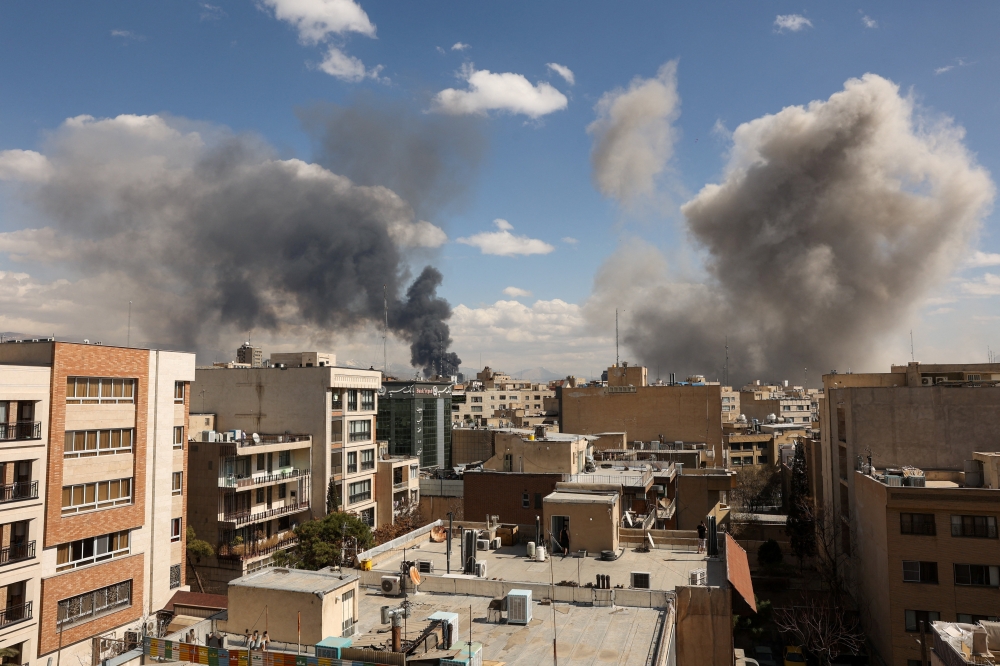
Smoke rises following an explosion, after Israel and the US launched strikes on Iran, in Tehran, Iran, March 1, 2026. — Majid Asgaripour/WANA (West Asia News Agency) pic via Reuters
GCC states may host foreign military facilities. But they remain sovereign governments.
Any strike on their soil, even if aimed at external forces, inevitably triggers national outrage and demands for collective defense.
In effect, Iran may have unified the Gulf monarchies at a moment when some were cautiously recalibrating relations with Tehran.
Recent diplomatic openings, quiet dialogues and economic engagements now risk collapse.
Iran’s retaliation also undermines its own narrative.
Tehran has long argued that it acts defensively when provoked.
Yet when missiles cross into multiple Arab territories, the optics change.
Instead of appearing defensive, Iran risks appearing expansionist.
That perception will have consequences.
Gulf states, already wary of missile proliferation and proxy networks, will interpret these strikes as confirmation of long-standing fears.
Rather than weakening American presence in the region, Iran’s actions may strengthen it.
Calls for enhanced missile defense systems and deeper military coordination are likely to intensify.
Oman’s exemption from Iranian retaliation is telling.
Muscat has historically served as a discreet mediator between Iran and Western capitals.
By sparing Oman, Tehran signals that it wishes to preserve at least one diplomatic channel.
But that corridor may narrow if the wider Arab world hardens its stance.
Iran appears to have misread regional dynamics.
The assumption may have been that some Gulf states would remain neutral.
Instead, escalation forces governments to respond firmly to protect their legitimacy.
No Arab capital can appear passive while its airspace is threatened.
Strategically, Iran has often relied on calibrated escalation.
By widening the battlefield, it risks provoking a broader coalition against itself.
Escalation benefits external powers.
Heightened insecurity justifies deeper foreign military entrenchment.
Energy markets grow volatile.
Shipping lanes become risk-prone.
None of these developments serve Iran’s long-term interests.
The Middle East cannot afford another prolonged regional war.
Iran still has room to recalibrate through diplomacy, particularly via Oman.
But that window is narrowing rapidly.
Strategic patience, not expansive retaliation, would better secure Tehran’s position.
Expanding the battlefield may satisfy immediate impulses.
It may, however, lead to long-term strategic isolation by the GCC and the world at large.
* Phar Kim Beng is professor of Asean Studies and director of the Institute of International and Asean Studies, International Islamic University of Malaysia.
** This is the personal opinion of the writer or publication and does not necessarily represent the views of Malay Mail.