APRIL 5 — Rare earth elements are the unsung heroes of the modern economy — powering everything from electric vehicles and wind turbines to smartphones and defence systems.
As the world scrambles to diversify supply chains away from China’s dominance, Malaysia sits on a potential goldmine, yet remains trapped in a cycle of debate and delay.
The core issue is not a lack of plans or task forces, but a crippling governance stalemate between federal and state authorities.
If Malaysia does not break this deadlock soon, it risks missing a generational opportunity to become a significant player in the global green economy.
The global context presents a window of opportunity. China currently controls over 60 per cent of global rare earth mining and nearly 90 per cent of refining capacity.
In response, the US, EU, Japan and Australia are actively seeking alternative suppliers.
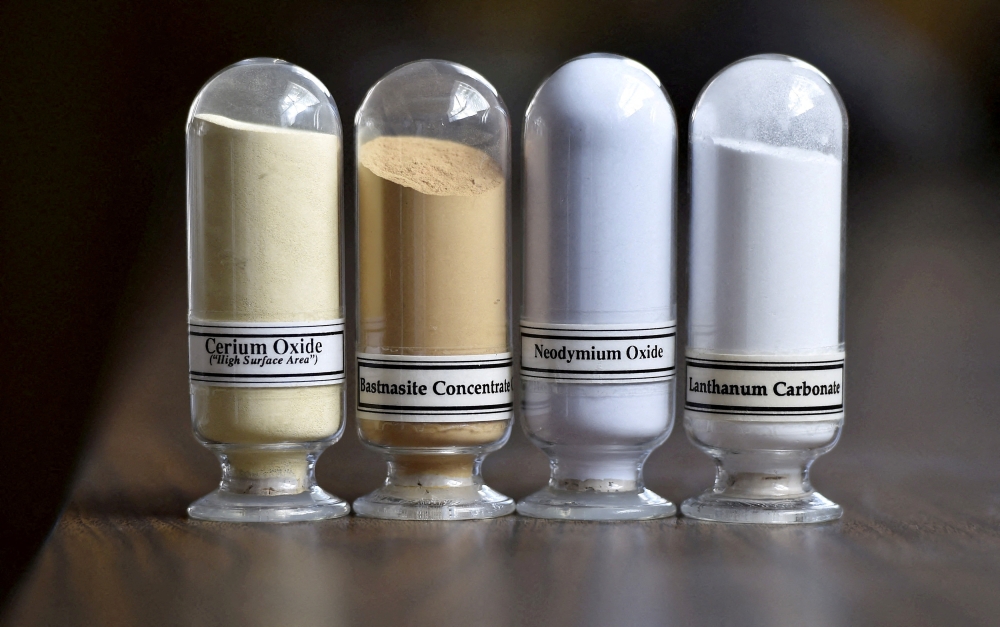
Samples of rare earth minerals from left, Cerium oxide, Bastnasite, Neodymium oxide and Lanthanum carbonate are on display during a tour of Molycorp’s Mountain Pass Rare Earth facility in Mountain Pass, California June 29, 2015. Rare earth elements are the unsung heroes of the modern economy — powering everything from electric vehicles and wind turbines to smartphones and defence systems. — Reuters pic
This geopolitical shift has created a rare opening for resource-rich nations like Malaysia. However, the window is narrowing as other countries, such as Vietnam and Australia, accelerate their own projects.
Malaysia’s advantage lies not only in its deposits — particularly in states like Kedah, Perak, and Terengganu — but also in its existing industrial ecosystem, including the world-class rare earth processing facilities operated by Lynas in Pahang.
Yet, without a coherent national strategy, these assets remain underleveraged.
Many know the root of the stalemate lies in the Federal vs. State powers. In Malaysia, mineral rights are largely vested in state governments, while federal authorities control licensing, environmental regulation and international trade.
This division has led to fragmented decision-making. States fear losing revenue and control, while the federal government struggles to implement a unified industrial policy.
The result? Endless discussions, duplicated task forces and bureaucratic inertia. The Lynas experience, though successful, also highlighted how political and environmental controversies can escalate without clear federal-state alignment.
Moving from talk to action calls for a five-point plan. For Malaysia to “put its act together,” it must adopt a pragmatic, collaborative approach that balances state interests with national strategic goals.
First, establish a Unified Rare Earth Authority. Create a dedicated federal-state joint authority with representation from all stakeholders — state governments, industry experts, environmental groups and federal agencies.
This body should have clear mandates: streamline approvals, set environmental and safety standards and coordinate infrastructure development.
It must be empowered to make binding decisions, not just recommendations.
Next, adopt a “Resource-to-Revenue” sharing model. Transparency in revenue sharing is key to gaining state buy-in.
The federal government should propose a model where states receive a significant portion of royalties and taxes, with a percentage reinvested into local communities and environmental protection. This would align economic incentives and reduce resistance.
Of course, leverage existing strengths. Malaysia should build on its existing rare earth processing expertise — particularly in separating and refining — rather than starting from scratch.
Encouraging downstream industries (e.g., magnet manufacturing) near processing plants could create higher-value jobs and attract foreign investment.
The National Trade Blueprint and New Industrial Master Plan should explicitly integrate rare earths into high-tech manufacturing goals.
It is important to prioritise sustainable and responsible mining. Past controversies around radioactive thorium waste have made environmental safeguards a public priority.
Malaysia must enforce world-class environmental, social, and governance (ESG) standards and invest in cleaner extraction technologies.
This would not only protect public health but also enhance Malaysia’s brand as a responsible supplier — a key selling point in Western markets.
One suggestion is to fast-track pilot projects. Instead of waiting for perfect consensus, select one or two pilot projects in states willing to collaborate — using them as test cases for federal-state coordination, community engagement and sustainable practices.
Success stories can build public confidence and create a template for scaling up. It is a test of national will.
Malaysia’s rare earth impasse is ultimately a test of its ability to navigate complex governance challenges.
The world is moving fast and Malaysia cannot afford to remain stuck in endless debates.
By forging a cooperative federal-state compact, focusing on value-added industries and committing to sustainability, Malaysia can transform its rare earth potential into an engine for economic advancement and geopolitical relevance.
The plans are already hatched — now it’s time to execute. If not, the opportunity will slip away, and with it, a chance to secure a more prosperous and strategically independent future.
* Professor Datuk Dr Ahmad Ibrahim is affiliated with the Tan Sri Omar Centre for STI Policy Studies at UCSI University and is an Adjunct Professor at the Ungku Aziz Centre for Development.
* This is the personal opinion of the writer or publication and does not necessarily represent the views of Malay Mail.