APRIL 4 — Sri Lanka’s renewed struggle to avoid another economic breakdown should serve as a warning to Malaysia and the wider Asean region.
Colombo has had to ration fuel, raise pump prices by roughly a third, and increase electricity tariffs by as much as 40 percent as the prolonged Middle East war drives up energy costs and compounds earlier domestic shocks, including the impact of a deadly cyclone late last year. These are not abstract policy adjustments.
They are emergency measures taken by a state that still remembers, all too painfully, the consequences of systemic economic collapse.
The lesson for Asean is not to panic, but neither is it to drift into complacency. Panic is politically contagious.
Once it takes hold, consumers hoard, investors hesitate, markets overreact, and governments are tempted into improvised decisions that worsen the very instability they are trying to contain.
Calm, by contrast, is not passivity. Calm is discipline. Calm is coordination.
Calm is the capacity of states and societies to act with sobriety when events around them grow more volatile. That is precisely what Malaysia and Asean now require.
There is a famous line often associated with Intel’s Andy Grove: “Only the paranoid survive.” The phrase has its place in corporate strategy, especially when it comes to anticipating disruption.
But nations and civilizations do not survive on paranoia alone.
They survive through social trust, prudent leadership, institutional resilience, and public composure. Science teaches us that systems under stress need stability, not frenzy.
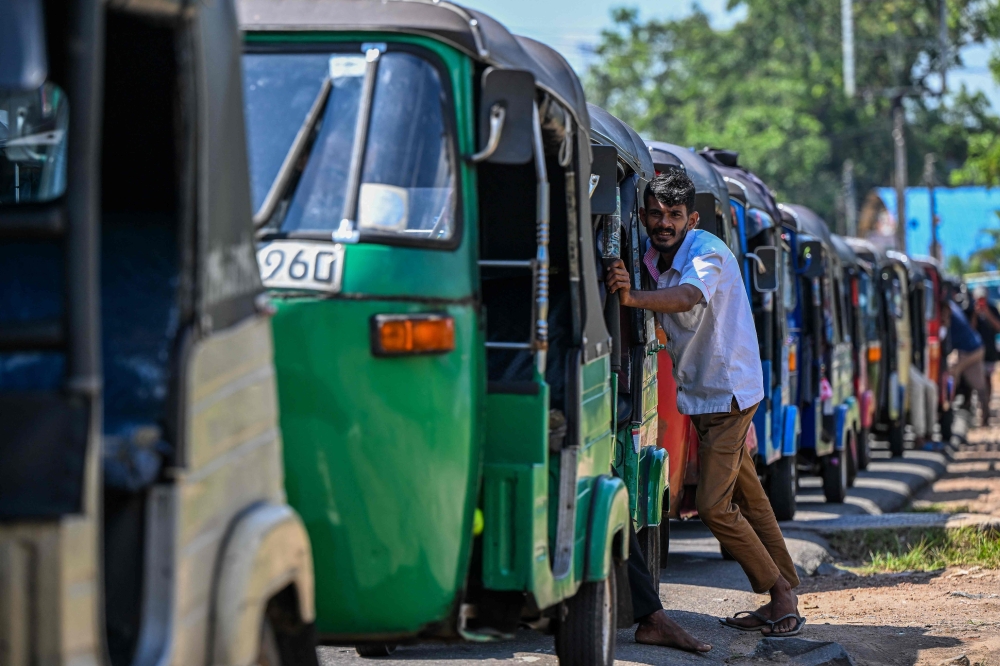
Drivers wait in a queue to refuel their auto rickshaws at a fuel station in Biyagama on the outskirts of Colombo on March 15, 2026. Sri Lanka is struggling to prevent a repeat of its spectacular economic collapse four years ago, as the prolonged Middle East war compounds the fallout from a deadly cyclone in November. — AFP pic
Religion, too, has long reminded humanity that fortitude and patience matter most when conditions are hardest. In a crisis of energy, food, fertilizer, and animal feed, fear of the unknown can become more destructive than the shock itself.
That is why the energy crisis now unfolding must be managed with a cool head.
The war in the Middle East is no longer a distant conflict for Asean. It has become an imported economic shock. Higher oil prices are feeding into transportation costs, electricity pricing, food production, fertilizer affordability, and shipping rates.
Even in the US, where political leaders often speak in the language of military resolve, the economic pressure is becoming harder to ignore.
Average gasoline prices have moved above US$4 per gallon nationally for the first time since 2022, reflecting how deeply the conflict has disrupted global energy markets.
That matters because energy inflation has a way of disciplining even the most expansionary geopolitical ambitions. When fuel prices rise sharply, domestic political tolerance narrows.
Economic pain moves from the abstract realm of strategy into the daily lives of households. What begins as a faraway war soon becomes a kitchen-table issue.
This is one reason any grand objective of total regime change in Iran now carries not only military risk, but also mounting economic and political costs for those pursuing it. That is an inference from the price data and the political pressure now visible in the US.
For Malaysia and Asean, however, the more urgent point is different. The region must not import the psychological instability of the war.
We must not allow fear to outrun facts. Malaysia is in a better position than many vulnerable economies because it still has more institutional capacity, more policy room, and more diversified external relationships than states already on the edge.
But that margin of safety can be eroded quickly if panic buying, policy inconsistency, and fragmented regional responses begin to dominate the scene.
Sri Lanka’s predicament is therefore a cautionary example, not a prophecy. It shows what happens when an external energy shock collides with pre-existing fragility. Asean need not repeat that path.
But to avoid it, member states must consult more closely, share assessments more honestly, and think of energy security as a regional challenge rather than a purely domestic one.
A coordinated Asean posture on fuel reserves, food logistics, fertilizer access, and shipping continuity would do far more to steady public expectations than any series of isolated national announcements. The public message matters too.
Governments must tell their people the truth: the crisis is serious, but it is manageable; the pressures are real, but they are not a reason for disorder; prices may remain elevated, but solidarity and preparation are better responses than alarm and speculation. Leadership in moments like this is not about sounding dramatic.
It is about sounding credible. Malaysia, in particular, should use its diplomatic weight to encourage calm across Asean.
That calm must be matched by foresight.
The region should reduce unnecessary exposure to supply shocks, expand intra-Asean coordination, strengthen social protection for the most vulnerable, and resist any rhetoric that turns temporary scarcity into permanent anxiety. In difficult times, public psychology becomes a strategic variable.
A frightened region makes poor decisions. A calm region buys itself time, flexibility, and room for collective action.
The deeper truth is this: civilizations are not tested only by war. They are tested by how they respond to the fear generated by war.
Panic rarely saves nations. It weakens them from within. Malaysia and Asean must therefore remain united, remain calm, and remain focused.
That is not weakness. That is wisdom. And in a time of energy shock and geopolitical uncertainty, wisdom may be the most valuable strategic resource of all.
When people panic, they lose the ability to share. They are seized by their need for self preservation. That’s extreme attitude will precipitate collective selfishness. Mass ego centricism is a weapons of mass destruction too.
* Phar Kim Beng is a professor of Asean Studies and director at the Institute of Internationalization and Asean Studies, International Islamic University of Malaysia
** This is the personal opinion of the writer or publication and does not necessarily represent the views of Malay Mail.