MARCH 17 — Recent comments by eminent economist Jeffrey Sachsm urging countries to reconsider hosting foreign military bases have sparked renewed debate on the strategic risks associated with foreign troop deployments.
Sachs argued that hosting such bases—especially those of the United States—could expose countries to retaliation during conflicts, pointing to the recent escalation in the Middle East where military facilities in several Gulf states were reportedly targeted amid hostilities involving Iran.
While his warning reflects the grim realities of the ongoing crisis in West Asia, the situation in Southeast Asia and the broader Indo-Pacific is markedly different.
In this region, American strategic thinking has evolved away from the Cold War model of large permanent bases toward a more flexible approach often described as “places, not bases.”
This distinction is crucial.
The Gulf lesson: bases as strategic targets
The Gulf Cooperation Council (GCC) states—including Bahrain, Qatar, Kuwait, Saudi Arabia, and the United Arab Emirates—host multiple American military installations.
These bases were originally established to deter aggression, ensure maritime security, and maintain energy stability in the Persian Gulf.
Yet the unfolding war between the United States, Israel, and Iran has demonstrated the inherent risks of such deployments.
According to Sachs, when countries host foreign military installations they effectively become extensions of the strategic competition between great powers.
In times of conflict, these bases transform from symbols of security into legitimate military targets in the eyes of adversaries.
This is precisely what has occurred in the current Gulf crisis.
Iranian retaliatory strikes and drone attacks have targeted facilities associated with American operations in the region.
Even countries that did not directly participate in the conflict found themselves exposed to the dangers of escalation.
In other words, the presence of large foreign military bases can create strategic vulnerability for host nations.
However, extrapolating this lesson directly to Southeast Asia would be misleading.
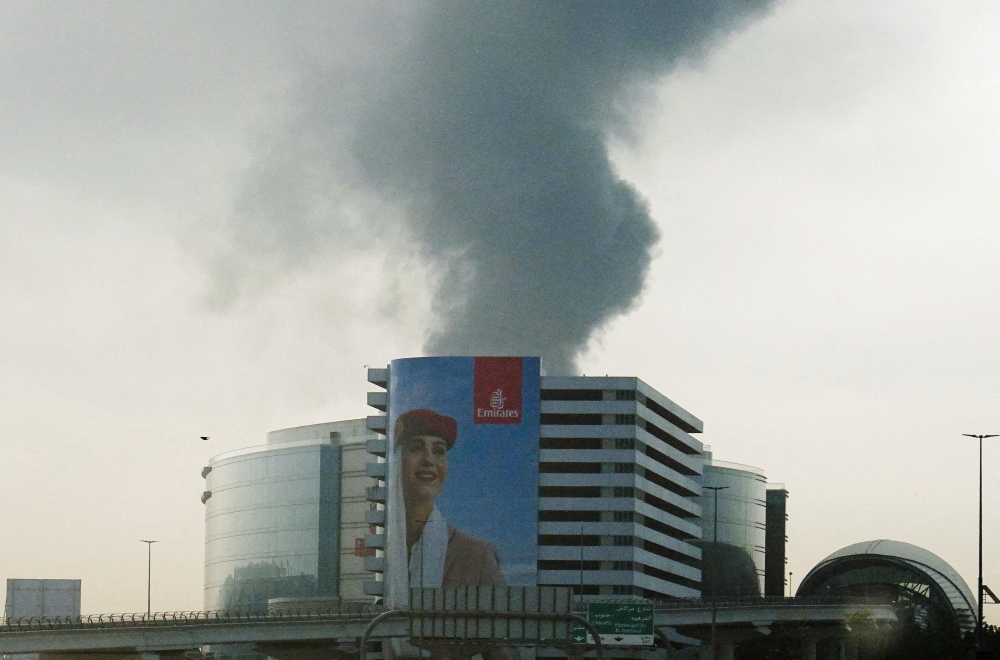
Smoke rises from an area near the Dubai International Airport, after a drone attack hit a fuel tank on March 16, 2026. — Reuters pic
The Indo-Pacific model: access without occupation
In the Indo-Pacific, the United States has increasingly adopted a different model of military presence.
Rather than constructing large permanent bases, Washington prefers rotational access agreements, logistics facilities, and security partnerships.
This approach—sometimes described as “places, not bases”—means that the United States seeks friendly access to ports, airfields, and training facilities without permanently stationing large numbers of troops.
Examples abound across the region.
In the Philippines, the Enhanced Defense Cooperation Agreement (EDCA) allows American forces rotational access to selected Philippine bases without transferring sovereignty.
In Singapore, the US Navy operates logistical facilities but does not maintain a full-scale base comparable to those in the Gulf or Japan.
Australia hosts rotational deployments of US Marines in Darwin rather than a permanent American garrison.
The logic behind this approach is strategic flexibility.
By dispersing forces across multiple locations rather than concentrating them in large installations, the United States reduces the risk of creating fixed targets while maintaining operational reach across the Indo-Pacific.
Island chains and strategic geography:
Another reason why the Indo-Pacific differs from the Middle East lies in geography.
American strategy in Asia revolves around what military planners describe as the first, second, and third island chains—a series of maritime arcs stretching from Japan and Taiwan down through Southeast Asia into the Western Pacific.
Rather than building massive bases along these chains, the United States focuses on ensuring that the surrounding countries remain friendly “places” where its forces can operate if necessary.
The objective is not occupation but access and partnership.
This strategy reflects a broader shift in US defence thinking after decades of experience in Iraq and Afghanistan. Large overseas bases have proven costly, politically sensitive, and vulnerable to attack.
Flexible partnerships, by contrast, provide strategic depth without the baggage of permanent military presence.
Asean delicate balance:
For Southeast Asia, this distinction matters greatly.
Asean countries have long pursued a policy of strategic autonomy.
While maintaining security ties with major powers—including the United States, China, Japan, and India—they remain cautious about hosting large foreign military installations.
The “places not bases” approach aligns well with this tradition.
It allows Asean states to cooperate with the United States on maritime security, disaster relief, counter-terrorism, and humanitarian assistance without appearing to join a formal military bloc.
Malaysia, for instance, does not host American bases.
Yet it continues to cooperate with the United States through joint exercises, intelligence exchanges, and naval engagements. The same is true for Indonesia and many other Southeast Asian states.
This approach preserves Asean centrality while avoiding the geopolitical tensions associated with permanent foreign bases.
Strategic competition without militarisation:
Critics often argue that the Indo-Pacific is becoming increasingly militarised due to intensifying rivalry between the United States and China.
While there is some truth to this claim, the reality is more nuanced.
Unlike the Cold War, when superpowers built sprawling military complexes across the world, the contemporary Indo-Pacific security architecture relies heavily on networked partnerships rather than fixed installations.
In this sense, Sachs’ warning about the risks of hosting foreign bases remains valid—but it applies primarily to regions where such bases still exist in large numbers.
The Gulf is one such region.
Southeast Asia, by contrast, has largely avoided this model.
Strategic prudence in a turbulent world:
The ongoing war in the Middle East underscores the dangers of geopolitical entanglement.
When conflicts erupt between major powers or regional rivals, countries hosting large foreign military facilities can quickly find themselves caught in the crossfire.
Yet the Indo-Pacific experience suggests an alternative.
Security cooperation does not necessarily require permanent bases.
Flexible arrangements, rotational deployments, and logistical access points can provide strategic deterrence while minimising political and military risks.
For Asean states seeking to navigate the intensifying competition between Washington and Beijing, this approach offers a workable middle path.
They can maintain constructive ties with the United States without transforming their territories into forward operating bases for great-power rivalry.
Conclusion:
Professor Jeffrey Sachs’ warning about the dangers of hosting foreign military bases deserves serious consideration, particularly in light of the ongoing conflict in the Gulf.
But the Indo-Pacific context reveals a more complex reality.
In this region, American strategy has already shifted toward a model based on places rather than bases—a network of partnerships, access agreements, and cooperative security arrangements.
For Southeast Asia, this framework preserves both sovereignty and strategic flexibility.
In an increasingly turbulent world, that balance may prove far more valuable than any permanent military installation.
* Phar Kim Beng is professor of Asean Studies and director of the Institute of International and Asean Studies, International Islamic University of Malaysia
** This is the personal opinion of the writer or publication and does not necessarily represent the views of Malay Mail.