MARCH 8 — UN Women had shared that in 1972, to mark its 25th anniversary, the Commission on the Status of Women (CSW) recommended that 1975 be designated International Women’s Year – an idea endorsed by the General Assembly to draw attention to women’s equality with men and to their contributions to development and peace.
The year was marked by holding the First World Conference on Women in Mexico City, followed by subsequent International Conferences on Women.
Two years later, in 1977, the United Nations officially recognised International Women’s Day, which first emerged from the activities of labour movements at the turn of the twentieth century in North America and across Europe.
Presently, International Women’s Day is celebrated on 8th March in many countries around the world, a day celebrating the achievements of women, sharing current challenges women face, engaging in discussions to find solutions, and inspiring more women to achieve further success.
Inspiration from UN Secretary-General Antonio Guterres’s recommendations of eight actions for a more equal world
On 2nd March 2026, Bernama had reported His Excellency’s remarks:
“Over nearly a decade leading the United Nations, I have seen our world repeatedly tested – by climate shocks, deepening poverty, violent conflict and shrinking civic space. But I have also watched many solutions take root, and they shared one common denominator: women.
“As the world marks International Women’s Day, it is time to recognise that gender inequality is the greatest human rights challenge of our time – and advancing equality is one of the strongest drivers of sustainable development and peace.
“Here are eight actions drawn from my own experience, and inspired by the work of the UN system and civil society movements across the globe, to advance women’s rights and deliver results.”
The eight actions listed by the Secretary-General included:
1. Fix the power gap
Gender equality is a question of power. But male-dominated institutions still shape our world. A rising tide of authoritarianism is deepening these inequalities, rolling back hard-won protections – from fair work practices to reproductive rights – and entrenching racial and gender biases that hold women back.
Gender equality lifts societies. When power is shared, freedom expands.
2. Make parity a priority
Women are grossly under-represented in governments and boardrooms across the globe. At the United Nations, we set out to make gender parity a priority, starting with senior leadership.
We did this by widening the search for qualified candidates, not by lowering standards.
The UN is stronger for it, with an enhanced workplace culture and more inclusive decision-making.
The lesson is clear. When institutions choose equality, results follow.
3. Bet on the highest-return investment
Investment in women delivers outsized returns. Every dollar spent on girls’ education yields nearly triple the gains, while maternal health and family planning generate more than eightfold benefits.
Policies that support families such as child care and elder care strengthen communities and unlock even more growth.
Taken together, such steps lay the foundation for closing gender gaps – which can boost national income by as much as 20 per cent.
4. Make room at the peace table
Peace agreements are more durable when women take part in negotiating and implementing them. Yet in too many conflicts – including Gaza, Ukraine, and Sudan – women have been largely shut out of the room, even though they carry the heaviest burdens of war.
At a time of rising instability, inclusion is not symbolic – it is a shortcut to stabilise our fractured world.
5. End legal discrimination
Worldwide, women hold only 64 per cent of the legal rights enjoyed by men. In too many places, they cannot own property, work freely, or seek a divorce.
Even where protections exist, women face higher barriers to access legal aid or the courts.
Every country must commit to dismantling discriminatory laws, and to enforcing rights in practice.
6. Zero tolerance for gender-based violence – and zero excuses
Violence against women is a global emergency, rooted in inequality and sustained by silence. Every woman and girl has the right to live free from fear.
Yet gender-based violence – including sexual exploitation and abuse – remains a horrific breach of trust and humanity. We must confront it everywhere, with zero tolerance, full accountability, and unwavering support for survivors.
7. Code out bias
With women comprising just one in four tech workers, bias is being hardwired into the systems that shape daily lives. Meanwhile, misogyny is exploding online.
Technology companies and governments must act together to build safe, inclusive digital spaces – and the world must do more to remove barriers for girls in science and technology.
8. Put gender in the climate plan
Climate change is sexist. Women often eat last in food crises and endure greater danger in emergencies. Girls face higher risks of child marriage when livelihoods collapse.
But women are also leading climate solutions – advancing green legislation, powering global movements, and driving change on the ground.
A liveable planet demands gender-responsive climate policies, including equal access to green jobs, better protection in emergencies, and full participation in environmental decision-making.
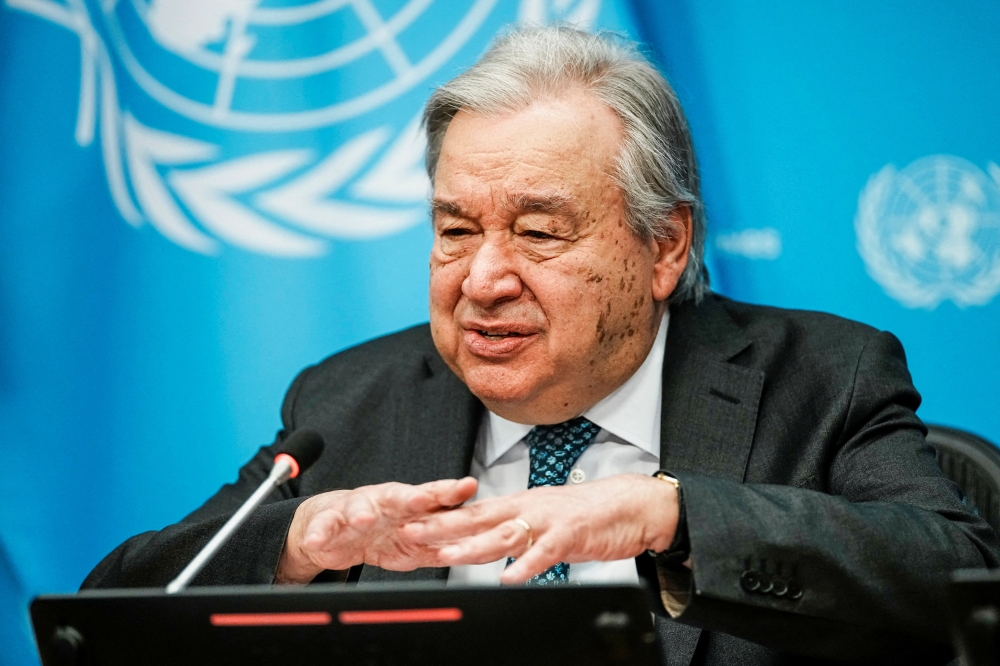
UN Secretary-General Antonio Guterres highlights gender equality as the strongest driver of sustainable development and peace on International Women’s Day. — Reuters pic
And His Excellency concluded his remark:
“Across the globe, I have seen these eight solutions in action – in war zones and recovery efforts, parliaments and classrooms, organisations and communities. If leaders get serious about gender equality and commit to them now, we will change the world – for women and girls, and for us all.”
Recommendations to the government of Malaysia and Philippines
Arising from the eight actions highlighted by UN Secretary-General Antonio Guterres above, I am inspired to offer the following recommendations on three of the action plans outlined by His Excellency for the attention, consideration, and support of the government of Malaysia for adoption and implementation for the benefit of women in Malaysia.
1. Put gender in the climate plan
Malaysia has and continues to experience severe weather conditions caused by climate change, creating havoc, chaos, destruction to lives, livelihoods, infrastructure, society, and nations.
Presently, much of policy, decision-making, and planning is primarily being organised and determined by men, whilst women and children suffer significantly from the impact of these disasters.
During COP28, world leaders, government, and policy makers had signed a number of declarations and pledges aimed at achieving the Paris Agreement target of not reaching more than 1.5 degrees Celsius by 2050 – covering everything from oil-and-gas company emissions and tripling renewables, tripling nuclear capacity through to food systems, and how the world can better integrate action on climate change and biodiversity loss.
In view of and recognition of the contribution and role of women in these initiatives, there was an initiative themed COP28 Gender-Responsive Just Transitions and Climate Action Partnership, which outlined the fundamental pledge by ministers and government officials covering:
“We, ministers and government officials, declare our resolve as we implement the Paris Agreement to drive gender-responsive just transitions, which strengthen all women’s and girls’ leadership and meaningful participation, decision making, capacities, and livelihoods in climate action to achieve gender equality and support the sustainable and transformational impacts of our adaptation, mitigation, and finance efforts.”
This is listed in full via this link.
Below are the contents for clarity covering: Building on progress in this regard in this year (2023) of the Global Stocktake, Women’s and girls’ full, equal and meaningful participation and leadership, Nexus of Gender Equality and Just Transitions, Advancing a “Gender-Responsive Just” Transition, and signatories to this pledge.
Building on progress in this regard in this year of the Global Stocktake, we:
1. Reaffirm the relevant outcomes of previous Conferences of the Parties (COP) to the United Nations Framework Convention on Climate Change, serving as the meeting of the Parties to the Paris Agreement and the enhanced Lima Work Program on Gender and its Gender Action Plan.
2. Reaffirm, as applicable, the Beijing Declaration and Platform for Action and the outcome documents of its reviews.
3. Reaffirm the 2030 Agenda for Sustainable Development, including the fifth goal on achieving gender equality and empowering all women and girls.
4. Reaffirm, as applicable, commitments to gender equality and the empowerment of all women and girls made at relevant United Nations summits and conferences, including the International Conference on Population and Development and its Programme of Action and the outcome documents of its reviews.
5. Welcome, as applicable, the agreed conclusions of the 66th Session of the Commission on the Status of Women, on achieving gender equality and the empowerment of women in the context of climate change, energy transitions, environmental and disaster risk reduction policies and programmes.
6. Welcome the Intergovernmental Panel on Climate Change’s Synthesis Report of the 6th Assessment Report, which recognises that vulnerabilities and climate risks can be reduced through carefully designed policies and laws that address specific inequities such as those based on gender.
Women’s and girls’ full, equal and meaningful participation and leadership
7. Acknowledge the significant contributions and roles of all women and girls in decision-making, governance and finance for climate action, including the clean energy transition.
8. Emphasise that achieving gender equality and women’s empowerment, including for women and girls facing intersecting inequalities, such as Indigenous women and girls, rural women and girls, and women and girls with disabilities, accelerates the implementation of the Paris Agreement.
Nexus of Gender Equality and Just Transitions
9. Recognise the disproportionate impacts of climate change on all women and girls, including as they relate to access to and the creation of decent work in the context of just transitions and as these effects relate to exacerbating inequalities.
10. Emphasise that where women have secure land rights that are legally recognised and enforceable, they are better able to use and benefit from the lands and resources and meaningfully participate in sustainable agriculture and land restoration efforts, with strong climate adaptation and mitigation benefits.
11. Take into account the climate-linked sectors in which women are often employed, including, but not limited to, agriculture, fisheries, tourism, the care economy, and the garment industry, and recognise that access to resources, services, education and training in climate-smart practices in these and other sectors, such as clean energy, is critical to both women’s economic security and just and inclusive transitions to decent work and sustainable, climate-adaptive livelihoods and effective climate action.
12. Express concern that climate change is exacerbating existing inequalities, as well as gender-based violence, and barriers to accessing critical services that underpin access to decent work, including, but not limited to, education, food, clean water and sanitation, health services including sexual and reproductive health, education, emergency response, and a healthy environment, and stress the need to strengthen and expand access to gender-responsive social protection systems.
Advancing a ‘Gender-Responsive Just’ transition
13. Recognising that urgent action is needed to combat climate change, we commit to working collaboratively to support just and inclusive transitions that advance gender equality and the goals of the enhanced Lima Work Program on Gender and its Gender Action Plan. To that end we will strengthen efforts to:
- Fully incorporate the human rights of women and girls in just transition efforts, including through social dialogue and working with decision makers and with men and boys, to promote gender-responsive investments in climate action that provide for the full, equal and meaningful participation and leadership of all women and girls.
- Encourage gender-responsive strategies on mitigation and adaptation, in line with national, regional, and international instruments, to strengthen the resilience to the adverse effects of climate change, with the aim of protecting, respecting and promoting human rights, economic empowerment, access to decent work and education, sustainable livelihoods and gender-responsive and disability-inclusive social protection systems that facilitate livelihoods transitions.
- Implement, as appropriate, gender-responsive budgeting, policy and planning, and develop legislation and policy, as well as promote skills training, including in informal sectors, and equal opportunities in job markets.
- Identify funding sources and opportunities with a view to continuing to enhance access to funding for women and girls in the regions most impacted by climate change, and with a view to promote gender-responsive, inclusive, locally led climate action, and improve tracking and reporting on gender-related aspects of climate finance, impact measurement and mainstreaming.
- Share experiences and best practices on gender-responsive planning and budgeting in the context of a just transition and conduct studies on gender-responsive just transitions in respective national contexts.
- Encourage and support the development of evidence-based methodologies, including sex, disability, and age-disaggregated data and standard indicators, to assess gender equality in the transition to a Paris Agreement-aligned economy.
- Pursue efforts and collaboration across sectors and in partnership with women’s organisations to ensure that they counteract any potential negative consequences and benefit from the transition to a Paris Agreement-aligned economy, including expanding access to gender-responsive social protection, and to support efforts towards the eradication of poverty in the transition.
- Promote measures to reduce, redistribute and value unpaid care and domestic work, including by promoting the equal sharing of responsibilities between women and men within the household.
- Make best efforts to reflect progress on gender equality in Biennial Transparency Reports, as appropriate.
- Reconvene for a dialogue at the 31st UN Climate Change Conference to report on the implementation of these commitments.
The above pledge serves as a strategic fundamental platform to enhance women’s participation in the Climate Action Plan.
However, currently only 82 countries are signatories to this pledge:
- Albania
- Andorra
- Antigua and Barbuda
- Australia
- Austria
- Azerbaijan
- Bangladesh
- Belgium
- Burkina Faso
- Cabo Verde
- Canada
- Chad
- Chile
- China
- Colombia
- Comoros
- Cook Islands
- Costa Rica
- Cote d’Ivoire
- Cyprus
- Czechia
- Democratic Republic of the Congo
- Denmark
- Dominican Republic
- Ecuador
- Estonia
- Fiji
- Finland
- France
- Germany
- Guatemala
- Hungary
- Iceland
- Ireland
- Israel
- Jamaica
- Japan
- Jordan
- Kiribati
- Kyrgyzstan
- Latvia
- Lebanon
- Lesotho
- Mali
- Mexico
- Micronesia
- Moldova
- Monaco
- Mongolia
- Morocco
- Netherlands
- New Zealand
- Nicaragua
- Nigeria
- North Macedonia
- Norway
- Pakistan
- Palau
- Paraguay
- Peru
- Poland
- Portugal
- Rwanda
- Saint Vincent and the Grenadines
- Serbia
- Seychelles
- Sierra Leone
- Slovenia
- Somalia
- Spain
- Sri Lanka
- Sweden
- Switzerland
- Tuvalu
- UAE
- Ukraine
- United Kingdom
- United States of America
- Uruguay
- Venezuela
- Vietnam
- Yemen
Vietnam is the only Asean member country signatory to this pledge key for putting gender in the climate plan via advancing a “gender-responsive just” transition.
A. Recommendation to the government of Malaysia
In view that this requires support, commitment, and action from several ministries in Malaysia, including Ministry of Women headed by Datuk Seri Nancy Shukri responsible for women, Ministry of Natural Resources and Environment (NRE) headed by Datuk Seri Arthur Joseph Kurup responsible for climate, and Ministry of Energy Transition and Water Transformation (Petra) Datuk Amar Fadillah Yusof responsible for energy transition, I look forward to Datuk Seri Anwar Ibrahim encouraging these three ministries to review the contents of this pledge and to determine which ministry should take the lead for Malaysia to be a new signatory to the pledge, to facilitate and support women having the opportunity to advance green legislation, power global movements, and drive change on the ground, whilst also having equal access to green jobs, better protection in emergencies, and full participation in environmental decision-making.
B. Recommendation to the government of Philippines
I had the honour and pleasure to meet the Secretary of Energy Philippines, Her Excellency Sharon Garin, at the recent Singapore International Energy Week 2025 (SIEW2025), where Her Excellency had offered her views and insights on energy at this prestigious event.
As the Philippines is Chair of Asean this year 2026, I would like to propose to Her Excellency Sharon Garin that, as a distinguished female energy leader, she could approach other remaining Asean member countries which have not signed this pledge to support signing the pledge, and for Philippines, during the Asean Energy Ministers Meeting this year, to set aside a special session for all Asean leaders to sign the pledge and officially announce that all Asean member countries are signing this pledge, and briefly share the benefits to and for women, which ultimately impacts our nations and our region.
* This is the personal opinion of the writer or publication and does not necessarily represent the views of Malay Mail.