FEBRUARY 13 — On February 2, Japan marked a significant historic milestone in resource security when rare-earth elements (REE)-rich sediment was successfully retrieved from a staggering depth of 6,000 meters undersea around Minamitori Island, within Japan’s Exclusive Economic Zone (EEZ).
Although this is only a pilot-scale success, it represents a significant technological breakthrough that may fundamentally challenge the global monopoly on critical minerals.
The technical superiority of seabed REE deposits lies in their mineralogical accessibility and naturally high concentration ratio of Heavy Rare Earth Elements (HREEs) to overall REE.
Unlike terrestrial “hard rock” ores, which require energy-intensive mechanical crushing and grinding, followed by complex chemical cracking to free elements from a strongly bonded crystalline lattice, HREE in subsea predominantly adsorbed onto the surfaces of minerals such as phillipsite.
Weak chemical bonding in these minerals allows more efficient extraction without using a large amount of strong acid, high-temperature calcination, and the massive volumes of radioactive tailings, specifically thorium and uranium.
However, Industrial-scale harvesting of the REE from the seabed introduces a complex “sustainability paradox”: the minerals are in some of the planet’s most fragile and least-understood ecosystems.
But if we never explore, we will never know.
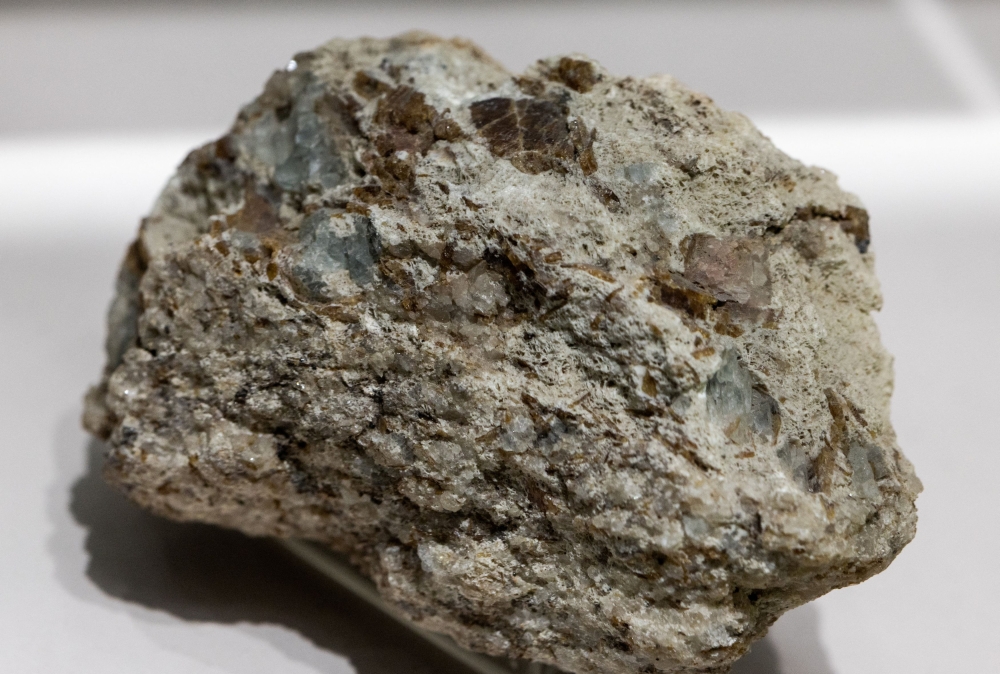
A sample of bastnaesite ore, a mineral used in the rare earth industry to extract elements such as cerium, lanthanum, and neodymium, is displayed at the Geological Museum of China in Beijing, China, October 14, 2025. — Reuters pic
Beyond the mechanical risks of equipment failure deep below sea level, the primary environmental concerns lies on the generation of sediment plumes during operation. When subsea collectors moving at the seabed, clouds of fine, nutrient-rich particles are spurred into the water column and travel thousands of kilometers via deep-sea currents, potentially smothering filter-feeding aquatic organisms and disrupting the visual foraging of abyssal predators.
In addition, the removal of the top sediment layer, which has accumulated over millions of years, threatens to cause irreversible habitat damage for sessile benthic communities. Trace elements from agitation may enter the marine food web that eventually impacts commercial fisheries.
Crucially, these environmental and operational risks are no longer blind gambles; the dispersion of the sediment plumes, flow characterisation of air-lift pump, and etc, can be simulated with high precision, thanks to the sophisticated numerical simulation frameworks pioneered by Japanese academic institutions.
Despite the technological optimism, seabed mining remains one of the most contentious frontiers in modern environmental and legal discourse. A significant point of controversy is the absence of regulatory surrounding activities within national waters; no specific international law or standardized global code that dictates how a sovereign state must conduct mining within its Exclusive Economic Zone (EEZ).
Under UNCLOS (United Nations Convention on the Law of the Sea), nations can explore and exploit subsea minerals, but they are left to develop their own domestic frameworks in a fragmented landscape.
Malaysia is a country with a vast maritime territory and a strategic interest in the rare-earth value chain. The achievement of Japan raises a pivotal question: should we take the initiative to collaborate with Japan?
Ultimately, Malaysia is not starting from zero: we possess a formidable technical foundation that makes us a natural partner for Japan’s subsea ambitions. Our existing rare earth refining ecosystem also provides the midstream expertise that Japan desperately needs to turn raw mud into high-purity oxides economically.
Malaysia also has decades of experience in shallow offshore engineering. Of course, the operation of seabed mining is hundreds of times higher pressure, a different class, but look at it positively, it may be one of the best opportunities for Malaysia to venture into deep-sea technologies.
With Japan being the world leader in the “upstream” vacuum and riser technology, this technological breakthrough offers a prime opportunity for Malaysia to transform from traditional manufacturing toward maritime technology. In the current geopolitical climate, great powers are competing intensively over critical mineral supply chains. Japan requires a trusted regional partner with a solid maritime footprint to diversify and secure the REE supply chain.
Malaysia-Japan partnership represents a stabilizing middle-ground.
For Malaysia, collaborating with Japan on subsea REE extraction isn’t just limited to harvesting the resource, but more importantly, developing deep ocean engineering talent and technology, and strategically, securing an anchoring role in the Indo-Pacific’s blue economy, especially sustainable exploitation of ocean resources.
Although REE extraction from ores and clays is well-established, the extraction of REE from mud has only been carried out in laboratory scale. Obviously, if Malaysia collaborates with Japan on the processing and extraction of HREE from these muds, that will further elevate the REE extraction technology in Malaysia.
One point to note, while regional neighbours like Vietnam and Indonesia also possess significant terrestrial REE reserves, their deposits are often characterized by a relatively low ratio of HREEs. If every country insists on processing its REE domestically, the processing efficiency and responsibilities in environmental sustainability will make the industry fall behind industrial scale globally.
Hence, this bilateral synergy between Malaysia and Japan could lead to the establishment of an Asean REE Processing Alliance. Asean countries with REE mines, such as Vietnam, Malaysia, and Indonesia, shall allow a degree of freedom for REE flow within the region.
By specializing in the extraction and processing of HREE-rich seabed muds in partnership with Japan, Malaysia can strategically position itself as the specialized HREE processing hub for Southeast Asia, while Indonesia and Vietnam concentrate on the high-volume Light Rare Earth (LREE) market.
This approach would generate the industrial scale necessary to compete globally. In addition, it also reduces the environmental impact for each country.
In conclusion, Malaysia already possesses the technical foundation rooted in our existing midstream refining infrastructure. If we are to move into higher value-added industries, we must embrace this partnership for sustainable development. By taking a leading role in collaborating with Japan today, Malaysia can initiate the definitive roadmap for an Asean REE processing hub. This is our opportunity in securing industrial sovereignty of Malaysia and economic prosperity for generations to come.
* Phar Kim Beng is a professor of Asean Studies and director of the Institute of International and Asean Studies, International Islamic University of Malaysia.
** This is the personal opinion of the writer or publication and does not necessarily represent the views of Malay Mail.