

MARCH 2 — Yesterday the world marked World Seagrass Day, a day set aside to recognise one of the planet’s most productive yet frequently overlooked ecosystems.
For Malaysia, that recognition brings us closer to home, to Johor, where some of the country’s most remarkable seagrass landscapes quietly flourish.
At first impression, seagrass meadows are unassuming. There are no dramatic coral formations or sudden flashes of colour.
But if you slow your breathing and let your eyes adjust, the scene begins to unfold. Juvenile fish dart between blades. Shrimps reshape the sand. Pipefish drift in pairs, almost invisible until they move. What at first glance seems still reveals itself to be intricate and alive.
Johor stands apart in Malaysia for the scale and diversity of its seagrass ecosystems.
Off Pulau Sibu lies a continuous subtidal meadow covering nearly 13 square kilometres, the largest documented seagrass meadow in the country.
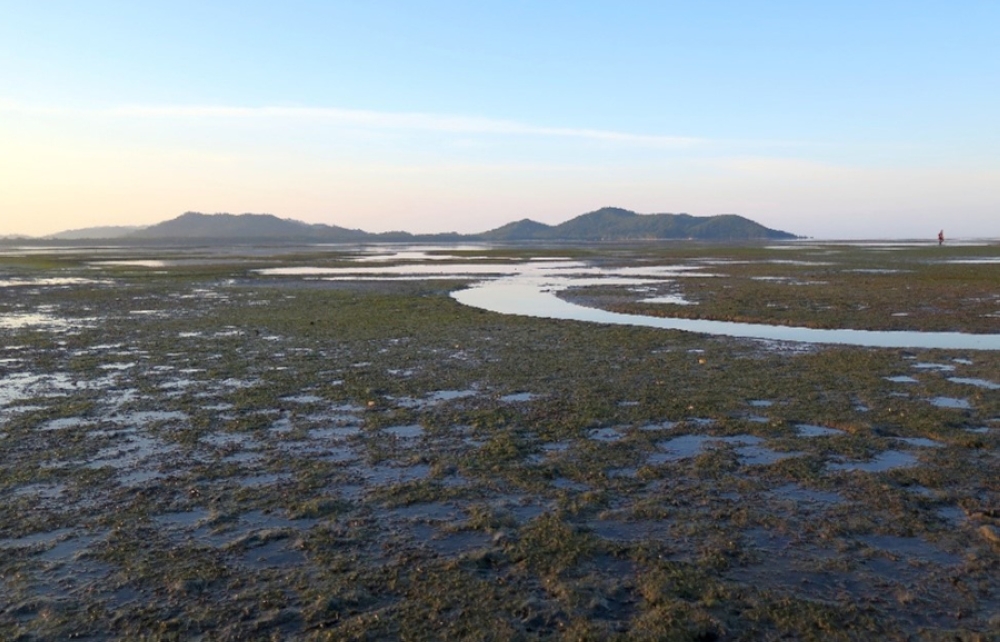
Intertidal seagrass meadow of Pulau Setindan, Johor. — Picture courtesy of Jillian Ooi
Spanning the Sibu-Tinggi and Besar islands, the Mersing coastline and the Tebrau Strait, these seagrass landscapes collectively form the greatest recorded extent in Peninsular Malaysia based on verified mapping.
This is not a scattering of small patches. It is a substantial coastal system that works hard — and one that forms an integral part of Johor’s maritime character.
In surveys conducted in Johor’s east coast island meadows, more than 1,100 individual fishes representing 86 taxa were recorded within a modest sampling area.
Many belonged to groups familiar to anyone who frequents a seafood market: emperors, goatfishes, threadfin breams and rabbitfishes.
Fish density and diversity increased where seagrass cover was higher. Where seagrass thrives, fish populations respond.
These meadows support more than fisheries; they are also among the feeding grounds of dugongs and green turtles that move through Johor’s coastal waters.
What may look like simple grass beneath the surface is, in reality, a foundation for fisheries, marine wildlife and coastal communities alike.
Down south, at the mouth of Sungai Johor where river meets sea, seagrass meadows trace the estuarine shoreline.
Cast nets rise and fall in practiced arcs. Each cast reflects knowledge shaped over years, handed down across generations who have learned where life gathers, and their nets fall where seagrass grows.
Artisanal fishing was visible in almost every meadow encountered, with fishers travelling considerable distances to reach these grounds, their repeated return a quiet measure of the habitat’s productivity.
The activity does not stop with boats. At low tide, parts of these same meadows become gathering grounds for families.
In some communities, more than half of observed gleaners were women, moving steadily across the flats in search of fish, crabs, sea cucumbers and shellfish.
Some collect to supplement household food supplies. Others come because it is what they have always done, alongside parents and grandparents before them.
Children learn to read the tide, to recognise subtle movements beneath shallow water, to distinguish edible from inedible. In these moments, seagrass is not a scientific term. It is dinner, knowledge, memory and belonging.
Yet these systems are not immune to pressure. In parts of Sungai Johor, nutrient runoff has fuelled algal growth that blankets the seabed and weakens the seagrass beneath.
In Mersing, once-dense meadows have thinned, smothered by sand loads that bury shoots faster than they can grow upward. When light is reduced or sediment becomes unstable, the meadow begins to unravel.
The consequences ripple outward to fish nurseries, gleaning grounds and the coastal communities tied to them.
For all its scale, Johor’s seagrass landscape does not guarantee security. In some areas, local communities speak quietly of meadows that have contracted over the past decade.
Safeguarding these ecosystems will require clear policies that prevent direct habitat loss and sustained efforts to improve coastal water quality.
Embedding seagrass protection within state planning would reflect the long-term thinking that has shaped Johor’s development in other sectors.
Giving seagrass the same policy attention as other natural resources would acknowledge its role in Johor’s future. Leadership here requires steady commitment.
World Seagrass Day invites us to notice what we often overlook. In Malaysia, that invitation naturally leads to Johor.
Its underwater meadows have long supported fisheries, fed families and shaped coastal knowledge across generations. Seeing them clearly is only the first step. Ensuring that they endure is the responsibility that follows.
* Associate Professor Dr Jillian Ooi is a marine scientist at Universiti Malaya and a Pew Fellow in Marine Conservation focusing on seagrass ecology and coastal conservation in Malaysia, and can be reached at [email protected]
** This is the personal opinion of the writer or publication and does not necessarily represent the views of Malay Mail.


