

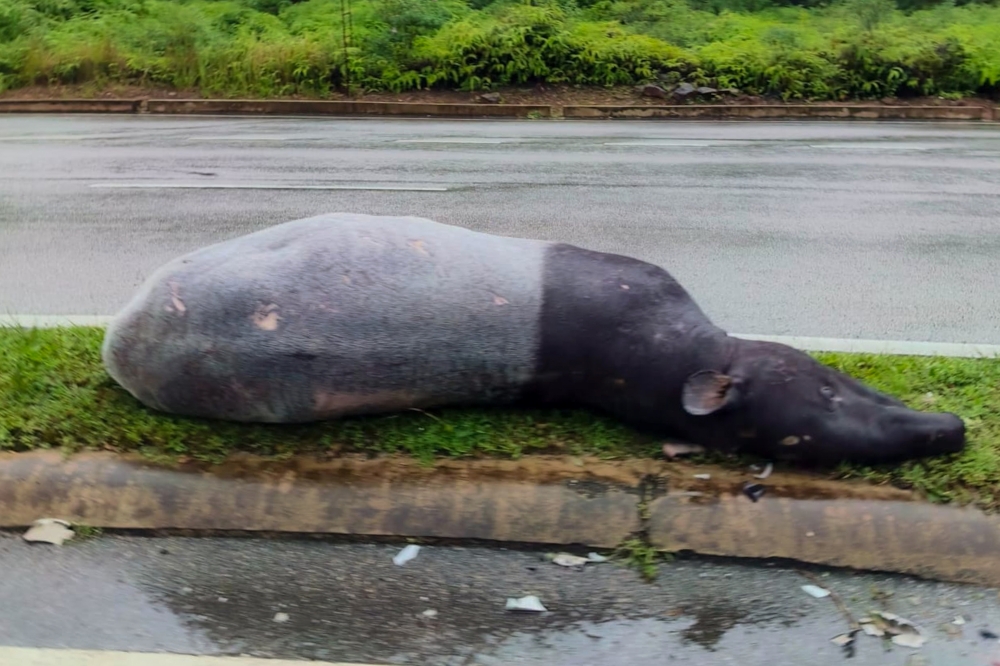
KUALA LUMPUR, April 4 — The Malayan tapir is one of Malaysia’s most recognisable forest animals — and one of its most vulnerable.
With its distinctive black-and-white colouring and solitary nature, the tapir moves through dense rainforest in search of food, water and space.
But as highways expand into forested areas, those same movements are increasingly bringing tapirs into deadly encounters with traffic.
Unlike threats that often occur deep within protected areas, roadkill is sudden and difficult to ignore — a single collision can be fatal and for a species with an already small population, each loss carries weight.
In recent years, tapir roadkill has emerged as a recurring issue across multiple states, particularly in areas where highways cut through or sit near forest reserves.
In Johor, for instance, two tapirs were recently found dead along a road linked to the Sedili–Desaru corridor, based on footage circulated on TikTok on March 20.
While the exact cause has not been officially confirmed, the incident reflects a wider and well-documented pattern of wildlife mortality linked to roads intersecting natural habitats.
These incidents also expose a deeper issue — what legal protections actually exist when wildlife deaths are caused not by poaching, but by infrastructure?
What the law covers
The law prohibits hunting, killing, capturing and trading the species, with heavy fines and possible jail terms — but its focus is largely on poaching and illegal wildlife trade.
However, the law does not address unintentional deaths caused by infrastructure.
Under the Wildlife Conservation Act 2010 [Act 716], there are no specific provisions for accidental killing of protected wildlife by vehicles; mandatory wildlife crossings such as eco-viaducts or underpasses; enforceable speed limits in wildlife corridors; and required mitigation after repeated roadkill incidents.
In most cases, collisions involving wildlife are treated as accidents rather than offences, unless negligence can be proven.
A gap between protection and planning
That said, some mitigation efforts do exist and led by agencies such as the Department of Wildlife and National Parks Peninsular Malaysia (Perhilitan).
Perhilitan has previously noted that roadkill is closely linked to habitat fragmentation, as animals are forced to cross roads to access food and mates, but conservation groups say more needs to be done.
WWF Malaysia has in previous reports called for stronger and more immediate measures, warning that existing efforts are not enough.
“We need more than just warnings. We need wildlife viaducts and underpasses… speed bumps and traffic-calming infrastructure,” it said.
The group also reportedly stressed that highways cutting through forest reserves create a “dangerous intersection between human development and wild territory.”
Ongoing calls have been made by the organisation, urging the authorities to implement wildlife crossings in key habitats, stricter speed controls in wildlife corridors and better driver awareness and enforcement.
Why each loss counts
Tapirs play a crucial ecological role as seed dispersers, helping regenerate forests and maintaining biodiversity.
By moving across large areas and depositing seeds, they support the growth of diverse plant species that sustain entire ecosystems.
This function is especially important in countries like Malaysia for maintaining the health of tropical rainforests.
However, this same need for wide-ranging habitats makes tapirs vulnerable when forests are fragmented by highways.
A growing and visible threat
Roadkill has become one of the main threats to tapirs in Malaysia as more than 100 tapirs were killed on Malaysian roads between 2020 and 2024.
As of 2025, the size of the wild population is estimated to be just around 700 to 800.
This means roadkill alone is taking a significant toll on an already small population.
Recent incidents suggest the problem is ongoing.
So what if Malaysia loses one tapir?
Losing tapirs is not just about one species.
As a key seed disperser, their decline can slow down forest regeneration, reduce plant diversity and disrupt wider ecosystems over time.
Each roadkill incident is more than a traffic accident — it is part of a gradual erosion of Malaysia’s rainforest systems.
While the endangered species are covered under the Wildlife Conservation Act 2010, it does not directly protect roadkills.
The bigger issue
The contradiction is clear: While Malaysia protects the species, it does not fully protect the spaces it depends on to survive.
These roadkill incidents point to a deeper policy gap — conservation laws address illegal harm, but not the systemic risks created by development.


