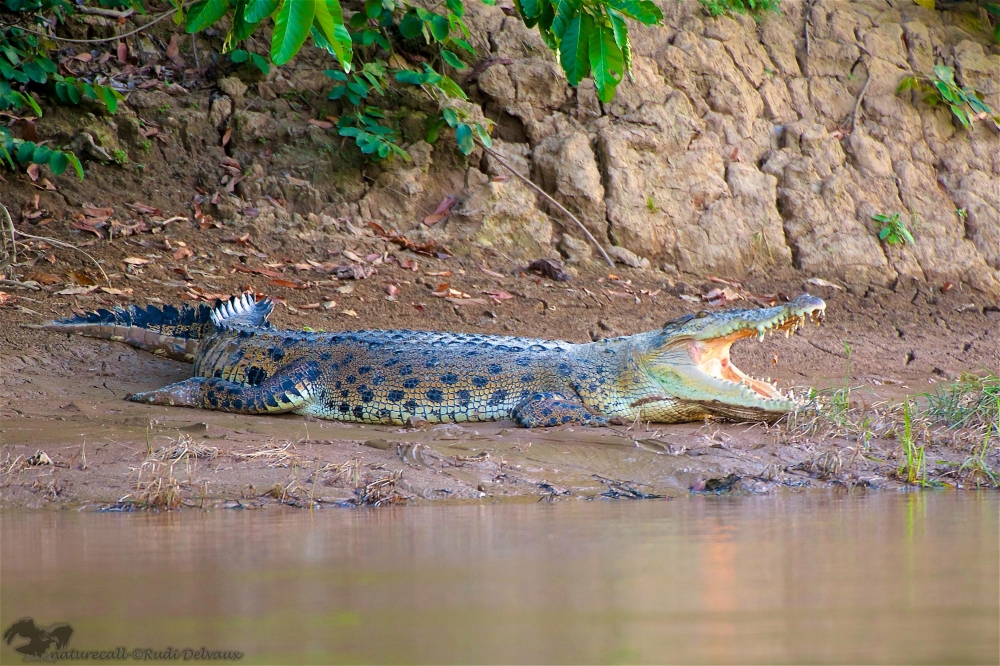
KOTA KINABALU, Feb 28 — Increased crocodile sightings in urban areas across Sabah, including Kota Kinabalu, do not indicate a growing population, but rather natural dispersal driven by habitat changes and food scarcity, says crocodile expert Sai Kerisha Kntayya.
Sai Kerisha, a PhD researcher at the Danau Girang Field Centre(DGFC), said saltwater crocodiles have always existed in Sabah’s rivers and coastal areas, but are now being seen more frequently in drains, lakes and urban waterways.
“This is actually very normal. Crocodiles have always been here but have largely been dwelling in rural areas away from human territory. What we are seeing now is dispersal — individual crocodiles moving around to find food and new territory,” she said when speaking to Malay Mail.
According to Sai Kerisha, the reason for the dispersal is the degradation of their natural habitat and reduced availability of natural prey such as fish, deer and proboscis monkeys are pushing crocodiles closer to human settlements.
Much of their natural habitats are being disrupted by development and human settlements as they may share the same river resources.
“When they can’t find enough food, they move. Some end up near rubbish dumps, fish markets, or residential areas where dogs, cats and waste become attractants,” she said.
She added that large male crocodiles — typically over four metres — are more territorial and more likely to attack, while smaller crocodiles found in drains after floods are usually transient.
In coastal areas such as Tanjung Aru and Likas Bay, Sai Kerisha said sightings of saltwater crocodiles are not common but can be expected.
“They don’t live in the sea, but they use it as a highway to move between rivers, find food and mates when they are spotted. They usually won’t stay unless there’s a river or lagoon nearby,” she said adding that they are not naturally a threat.
She cited littering and fish waste as key factors drawing crocodiles into urban spaces, including Pulau Gaya.
“They hang around where there is rubbish. If the area stays clean, they usually move on within a few days.”
She explained that sightings do not equate to population growth, noting that surveys conducted along the Kinabatangan River in 2010, 2017 and 2019 showed no significant increase.
She estimates roughly about 3,000 crocodiles in the state which is in line with another study between 2007 and 2020 covering 10 rivers which estimates around 2,886 crocodiles across the state.
The largest river in Sabah, the Kinabatangan river has the highest number of crocodiles.
“In 2017, we counted about 420 crocodiles in Lower Kinabatangan. Based on that, the total population in Kinabatangan could be roughly double, but overall there is definitely no indication of a population boom,” she said.
Places like Mengkabong in Tuaran, which has recently had several crocodile sightings may have up to five as crocodiles are territorial species and will not tolerate many same species in close proximity.
“People say there are hundreds — that’s simply not true. Usually it’s four or five individuals who are circling their territory,” she said.
The Sabah Wildlife Department data showed 404 reports of crocodile attacks between 2019 and 2024, with 21 crocodiles shot during that period. The current practice seems to be “removal” of presumed threats in highly public areas.
However, scientists like her and DGFC director Benoit Goossens cautioned against relying on culling as a solution.
“There are thousands of crocodiles around. Removing one doesn’t make it safer — it only creates a false sense of security. Another will take its place,” he said.
In places like Australia, which has an estimated 400,000 to 500,000 crocodiles — the biggest population in the world and far more than Malaysia — but yet comparatively fewer attacks relative to population size due to strong public awareness and compliance.
“The attack rates in Sabah are higher – perhaps hundreds in the last 20 years – which we can likely attribute to the lack of awareness here.
“People are aware of the risk of crocodiles – they have been living in the waters longer than the people there – but they insist on getting in the water – the compliance level is low,” he said.
Goossens denies that the people’s “river culture” should be the excuse, saying that change was possible and necessary.
“The issue here is the overlap between wildlife and humans, but we can change and adapt. We are not asking the people to stop fishing, but perhaps just change the way they fish,” he said.
“Shooting or killing them is not a feasible solution. If elephants damage crops, do we cull them all? We must change behaviour, not expect wildlife to disappear for humans,” he said.
The two acknowledged tourism concerns but said informed management — signage, monitoring, lifeguards, temporary beach closures — are far more effective than reactive shooting.
Wildlife attractions are a major part of Sabah’s tourism and should be encouraged across all areas, not just in rural areas.
“Culling crocodiles just because they show up in urban areas is not a good look for Sabah’s eco tourism image.
“Sabahans have a real opportunity to do well with wildlife conservation. Crocodiles have been in our rivers longer than people. We need to learn how to live with them,” she said.