

MARCH 9 — The United States is projected to produce nearly 13.6 million barrels of crude oil per day in 2026, according to the US Energy Information Administration.
This makes the United States the largest oil producer in the world, far ahead of Saudi Arabia, which produces roughly 9.87 million barrels per day according to the International Energy Agency.
At first glance, this extraordinary level of American production might suggest that the United States is largely insulated from energy shocks.
With domestic supply reaching historic levels, it is tempting to assume that Washington has achieved a degree of energy security that shields its economy from geopolitical disruptions.
Yet the reality is far more complex.
Neither the United States nor the rest of the world is immune to oil shocks and the global inflation that inevitably follows.
The structure of the international energy market ensures that disruptions in one region quickly reverberate across the global economy.
Oil remains one of the most globally integrated commodities in existence.
Unlike many other goods, crude oil is traded across continents through a tightly interconnected system of shipping lanes, futures markets, and international benchmarks such as Brent and West Texas Intermediate. Prices are therefore determined by global supply and demand, not by the production levels of any single country.
Recent developments in the Middle East underscore this reality.
Following the US-Israel strikes on Iran, Tehran responded by effectively restricting shipping traffic through the Strait of Hormuz, one of the most important energy chokepoints in the world.
Roughly 20 per cent of global oil demand passes through this narrow maritime corridor linking the Persian Gulf to international markets.
Even though Iran itself accounts for only around three per cent of global oil supply, its ability to threaten the Strait of Hormuz gives it enormous strategic leverage.
Any disruption in this corridor instantly rattles global energy markets, pushing prices higher and generating uncertainty among traders and policymakers alike.
The consequences are immediate and worldwide.
When oil prices surge, inflationary pressures spread rapidly through the global economy. Energy is not merely another commodity; it is a fundamental input for nearly every sector of economic activity.
Transportation, manufacturing, agriculture, and logistics all depend heavily on stable energy prices.
As fuel costs rise, the price of transporting goods increases.
Airlines raise ticket prices, shipping companies charge higher freight rates, and manufacturers face rising production costs.
These increases are ultimately passed on to consumers in the form of higher prices for everyday goods.
In this way, oil shocks function as a powerful driver of global inflation.
Economists estimate that a sustained increase of US$15 per barrel in oil prices can push global inflation higher by approximately 0.5 percentage points, while simultaneously slowing economic growth.
This dual effect—higher inflation combined with weaker growth—poses serious challenges for central banks and policymakers around the world.
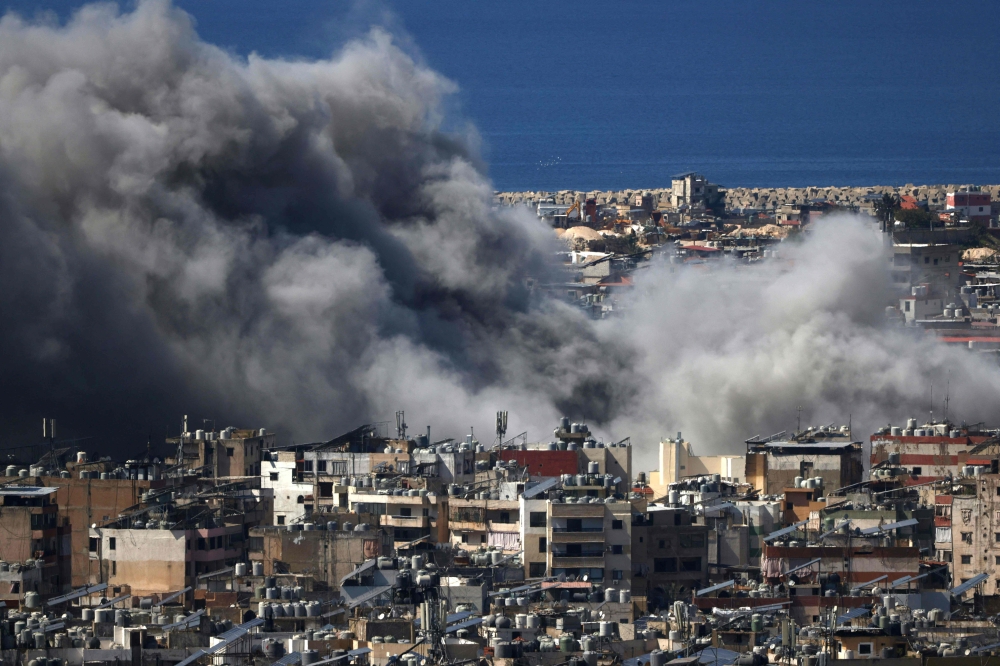
Smoke billows from the site of an Israeli air strike in the southern suburbs of the Lebanese capital, Beirut, on March 9. — AFP pic
The United States, despite its record production levels, cannot escape this dynamic.
American consumers remain tied to global oil prices because domestic fuel markets operate within the same international pricing structure.
US refineries, traders, and energy companies participate in a global marketplace where price signals are transmitted almost instantaneously.
When global prices rise due to geopolitical disruptions, American gasoline and diesel prices inevitably follow.
Nor are other major economies spared. Countries such as Japan, South Korea, and China are even more exposed because of their heavy reliance on imported energy from the Middle East.
Europe, already struggling with energy insecurity following the disruption of Russian gas supplies, faces similar vulnerabilities.
Thus, an oil shock triggered in the Persian Gulf does not remain confined to the Middle East. It spreads across the global economy, affecting advanced industrial nations and developing economies alike.
For emerging economies, the consequences can be even more severe.
Many developing countries are particularly sensitive to rising energy costs because fuel imports represent a significant share of their national expenditures.
Higher oil prices strain government budgets, weaken currencies, and accelerate inflation. Central banks may be forced to raise interest rates, further slowing economic growth.
In Southeast Asia, for instance, rising oil prices can exert pressure on currencies and financial markets.
Countries such as Indonesia, Thailand, and the Philippines must balance the need for economic stability against the political risks of rising fuel prices.
Even energy-exporting countries are not entirely immune.
Higher oil prices may increase government revenues in the short term, but they also raise domestic costs and contribute to global economic instability.
If inflation spreads across major economies, demand for exports may weaken, ultimately affecting global trade flows.
In this sense, oil shocks create a paradox.
While some countries may benefit temporarily from higher prices, the broader economic consequences are rarely positive.
The global economy today is more interconnected than ever before.
Supply chains stretch across continents, financial markets respond instantly to geopolitical developments, and energy flows underpin the movement of goods and people worldwide.
Under such conditions, energy shocks quickly become global economic shocks.
The recent tensions in the Persian Gulf serve as a stark reminder that the stability of maritime chokepoints such as the Strait of Hormuz remains critical to the functioning of the global economy.
Any prolonged disruption in this corridor could trigger a cascade of economic consequences—from rising inflation and currency volatility to slower global growth.
For policymakers around the world, the lesson is unmistakable.
Energy security cannot be understood purely in national terms.
Even the largest producers remain tied to the global market, and disruptions anywhere along the supply chain can reverberate worldwide.
The United States may produce more oil than any other country today, but it remains embedded in the same global economic system as Europe, Asia, and the developing world.
In that system, oil shocks do not respect national borders.
When energy markets are disrupted, the resulting inflation and economic instability spread across the entire global economy.
The reality is therefore simple but sobering: in the modern world, both the United States and the rest of the international community remain equally vulnerable to the shocks of global energy markets.
* Phar Kim Beng is professor of Asean Studies and director of the Institute of International and Asean Studies, International Islamic University of Malaysia.
** This is the personal opinion of the writer or publication and does not necessarily represent the views of Malay Mail.


