APRIL 28 — The announcement of a “major” defence partnership between the United States and Indonesia has triggered a familiar wave of speculation across Southeast Asia.
Commentators have rushed to interpret the agreement as a sign of Indonesia tilting towards Washington, or as part of a broader American effort to consolidate its strategic position in the Indo-Pacific.
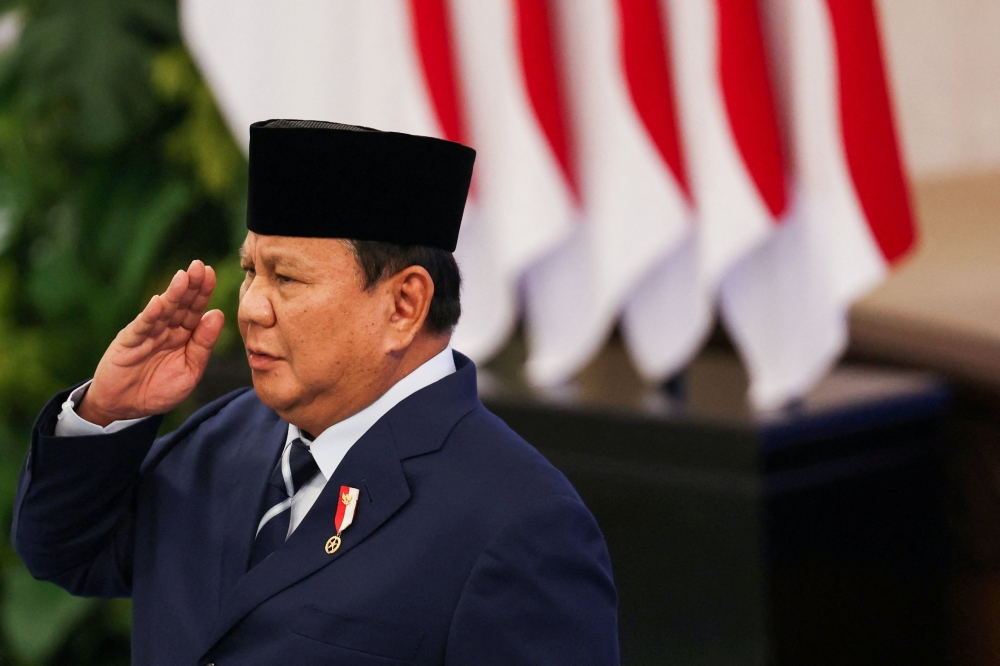
For decades, Jakarta has pursued military modernisation through diversified procurement and training relationships. — Reuters pic
Such readings, while understandable, are premature.
They risk overstating what is, in essence, a long-term modernization framework for Indonesia’s armed forces rather than a decisive geopolitical realignment.
At its core, the Major Defense Cooperation Partnership (MDCP) is an extension of Indonesia’s enduring effort to upgrade the Tentara Nasional Indonesia (TNI).
For decades, Jakarta has pursued military modernisation through diversified procurement and training relationships.
It has acquired platforms from Europe, engaged Turkey in defence co-production, maintained ties with the United States, and cautiously explored cooperation with other powers when necessary.
This pattern is not accidental.
It reflects Indonesia’s deeply ingrained doctrine of bebas aktif—an independent and active foreign policy that resists formal alliances while maximizing strategic flexibility.
The MDCP, therefore, does not represent a departure from this doctrine. It is, instead, consistent with Indonesia’s long-standing approach: engage all major powers, align with none, and strengthen national capabilities from within.
Yet, to dismiss the agreement entirely as an internal matter would also be incomplete. In geopolitics, perception often travels faster than intent.
Even a capacity-building framework can be interpreted externally as a signal of alignment, especially in a region where the strategic rivalry between the United States and China continues to intensify.
This is where the MDCP acquires a second layer of meaning—not because of what it is, but because of how it may be seen.
For Southeast Asia, however, the more important question is not whether Indonesia is tilting towards one power or another.
It is whether such a tilt, even if it were to occur, can materialise in any meaningful way in the near term. The answer is almost certainly no.
The structural conditions of the current international system militate against any rapid or decisive alignment.
The unfolding crisis in West Asia, particularly around the Strait of Hormuz, underscores this point with stark clarity.
The United States itself is deeply entangled in a volatile confrontation with Iran, where maritime chokepoints, energy flows, and military deployments intersect in unpredictable ways.
The Strait of Hormuz, through which a significant portion of the world’s oil and liquefied natural gas passes, remains vulnerable to disruption.
Any escalation there reverberates across global markets, affecting not only Asia but the United States itself.
In such a context, it becomes exceedingly difficult to identify a clear “winner” in the ongoing great power rivalry.
Energy insecurity does not discriminate neatly between East and West. It imposes constraints on all major actors.
The United States, despite its increased energy production, remains exposed to global price volatility and supply chain disruptions.
China, heavily dependent on imported energy, faces its own vulnerabilities. Europe continues to grapple with the aftershocks of earlier energy crises.
Southeast Asia, including Indonesia, sits at the receiving end of these cascading pressures.
Under such conditions, the notion that Indonesia—or any ASEAN member state—would decisively tilt towards one camp in the short term becomes highly implausible. Strategic choices are not made in a vacuum. They are shaped by uncertainty, risk, and the need to counter a balance multiple contingencies.
The MDCP must therefore be understood within this broader environment of systemic flux. It is a long-term investment in capability, not a short-term declaration of alignment.
Even if the partnership deepens over time through joint exercises, technological cooperation, and enhanced interoperability, the translation of these developments into a clear geopolitical tilt will be gradual at best.
Institutional habits, procurement cycles, doctrinal evolution, and political consensus all take years—if not decades—to consolidate.
Moreover, Indonesia’s own strategic culture acts as a powerful moderating force. Its leadership has consistently resisted external pressures to choose sides, even at moments of heightened tension.
The logic is simple but profound: alignment reduces autonomy, and autonomy remains the cornerstone of Indonesia’s national strategy.
For ASEAN as a whole, this dynamic carries important implications.
First, it suggests that fears of an immediate regional polarization are overstated.
The diversity of strategic preferences within ASEAN, combined with the uncertainties of the global environment, will continue to favour a more fluid and non-aligned posture.
Second, it reinforces the importance of patience in assessing strategic trends.
Defence partnerships, particularly those centred on capacity-building, do not produce immediate geopolitical outcomes. Their effects accumulate slowly, often imperceptibly, before becoming visible over longer time horizons.
Third, it highlights the limits of great power competition itself. In an era defined by energy shocks, supply chain disruptions, and overlapping crises, even the most powerful states find their strategic ambitions constrained.
The competition between the United States and China is real, but it is also bounded by structural realities that prevent either side from achieving decisive dominance.
In this sense, the MDCP is less a harbinger of imminent change than a reflection of a world in transition—one where states seek to enhance their capabilities without foreclosing their options.
Indonesia’s approach embodies this logic with remarkable consistency. It engages, calibrates, and adapts, but it does not commit prematurely.
The rest of Southeast Asia would do well to interpret the MDCP through this lens.
Rather than viewing it as a signal of alignment, it should be seen as part of a broader pattern of strategic hedging that will define the region for years to come.
The decisive shifts, if they occur at all, will not be sudden. They will unfold gradually, shaped by forces that extend far beyond any single agreement.
Until and unless the global system stabilizes—particularly in critical domains such as energy security—it will remain impossible to discern a clear victor in the great power rivalry.
And without such clarity, the strategic centre of gravity in Southeast Asia will continue to hold, not tilt.
* Phar Kim Beng, PhD is the Professor of Asean Studies at International Islamic University of Malaysia and Director of Institute of International and Asean Studies (IINTAS).
** This is the personal opinion of the writer or publication and does not necessarily represent the views of Malay Mail.