APRIL 22 — A play, which was recently staged at Universiti Malaya (UM) as part of its theatrical competition called Karnival Teater, became an object of horror and derision among the audience as well as the university administration.
Those who were not present at the actual performance – that is, the public– were also quick to spew harsh words at the troupe concerned.
It appeared that there was more steam emanating from social media than the actual bedroom scene in the play.
The scene, a video clip of which made its rounds on the Internet, riled up many people, especially keyboard warriors, because they felt that it was too raunchy and violated their moral codes and hurt their sensitivities.
The troupe reportedly inserted the scene at the eleventh hour apparently without the knowledge of the competition organisers. Why did this happen?
In the interest of fairness and clarity, the troupe ought to be given the opportunity to explain themselves regarding the controversial outcome of their performance.
Those who didn’t watch the play would certainly like to know what was the context in which the bedroom scene was eventually included.
We should be mindful that in this Internet age, we might risk hastily passing judgement – if at all necessary – based entirely on a short clip that is possibly devoid of its context.
Advanced communications technology has created a situation where what is meant for restricted group interaction can now be made a larger public spectacle by social media.
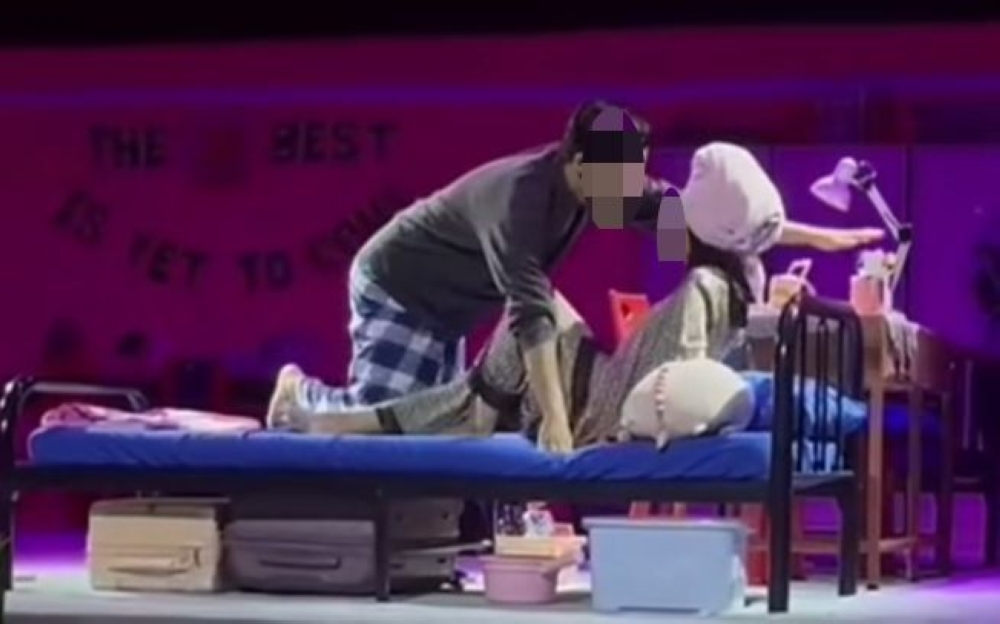
A still shows two performers during the controversial bedroom scene in a theatrical production during Universiti Malaya’s Theatre Carnival in April 2026. — Picture from social media
If one could hazard a guess, the scene might have meant to convey a situation where a man makes sexual advances on a woman, and if this is the case, then shouldn’t such portrayal of suggestive behaviour be calculated to shock anyone because it’s reprehensible?
Of course, the depiction should not be executed in the play in a way that is deliberately licentious.
However, if the said play was indeed found to be unnecessarily laced with sex as an unprofessional way of spicing things up, it deserves disqualification from the competition.
In a sense, the disqualification is a censure against flouting the rules of the competition. This should suffice to placate the fury of particularly those who saw themselves as standing on moral high ground.
One wonders at this juncture whether this issue warrants the intervention of the university management to the point of it offering a public apology.
To be sure, the arts, which includes music, film and theatre, has an important role to play in society.
Among others, the arts provide a platform for social commentaries, fosters community cohesion, reflects social reality, as well as challenges norms.
That is why it is often considered an arena of struggles, especially in an ecosystem where democratic space has narrowed over time. Book banning is an indication.
While the arts may help to preserve values and traditions as suggested by certain quarters in the wake of the UM play controversy, changing circumstances may also necessitate it to challenge certain conventions.
The arts also help to prompt people to look at things in a different light.
In her movie Sepet, for instance, the late Yasmin Ahmad explored interethnic romantic relationship between a Malay girl and a Chinese boy that has repercussions in a multiethnic and multireligious Malaysia.
Sepet persuaded us to inspect the tension and challenges in our society, particularly racism and socio-economic gap.
Surely, the movie was not aimed at causing public unrest or racial disharmony, as some claimed.
As a result of the bedroom scene dispute, certain people have urged UM to put stricter rules in place so that such an incident will not recur.
The rules should be applied prudently so as to avoid them from becoming an effective tool of censorship that stifles creativity.
Imposing very strict restrictions runs the risk of having students produce creative output of questionable quality.
The arts, particularly theatre, thrives in an environment where the artistes do not have to look over their shoulders.
* This is the personal opinion of the writer or publication and does not necessarily represent the views of Malay Mail.