MAY 1 — The warning by Senator Richard Blumenthal, published by the Middle East Eye on May 1 2026, that an imminent military strike is “very much on the table” must be read with gravity.
It reflects not conjecture, but a strategic direction that has already crossed a critical threshold.
The phase of decapitation has, by most accounts, already been undertaken.
The joint actions by the United States and Israel on February 28, 2026, targeting elements of Iran’s political and religious leadership, marked a decisive turn toward escalation.
What was framed as a limited effort to degrade leadership structures has instead widened the scope of confrontation.
Decapitation, far from containing conflict, often accelerates its diffusion.
Now, more than 60 days into the war, the absence of a negotiated solution is deeply troubling. The conflict has not only persisted—it has metastasized.
What began as targeted strikes has evolved into a multi-theatre contestation, increasingly anchored in maritime domains critical to global stability.
The first two theatres are well known: the Strait of Hormuz and the Red Sea.
These are the twin arteries of global energy and trade. Any disruption here reverberates instantly across global markets, affecting oil prices, shipping routes, and inflation trajectories.
Yet a third, less discussed but equally consequential theatre is emerging—the Caspian Sea.
Should the Islamic Revolutionary Guard Corps (IRGC) face sustained bombardment beyond its immediate capacity to absorb, there is a plausible risk of strategic diversion.
In such a scenario, Tehran could seek to redistribute military assets—including ammunition and logistical support—northward via the Caspian Sea, potentially aiding Russia in its ongoing conflict with Ukraine.
This would effectively link the Middle Eastern theatre with the Eastern European one, creating a trans-regional axis of military coordination.
Such a development would mark a dangerous escalation in horizontal proliferation.
The conflict would no longer be confined to West Asia but would intersect with the already volatile dynamics of the Russia-Ukraine war.
The Caspian Sea, often viewed as a relatively insulated inland body, would thus assume a new strategic role—as a conduit of conflict extension rather than containment.
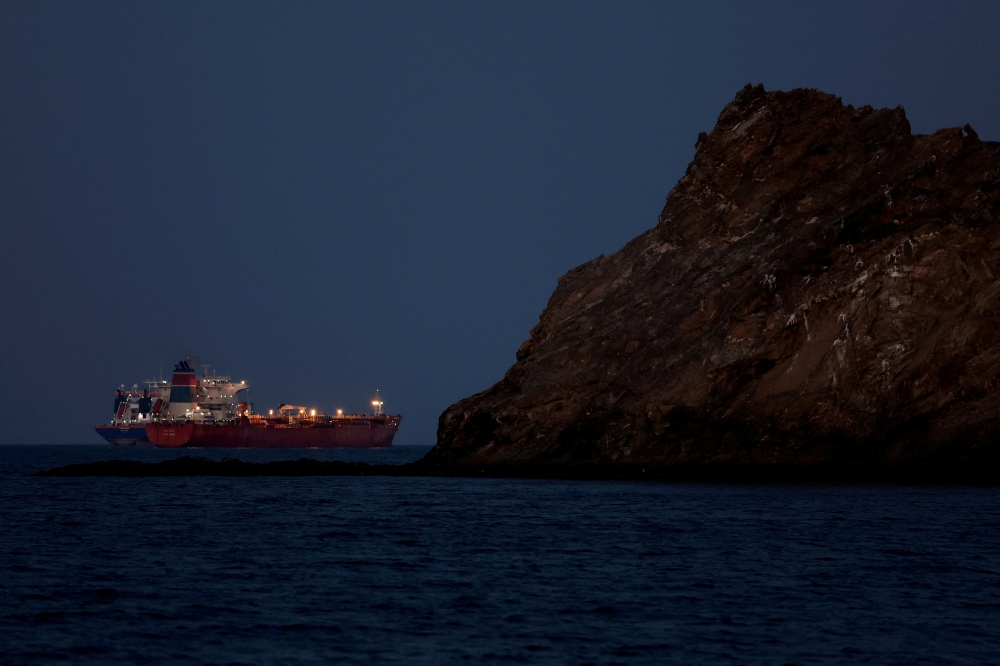
The Callisto tanker sits anchored as the traffic is down in the Strait of Hormuz, amid the US-Israeli conflict with Iran, in Muscat, Oman March 10, 2026. — Reuters pic
This is the essence of deeper enmeshment.
The world is no longer dealing with isolated flashpoints but with an interconnected web of maritime vulnerabilities. The Strait of Hormuz threatens global energy flows.
The Red Sea endangers trade routes linking Europe and Asia. The Caspian Sea, meanwhile, risks becoming a logistical bridge between two major theatres of war.
In other words, the international community now faces three simultaneous strategic maritime challenges.
Each one, on its own, would demand urgent attention.
Taken together, they suggest a systemic crisis—one that cannot be resolved through piecemeal responses. Military strikes, including decapitation efforts, have demonstrated their limits.
They can disrupt adversaries but also trigger adaptive responses that expand the scope of conflict.
The implication is clear: restoring even a semblance of world peace now requires a coordinated approach to all three maritime domains.
First, there must be immediate efforts to stabilize the Strait of Hormuz.
This includes ensuring freedom of navigation, preventing blockades, and establishing de-escalation mechanisms among naval forces operating in the Gulf.
Second, the Red Sea must be secured as a corridor of global trade. This will require not only naval patrols but also diplomatic engagement with regional actors to reduce the risk of attacks on commercial shipping.
Third, and most critically, the Caspian Sea must not be allowed to become a conduit for conflict expansion.
This will require careful monitoring and, where possible, diplomatic engagement with littoral states to prevent the transfer of military assets that could further entrench the Russia-Ukraine war.
Senator Blumenthal’s warning about American forces being placed in harm’s way thus extends beyond immediate battlefield risks.
It speaks to a broader strategic dilemma: the United States, and indeed the world, is being drawn into a condition of layered entanglement where actions in one theatre have cascading effects in others.
For energy-dependent regions such as East Asia, the stakes are profound.
The disruption of maritime flows in Hormuz and the Red Sea directly affects fuel prices, supply chains, and economic stability.
The potential linkage with the Caspian Sea adds another layer of uncertainty, raising the specter of prolonged global instability.
Malaysia, as a trading nation, cannot remain insulated from these developments. Its economic resilience is tied to stable energy supplies and secure shipping routes.
Any sustained disruption across these three maritime domains would test not only its fiscal capacity but also its strategic foresight.
The transition from decapitation to enmeshment is therefore complete.
What began as a targeted strategy has evolved into a systemic condition—one that binds together multiple regions, actors, and domains.
The world now faces a stark choice: continue down a path of fragmented responses and escalating entanglement, or pursue a comprehensive strategy that addresses the interconnected nature of these crises.
Until and unless the Strait of Hormuz, the Red Sea, and in due course, the Caspian Sea, are stabilized in tandem, the prospect of restoring global equilibrium will remain elusive.
And with each passing day, the cost of inaction—or miscalculation—will only grow.
* Phar Kim Beng is a professor of Asean Studies and director at the Institute of Internationalization and Asean Studies, International Islamic University of Malaysia.
** This is the personal opinion of the writer or publication and does not necessarily represent the views of Malay Mail.