MAY 7 — There is always that one meeting.
The room is a little too cold, the projector takes a moment longer than expected, and someone is clicking through slides that everyone has already skimmed the night before. Or reading together minutes from the previous meeting that has just been distributed five minutes before it started.
The word “change” appears early, and then often. How to manage it, how to drive it, how to make sure this time it actually stays. Heads nod. A few notes are written, some more for form than for memory. Tasks are assigned with good intention.
Then the meeting ends. People step out, check their phones, and by the time they return to their desks, the day has already resumed its usual rhythm. Nothing dramatic happens. And perhaps that is the point.
I was reminded of something I first came across years ago, from Virginia Satir. She described change not as a clean transition, but as a disruption. A period where the old way no longer holds, and the new way has not quite formed.
She called it chaos, though not in the dramatic sense. More like a quiet disorientation. The kind where people are still functioning, still attending meetings, but carrying a certain uncertainty that is difficult to name.
And yet, she believed that things could get better. Not automatically, and not simply because a plan exists. But because people, when supported properly, are capable of moving through that uncertainty and finding a more stable way forward.
Over time, I have come to think that change rarely fails because the idea is weak.
Most proposals are well thought through. The slides are convincing. The intentions are, more often than not, sincere. What is less visible is what happens after the meeting.
I remember watching a head of department navigating a restructuring exercise. She understood the direction. She believed in it. But in the weeks that followed, most of her work happened outside the formal structure.
In corridor conversations. In quick clarifications after meetings; in personal emails and WhatsApp messages. In moments where her team asked questions that had no prepared answers.
She managed, as most people do. But there was a quiet weight to it. The kind that does not show up in reports, but sits somewhere between responsibility and expectation.
We often speak about execution, about delivery, about outcomes. But the actual work of change tends to happen in these smaller spaces.
In one-to-one conversations. In judgment calls made without complete information. In decisions that carry consequences beyond what was originally outlined. And those making these decisions are usually not the ones who designed the change.
They are expected to carry it.
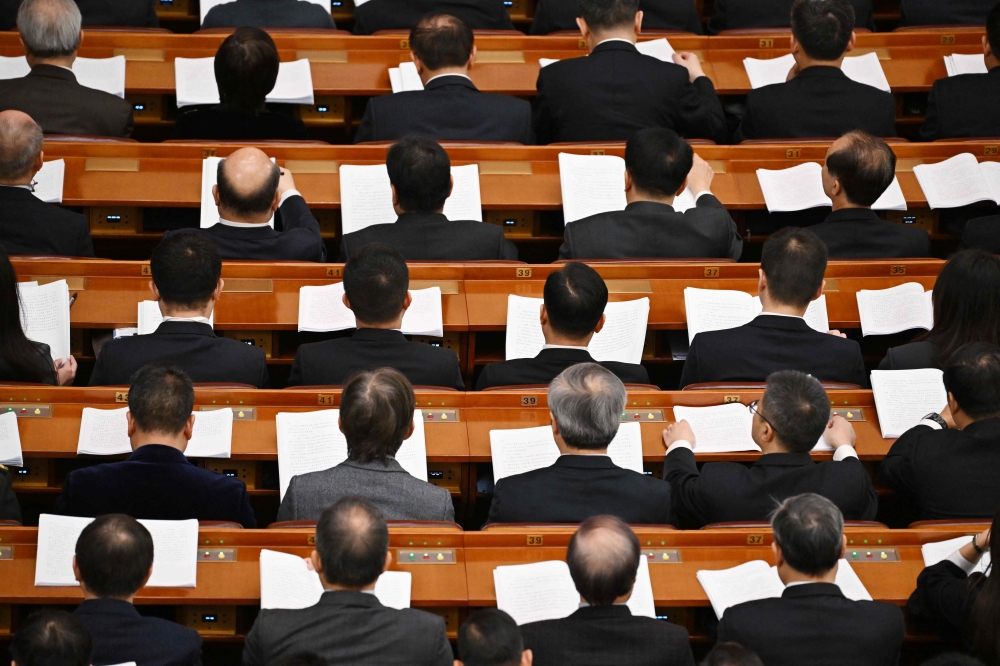
Delegates attend a plenary session of the Chinese People’s Political Consultative Conference at the Great Hall of the People in Beijing on March 9, 2024. — AFP pic
Marcus Aurelius once wrote, “The impediment to action advances action. What stands in the way becomes the way.”
The line is often quoted as a form of encouragement, but it also carries a quieter implication. That the obstacle is not removed. It is worked through. And the person doing the working must find a way to hold steady while doing so.
In organisations, that person is often the one in the middle. Empowerment, then, cannot remain as a phrase we place in documents.
It has to take a more recognisable form. It begins with clarity. People need to understand not just what is changing, but why it matters, and where the boundaries are.
It requires a certain level of trust. Space to make decisions without the constant sense of being second-guessed.
And perhaps more importantly, it requires attention. Not the formal kind, not necessarily the public acknowledgement that we tend to default to.
Sometimes it is something simpler. Being asked for input before decisions are finalised. Being included early enough that the conversation still has room to move. Or even just a brief, genuine check-in that is not tied to performance.
Different people respond to different forms of recognition. But most can tell when they are being seen, and when they are simply being relied upon.
Satir’s work was never about perfection. It was about movement. About the possibility that systems, like people, can become more functional, more honest, over time.
But that movement depends on whether we pay attention to those who are holding things together during the most uncertain phases.
Change, in that sense, is less about documents and timelines, and more about people learning to find their footing again.
And if there is one place to begin, it is perhaps with the person in the middle. The one translating direction into action, absorbing uncertainty, and keeping things moving, often without much noise.
Most of the time, they will carry on anyway. It just helps, sometimes, to know they are not doing it alone.
* Nahrizul Adib Kadri is a professor of biomedical engineering at the Faculty of Engineering, the Director of UM Press, and the Principal of Tuanku Bahiyah Residential College, Universiti Malaya. He may be reached at [email protected]
** This is the personal opinion of the writer or publication and does not necessarily represent the views of Malay Mail.