MAY 10 — The world may still view the conflict in West Asia through the traditional lens of missiles, drones and air strikes.
Yet Iran’s most important strategic weapon today may not be military hardware at all. It is leverage.
And Tehran is increasing that leverage in ways the global economy can no longer ignore.
The Strait of Hormuz has become the central instrument through which Iran is transforming geography into political influence.
Roughly one-fifth of global oil and substantial liquefied natural gas supplies normally pass through this narrow maritime artery.
Iran understands a simple but powerful reality: it does not need to defeat the United States militarily to create strategic pressure worldwide.
It only needs to make the costs of instability unbearable for everyone else. This is precisely what is unfolding now.
Although the United States possesses overwhelming military superiority, Iran has managed to create a situation where even Washington struggles to restore normal commercial confidence in the Gulf.
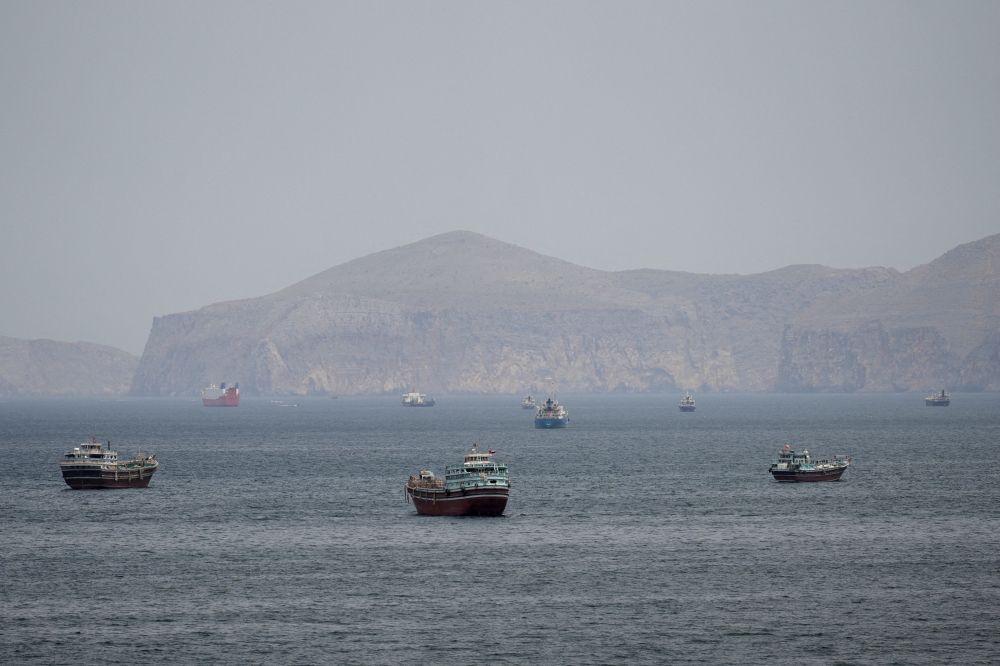
Ships and boats in the Strait of Hormuz, Musandam, Oman, April 22, 2026. — Reuters pic
According to recent reports, maritime traffic through Hormuz has fallen dramatically, while hundreds of vessels and thousands of crew members remain trapped or delayed across the wider Gulf region.
The more prolonged the standoff becomes, the more leverage Iran accumulates indirectly.
Oil prices become volatile.
Shipping insurance costs rise.
Global inflationary pressures intensify.
Asian economies become nervous about energy security.
Financial markets begin pricing geopolitical risk into nearly every major commodity.
Iran therefore gains influence not because it controls the global economy, but because it can disrupt the arteries through which the global economy breathes.
This explains why the current confrontation has evolved into what many analysts now call a “double blockade”.
Iran has restricted maritime movement through Hormuz while the United States has imposed a counter-blockade targeting Iranian ports and vessels. Washington has redirected 58 commercial ships away from Iranian ports and disabled four vessels since April 13, according to United States Central Command.
American forces also reportedly struck two empty Iranian oil tankers accused of attempting to bypass the blockade.
Yet despite immense pressure, Iran continues demonstrating resilience.
This is the paradox confronting Washington.
The harder the United States squeezes Iran economically, the more Tehran seeks to convert regional instability into geopolitical bargaining power.
Iran’s leverage now extends beyond oil itself.
The disruption affects fertiliser supplies crucial for agriculture across Asia.
It affects industrial gases such as helium that are important for semiconductor manufacturing and advanced medical technologies.
In effect, Iran is signalling that no major economy remains insulated from prolonged confrontation in the Gulf.
This strategy also explains why Tehran has shown no urgency to concede quickly. If anything, Iran is insisting that it is winning.
Iranian policymakers appear to believe time itself can become a strategic asset.
While the United States faces rising political pressure over inflation, energy prices and global economic instability, Iran calculates that prolonged uncertainty gradually increases international calls for compromise.
Even major shipping companies now warn that reopening Hormuz alone may not immediately restore commercial confidence because insurers, shipowners and crews remain fearful of renewed escalation.
Notwithstanding the willingness of the United Arab Emirates (UAE) to insure some oil tankers to use the Strait of Hormuz.
This gives Iran another layer of leverage: psychological leverage.
The mere possibility of disruption is becoming almost as powerful as actual disruption itself.
The world economy increasingly reacts not only to events, but to anticipated risks.
That is why this crisis differs fundamentally from older forms of warfare.
The conflict is no longer simply about battlefield victories or territorial conquest. It is about manipulating uncertainty faster than rivals can stabilize it.
Iran’s strategy resembles a form of geopolitical pressure economics.
Tehran recognises it cannot match the United States conventionally across every military dimension. Instead, it seeks to impose cumulative strategic costs across shipping, insurance, inflation, diplomacy and energy markets simultaneously.
This is asymmetric leverage on a global scale.
For Asean, the implications are serious.
South-east Asia remains deeply dependent on stable maritime commerce and energy imports.
China, Japan, South Korea and Asean economies all remain vulnerable to prolonged instability around Hormuz and Bab el-Mandeb.
Thailand, for now, can lean on supplies from Brunei, Libya and the United States. But the solution is still a mere band aid.
The consequences extend beyond energy prices alone.
Food security becomes vulnerable when fertiliser supplies tighten. By the end of May 2026 when Vietnam does not have enough fertilisers it is too late for the rice fields to be tilled. Exports to the Philippines will be disrupted too.
Manufacturing becomes vulnerable when shipping disruptions intensify.
Inflation becomes harder to contain when freight and insurance costs surge.
Even economic planning itself becomes difficult under prolonged geopolitical uncertainty.
Asean therefore cannot afford to treat the Gulf crisis as geographically distant.
The Strait of Hormuz now affects the Indo-Pacific directly.
Malaysia, particularly as Coordinator of China-Asean Relations between 2025 and 2028, should continue emphasising multilateral diplomacy and a United Nations-centred international system capable of slowing escalation before the global economy enters deeper fragmentation.
The broader lesson is deeply sobering.
Modern wars are increasingly defined not by territorial occupation alone, but by the ability to weaponise interdependence.
Iran is demonstrating that leverage in the 21st century comes not only from military power, but from the capacity to disrupt the networks upon which globalisation depends.
The world once feared the outbreak of total war.
Today, it may need to fear something equally dangerous: prolonged instability where no side wins outright, yet everyone becomes progressively weaker the longer the crisis continues.
* Phar Kim Beng is a professor of Asean Studies and director, Institute of Internationalisation and Asean Studies, International Islamic University of Malaysia.
** This is the personal opinion of the writer or publication and does not necessarily represent the views of Malay Mail.