APRIL 21 — The paradox of the United States in the spring of 2026 is striking. He has shown no expliciti indication of exiting from the war against Iran. This is bewildering by virtue of his approval ratings that are tanking.
On one hand, President Donald Trump faces an abysmal approval rating hovering around 37 per cent — an unmistakable signal of domestic dissatisfaction. The numbers continue to be dropping.
On the other hand, the American stock market continues to surge, buoyed by robust corporate earnings and the commanding dominance of its financial institutions.
This divergence between political fragility and financial strength is not merely ironic. It is dangerous.
At the heart of this contradiction lies the extraordinary performance of major US banks.
Institutions such as JPMorgan Chase and Bank of America have reported stronger-than-expected earnings in the first quarter of 2026, reinforcing the perception that the American economy remains resilient despite mounting geopolitical tensions.
Consumer spending has held firm. Credit flows remain intact. Balance sheets appear healthy.
More strikingly, along with JPMorgan Chase, Bank of America and other major financial institutions, about 10 per cent of companies in the S&P 500 have already reported their results for the start of 2026.
Nearly nine out of ten have delivered profits that exceeded analysts’ expectations, according to FactSet.
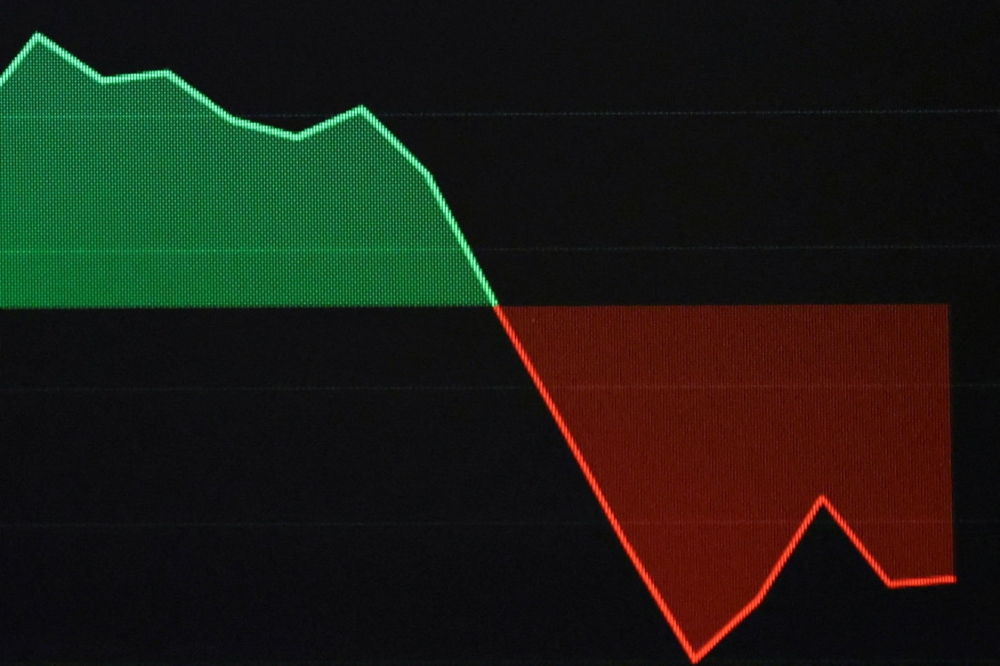
The author argues that the disconnect between weak political support and strong financial markets in the US risks fuelling dangerous overconfidence, as market optimism may encourage prolonged geopolitical escalation while underestimating systemic risks. — Reuters pic
Should the remaining firms merely meet forecasts, overall earnings per share for the index are projected to rise by 13 per cent compared to a year earlier.
Such broad-based earnings strength is not trivial. It reflects a corporate sector that, at least for now, appears insulated from geopolitical volatility.
Analysts, including those at Morgan Stanley, have responded by revising their profit expectations upward — even after the outbreak of conflict in the Middle East.
Such financial buoyancy creates a powerful narrative: that the United States can withstand external shocks, absorb geopolitical disruptions, and continue to grow.
It is precisely this narrative that risks distorting strategic judgment at the highest levels of political leadership.
President Trump, long attuned to market signals as proxies for national strength, may interpret the rally in US equities as validation of his economic stewardship.
In his worldview, a rising stock market is not merely an economic indicator; it is a political endorsement. It suggests that his administration’s policies — however controversial — are ultimately delivering results.
Yet markets are not always wise. They are often myopic.
The current rally in US bourses reflects expectations of continued earnings growth, not the full pricing-in of geopolitical risk.
Financial markets, by their nature, tend to discount immediate disruptions while underestimating systemic shocks.
The Strait of Hormuz crisis, the fragile ceasefire negotiations with Iran, and the broader regional instability have yet to be fully internalized in asset valuations.
In this sense, Wall Street’s optimism may be less a reflection of reality than a collective act of denial.
This disconnect matters profoundly. It emboldens political leaders to take greater risks. When markets remain strong, the perceived cost of escalation diminishes.
The logic becomes self-reinforcing: if the economy is resilient, then the nation can afford to push harder, negotiate tougher, and wait longer.
This appears to be precisely the calculation behind Trump’s posture toward Iran ahead of the April 22 ceasefire deadline. Rather than seeking rapid de-escalation, the administration seems willing to prolong pressure — economically and militarily — in the belief that time is on America’s side.
Such confidence, however, may be misplaced.
The resilience of US banks and corporations does not insulate the global economy from disruption in energy flows, supply chains, and strategic chokepoints.
The longer tensions persist, the greater the risk of a cascading crisis — one that could quickly erode the very financial strength that currently sustains market optimism.
Indeed, history offers sobering lessons. Financial markets often remain buoyant until the very moment they are not.
Prior to major geopolitical shocks, from the oil crises of the 1970s to more recent conflicts, markets have displayed a persistent tendency to underestimate risk — only to correct abruptly when reality intrudes.
The danger today is that the illusion of strength becomes a substitute for strategic prudence.
Trump’s low approval ratings should, in theory, act as a constraint on foreign policy adventurism.
Yet the opposite may be occurring. Faced with domestic political weakness, and a mid-term congressional elections in November 2026, the administration may be tempted to project strength externally. How?
By using the resilience of financial markets as both justification and shield to keep the war going in order to pummel Iran into submission.
This is where the intersection of economics and geopolitics becomes most perilous.
A strong stock market can create the illusion of unlimited strategic bandwidth.
It can encourage leaders to believe that escalation carries manageable costs.
It can lull decision-makers into thinking that markets will continue to absorb shocks indefinitely. They will not.
If the April 22 ceasefire effort collapses completely, notwithstanding Trump’s assertion that Vice President JD Vance is back in Islamabad to work out a final deal with Iran, there are no signs of a definitive ceasefire yet.
The consequences will not remain confined to any such failure to uphold the ceasefire.
If anything, energy prices could spike sharply. Supply chains could fracture further. Inflationary pressures could intensify.
And the very earnings growth — projected now at a robust 13 per cent year-on-year — that underpins Wall Street’s rally could begin to falter.
In such a scenario, the feedback loop would reverse. Markets would no longer embolden policy — they would constrain it.
The United States today stands at a critical juncture. Its financial system, led by powerful banks and buoyed by strong corporate earnings, projects an image of resilience and dominance.
But this image is, at best, partial. It obscures the underlying fragility of a global system under strain.
Strategic decisions made under the influence of market optimism risk being fundamentally miscalibrated.
The lesson is clear: economic strength should inform policy, not intoxicate it.
The durability of US banks and the performance of its stock market are undeniable.
But they are not a substitute for geopolitical realism.
To conflate the two is to risk turning financial success into strategic overreach.
And in a world already on edge, that is a gamble the United States — and the global economy — may not be able to afford.
* Phar Kim Beng, PhD is the Professor of Asean Studies at International Islamic University of Malaysia and Director of Institute of International and Asean Studies (IINTAS).
** This is the personal opinion of the writer or publication and does not necessarily represent the views of Malay Mail.