MAY 5 — In one of my visits to Zimbabwe, I had the opportunity to spend time in a rural village some distance away from the main towns.
The journey itself was unhurried. The road gradually gave way to narrower paths, and the landscape opened into wide stretches of land where daily life followed a rhythm quite different from what many of us are used to.
It was early morning when I stepped outside the house where I was staying. The air was cool, and the light was still soft.
Not far from where I stood, a few women were already walking along a narrow path, each carrying a container. Their pace was steady and purposeful.
Later, I learned that they were on their way to collect water from a well some distance away.
There were no pipes running into the homes, no taps to be turned on. Water had to be fetched, carried and used with care.
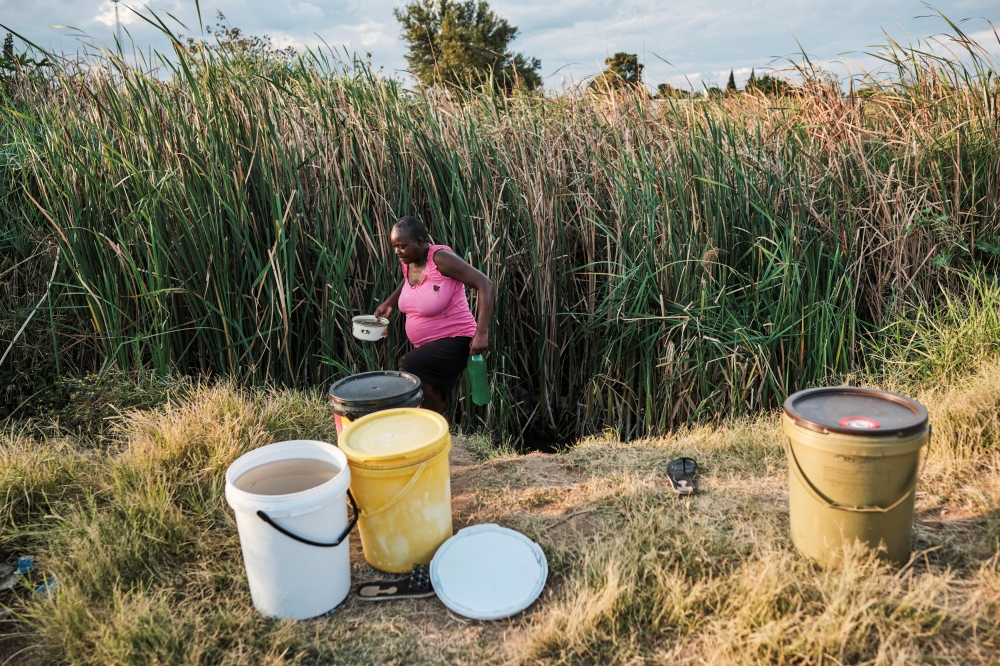
A woman gathers water from a shallow well near a river, as temperatures soar during the El Nino-related heatwave and drought affecting a large part of the country in Bulawayo, Zimbabwe March 7, 2024. — Reuters pic
What might appear, at first glance, as a limitation was in fact part of an established way of life. The task was not hurried. It was shared, understood and quietly integrated into the rhythm of the day.
As I spent more time in the village, I began to notice other small details. Tasks that modern conveniences have simplified elsewhere were carried out here through skill, memory and cooperation.
Knowledge was not written down, but practised and passed on through daily living. There was a sense of attentiveness, both to the land and to one another, that did not need to be stated.
At first, I found myself observing these practices from a distance, trying to understand them through familiar categories. It is easy to describe such conditions as lacking in comfort or convenience.
Yet the more time I spent with the families, sitting with them, listening to their stories and watching how they organised their lives, the more I began to see something that was not immediately obvious.
There was a quiet coherence in the way things were done.
One morning, I was offered a small twig to clean my teeth. At first, I was unsure how to use it.
I was then shown how the end could be gently chewed until it softened into fine fibres.
These fibres were then used to clean the teeth, much like a toothbrush. The process was simple, but effective.
It was explained to me that certain plants are chosen not only for their texture, but also for their natural properties.
Some contain compounds that help maintain oral hygiene. What seemed, at first, to be a rudimentary practice was in fact grounded in careful observation and accumulated knowledge.
It was not merely about the twig itself, but about the way knowledge had been developed and sustained.
This was not knowledge acquired through formal instruction or technological systems, but through long engagement with the natural environment.
It reflected an understanding that had grown over generations, shaped by necessity, attentiveness and continuity.
The experience brought to mind something I had learned many years ago as a boy scout.
Lord Baden-Powell, the founder of the Scout movement, had spent time in Africa and was deeply influenced by what he observed there.
Many of the skills later associated with scouting, like reading the land, finding water, and using natural materials, were not inventions but lessons drawn from indigenous communities who had long understood how to live attentively within their environment.
What was taught to us as outdoor skills was, in its original context, simply a way of life.
Over time, I began to reflect on how easily such knowledge can be overlooked. In many modern settings, we are accustomed to associating progress with complexity, speed and technological advancement.
Solutions are often expected to be sophisticated, engineered and scalable.
When we encounter practices that do not fit this pattern, we may be quick to dismiss them as outdated or incomplete.
Yet experiences like this invite a different kind of reflection. They suggest that not all knowledge moves in a single direction.
What appears simple may in fact carry a depth that is not immediately visible.
What seems familiar to one community may be entirely unknown to another.
In this sense, learning is not always about acquiring something new, but sometimes about recognising what has been quietly present all along.
As I prepared to leave the village, I once again saw people walking along the same narrow path, carrying water as they had done earlier in the day.
The movement was steady, unhurried and purposeful. Nothing about the scene had changed, yet my understanding of it had shifted.
What I had initially observed as a routine task now appeared as part of a larger pattern of life, one that reflected resilience, knowledge and a deep connection to the natural environment.
It is easy to travel across places and return with photographs or descriptions of what we have seen. It is less common, perhaps, to recognise how those encounters have quietly changed the way we see.
And perhaps that is where the deeper lesson lies.
Learning from nature is not always about discovering something new. Sometimes, it is about learning to recognise the wisdom that has been there all along, waiting patiently for us to see it.
* Ng Kwan Hoong is an Emeritus Professor of Biomedical Imaging at the Faculty of Medicine, Universiti Malaya. A 2020 Merdeka Award recipient, he is a medical physicist by training but also enjoys writing, drawing, listening to classical music, and bridging the gap between older and younger generations. He may be reached at ngkh@ummc.edu.my
** This is the personal opinion of the writer or publication and does not necessarily represent the views of Malay Mail.