Petaling Jaya (23 November 2026) : Bitcoin and Ether fell far more sharply than Malaysian equities in October 2026, even as Budget 2027’s tokenised retail sukuk proposal, Bank Negara Malaysia’s SSDS+ infrastructure launch, and tighter exchange enforcement pointed to a more selective, Shariah-grounded digital-finance trajectory.
October 2026 exposed a widening structural divergence between global cryptocurrency market performance and the policy architecture of digital finance in Malaysia. While investors endured a broad monthly drawdown across unbacked digital assets and institutional exchange-traded funds, Malaysian authorities pressed ahead with a calibrated agenda designed to anchor distributed-ledger technology within regulated securities, Islamic capital markets, and wholesale payment rails.
Baca juga: Usahawan bateri dinobat ‘The Most Promising Company’ di Anugerah Usahawan Mara 2026
On a ringgit-adjusted basis, Bitcoin declined 8.13% between 30 September and 31 October, while Ether dropped 16.71%—more than double Bitcoin’s monthly loss. Over the same period, domestic equities exhibited markedly lower sensitivity to global crypto volatility: the benchmark FBM KLCI eased a comparatively modest 2.15% across its October trading sessions, while the FBM EMAS Shariah Index dipped just 0.77%. From an Islamic capital-market standpoint, the resilience of the FBM EMAS Shariah Index illustrates how quantitative Shariah screening—which caps debt-to-total-asset ratios and excludes interest-bearing financial institutions and highly leveraged speculative businesses—acts as a natural buffer during periods of global liquidity contraction. These figures capture one month’s empirical experience rather than a permanent ranking of asset-class risk. [1–5]
OCTOBER MARKET SNAPSHOT | PRICE RETURNS
| BITCOIN
−8.13% |
ETHEREUM
−16.71% |
FBM KLCI
−2.15% |
FBM EMAS SHARIAH
−0.77% |
Figure 1. Cumulative October price returns (30 September = 0%)
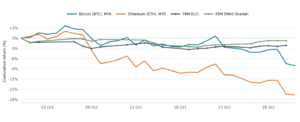
Bitcoin and Ether are converted into MYR using BNM reference rates. Bursa indices follow the local trading calendar, ending 30 October; crypto observations run to 31 October. Sources: [1–5].
A global sell-off, and a sharper focus on security
October’s downward pressure extended well beyond Bitcoin and Ether, reflecting a broad-based de-risking across global digital-asset markets. According to Nasdaq’s October 2026 Digital Asset Market Report, total global digital-asset market capitalisation contracted by approximately 10% during the month, reversing late-third-quarter gains as macro-rate expectations and institutional profit-taking weighed on risk appetite. In the United States, spot Bitcoin exchange-traded funds recorded roughly US$515 million in net outflows over October, signalling a pause in institutional allocation flows that had previously cushioned spot prices during mid-year pullbacks. [6]
For Malaysian investors tracking ringgit-denominated performance, foreign-exchange dynamics added a secondary layer of dispersion. Using Bank Negara Malaysia’s daily USD/MYR reference rates between 30 September and 31 October, ringgit movements interacted with dollar-denominated crypto drawdowns to shape local holding-period returns—reminding domestic market participants that cross-border digital assets carry embedded currency exposure alongside spot price volatility. Unlike Bursa Malaysia’s Shariah-compliant equities, which trade within a defined local market session and derive cash flows from domestic and regional real-sector operations, global cryptocurrencies trade continuously across fragmented offshore liquidity pools that amplify weekend and overnight swings. [1–5]
Equally consequential was a major security breach and asset theft reported at Binance in the final days of October. The incident underscored a critical operational distinction that is frequently overlooked during bull markets: even when a public blockchain protocol continues to validate blocks without technical interruption, centralised exchanges, hot-wallet custody arrangements, and off-chain intermediaries remain vulnerable to catastrophic operational and security failures. [6]
Evaluated through an Islamic commercial jurisprudence (Fiqh al-Muamalat) lens, October’s Binance theft carries direct governance lessons. Under the higher objectives of Shariah (Maqasid al-Shariah), the preservation and protection of wealth (hifz al-mal) is a foundational requirement of sound financial stewardship. When digital assets are held on offshore platforms lacking clear legal segregation of client holdings, enforceable local custody rules, or transparent reserve verification, investors are exposed to gharar fahish(excessive operational and contractual uncertainty). October’s breach demonstrated that the Shariah permissibility of an underlying token does not insulate investors from counterparty failure when custody and platform governance fall short.
Malaysia’s digital-finance agenda moves forward
At home, October’s most consequential developments came from policy architecture rather than secondary-market token prices—specifically around building Shariah-native digital capital-market infrastructure. In the Fifth MADANI Budget 2027 speech delivered on 9 October, the government announced plans to introduce a tokenised retail savings sukuk enabling Malaysian citizens to channel personal savings directly toward real-economy developmental priorities, including education, healthcare, and social protection. While the announcement represents a strategic statement of policy intent rather than an immediate product launch or public offering, it signals a deliberate effort to democratise retail participation in sovereign-linked Islamic instruments using distributed-ledger technology. [7]
That policy vision gained a concrete institutional backbone on 20 October, when Bank Negara Malaysia (BNM) launched SSDS+ (Fully Automated System for Issuing/Tendering Plus), a next-generation market infrastructure platform engineered to support the issuance, safekeeping, and ownership registry of digital and tokenised bonds and sukuk. Critically, SSDS+ is integrated with RENTAS+ (Real-time Electronic Transfer of Funds and Securities System Plus), enabling atomic, real-time payment and securities settlement. This development is foundational for Malaysia’s Islamic capital market: rather than creating unregulated speculative tokens, SSDS+ embeds distributed-ledger efficiency directly inside existing legal frameworks where investor rights, asset backing, and Shariah governance are already established. [8]
Cross-border regulatory experimentation also advanced in October. On 6 October, Bank Negara Malaysia and the Hong Kong Monetary Authority (HKMA) agreed to strengthen bilateral cooperation by exploring policy and supervisory arrangements for compliant stablecoin use cases between Malaysia and Hong Kong. In an Islamic-finance context, fiat-referenced payment tokens implicate the classical rules of bay’ al-sarf (currency exchange), which mandate spot settlement and full, verifiable backing to avoid riba (usury) and gharar. The BNM–HKMA initiative indicates that any future cross-border stablecoin corridor involving Malaysia will be anchored in strict reserve backing, prudential supervision, and institutional interoperability—and should not be misconstrued as a general authorisation for retail stablecoin issuance or unbacked token trading in Malaysia. [10]
At the same time, regulators reinforced the perimeter separating licensed domestic market operators from unauthorised offshore venues. On 8 October, the Securities Commission Malaysia (SC) added Binance to its Investor Alert List for carrying on unauthorised capital-market activities in Malaysia. Placed alongside the late-October theft reported at the same exchange, the SC’s enforcement action highlights why local regulatory registration is a primary safeguard rather than a bureaucratic formality: global brand recognition and deep offshore liquidity do not substitute for domestic investor protection, segregated client custody, or local legal recourse. [9, 11]
From a Shariah compliance standpoint, the integration of SSDS+ and RENTAS+ directly addresses classical requirements surrounding milk al-tam (complete and unambiguous ownership) and taqabudh (constructive or actual possession at settlement). By maintaining a unified, tamper-resistant ownership ledger synchronized with central-bank settlement money, SSDS+ reduces reconciliation delays, prevents double-pledging of sukuk certificates, and strengthens auditability for Shariah committees overseeing primary issuances and secondary transfers. [8]
OCTOBER 2026 POLICY & MARKET TIMELINE | MALAYSIA
Table 1. Key Malaysian digital-finance, regulatory, and Shariah-market developments in October 2026
| Date (Oct 2026) | Institution | Development | Market & Shariah Significance |
| 6 October | BNM & HKMA | Bilateral cooperation to explore compliant cross-border stablecoin policy arrangements [10] | Signals institutional focus on reserve-backed, supervised payment rails aligned with bay’ al-sarf principles rather than unbacked retail tokens. |
| 8 October | Securities Commission (SC) | Binance added to SC Investor Alert List for unauthorised Malaysian market activity [9, 11] | Reinforces the domestic regulatory perimeter and highlights custody/counterparty risks (hifz al-mal) on unlicensed offshore platforms. |
| 9 October | Ministry of Finance / PMO | Budget 2027 announcement of planned tokenised retail savings sukuk [7] | Channels retail savings toward real-economy social priorities (education, healthcare, social protection) via Shariah-compliant contracts. |
| 20 October | Bank Negara Malaysia | Launch of SSDS+ integrated with RENTAS+ for tokenised bonds and sukuk [8] | Provides regulated issuance, safekeeping, and atomic settlement, strengthening ownership certainty (milk al-tam) in Islamic debt markets. |
| 30–31 October | Bursa Malaysia & Global Crypto | Monthly close: FBM EMAS Shariah −0.77% vs. BTC −8.13% and ETH −16.71% (MYR) [1–5] | Demonstrates the defensive shock-absorbing effect of Shariah equity leverage caps during global digital-asset drawdowns. |
Perspective for Shariah-conscious investors
October’s combination of sharp cryptocurrency drawdowns, offshore custody failures, and domestic sukuk-infrastructure milestones offered a timely, practical lesson for Shariah-conscious investors. Under the Securities Commission Malaysia’s published Shariah list, Bitcoin and Ethereum remain recognised as Shariah-compliant digital assets within Malaysia’s regulated Digital Asset Exchange (DAX) framework. However, October’s 8.13% drop in Bitcoin and 16.71% slide in Ether—coupled with the SC’s 8 October Investor Alert against Binance and the late-month exchange theft—demonstrate that asset-level Shariah classification does not automatically validate every trading venue, yield-bearing lending scheme, leveraged derivative, or promotional product built around those tokens. [11]
From an Islamic-finance perspective, the central question for investors in October was therefore not merely whether a token carries a Shariah-compliant label, but whether the end-to-end transaction upholds transparent ownership, segregated custody, and fair disclosure without prohibited interest-based (riba) margin financing or excessive speculative features (maysir and gharar). October’s Budget 2027 and SSDS+ announcements also sharpened the conceptual boundary between cryptocurrencies and tokenised sukuk: tokenisation is simply a technological mechanism for recording, transferring, and settling claims, whereas the underlying Shariah contract—such as Wakalah, Murabahah, or Ijarah—together with defined cash flows and recourse rights determines what an investor genuinely owns. [11, 12]
Furthermore, the SC’s updated regulatory provisions effective from 30 March 2026 require registered market operators intending to offer Shariah-compliant digital currencies to obtain formal endorsement from the relevant Shariah Advisory Council (SAC). October’s market turbulence underscored the value of this two-tier governance standard: both the digital asset itself and the institutional intermediary facilitating its trade, safekeeping, and settlement must satisfy Shariah and regulatory oversight. [11]
ANALYTICAL FRAMEWORK | SHARIAH & GOVERNANCE COMPARISON
Table 2. Distinguishing regulated cryptocurrencies, unregulated offshore platforms, and tokenised sukuk in Malaysia (October 2026 context)
| Evaluation Dimension | Regulated Shariah-Compliant Crypto (SC DAX) | Unregistered Offshore Crypto Platforms | Tokenised Sukuk (BNM SSDS+ / Budget 2027) |
| Shariah Basis & Oversight | SC SAC recognition of underlying token (e.g., BTC, ETH) plus mandatory SAC operator endorsement (effective 30 Mar 2026) [11] | No local SAC oversight; even if token is listed by SC, platform custody, margin lending, and staking may breach Shariah rules | Structured via underlying Shariah contracts (e.g., Wakalah, Murabahah) with full Shariah committee governance [8, 12] |
| Source of Value & Cash Flows | Market supply-demand and network adoption; no intrinsic cash flows or real-asset backing | Speculative market pricing often amplified by offshore leverage and derivatives | Contractual claims backed by real-economy assets or developmental expenditures (e.g., education, healthcare) [7, 12] |
| Custody & Settlement Certainty | Regulated domestic custody rules and ringgit payment rails under SC supervision [11] | High counterparty and custody risk, underscored by SC Investor Alert (8 Oct) and late-Oct Binance theft [6, 9] | Centralised ownership registry on SSDS+ with atomic central-bank settlement via RENTAS+ [8] |
| October 2026 Risk Profile | High price volatility (BTC −8.13%, ETH −16.71% in MYR), mitigated by regulated spot-only execution [1–3, 11] | Compounded market volatility plus acute operational and regulatory enforcement exposure | Policy-building phase; designed for capital preservation, defined income, and low settlement risk [7, 8] |
| KEY TAKEAWAYS | OCTOBER 2026 SHARIAH & MARKET SYNTHESIS
1. Asset status is not platform endorsement: SC Shariah recognition of Bitcoin and Ether applies within Malaysia’s regulated market perimeter and does not extend to unlicensed offshore exchanges or leveraged products. 2. Custody is a core Shariah concern: October’s Binance theft illustrates that weak asset segregation threatens wealth preservation (hifz al-mal) even when blockchain networks operate normally. 3. Tokenisation serves real-sector Islamic finance: Budget 2027’s proposed retail savings sukuk and BNM’s SSDS+ show Malaysia deploying distributed-ledger technology to strengthen ownership certainty and retail inclusion rather than speculative trading. |
Looking towards November 2026, four interrelated indicators warrant close monitoring by market participants and Islamic-finance observers: first, whether US spot Bitcoin ETF flows stabilize following October’s US$515 million net outflow and how ringgit-adjusted crypto volatility behaves relative to the FBM EMAS Shariah Index; second, forensic and regulatory disclosures arising from the investigation into the late-October Binance security breach; third, further technical and Shariah-structuring details from the Ministry of Finance and Bank Negara Malaysia regarding Budget 2027’s proposed tokenised retail savings sukuk and early institutional onboarding onto SSDS+; and fourth, new Shariah Advisory Council endorsements issued under the SC’s 2026 digital-asset framework. [6–8, 11]
Ultimately, October’s overarching lesson is neither a blanket rejection nor an uncritical endorsement of digital assets. Rather, it is that meaningful financial innovation—particularly within Malaysia’s Islamic capital market—must be evaluated by the legal clarity, custodial integrity, and real-economy utility of its underlying contracts, separately from the short-term price volatility of the tokens traded in its name.
This article offers an independent academic interpretation for education and public discussion. It is not investment, financial, legal or Shariah advice and does not recommend any asset, platform or trading strategy.
Sources
[1] YCharts. Bitcoin Price (Daily), historical BTC/USD prices for 30 September to 31 October 2026. Source
[2] YCharts. Ethereum Price (Daily), historical ETH/USD prices for 30 September to 31 October 2026. Source
[3] Bank Negara Malaysia. Exchange Rates, USD/MYR reference series, September to October 2026. Source
[4] Countryeconomy.com. FBM KLCI, October 2026 daily closing data; cross-checked with published Bursa market reports. Source
[5] Investing.com. FTSE Bursa Malaysia EMAS Shariah historical data; supplemented with published Bursa closing reports. Source
[6] Nasdaq Global Indexes. Monthly Digital Asset Market Report: October 2026, pp. 1–2. Source
[7] Prime Minister’s Office Malaysia. Speech: The Fifth MADANI Budget 2027, 9 October 2026, para. 63. Source
[8] Bank Negara Malaysia. BNM launches SSDS+: Powering digital and tokenised bond and sukuk issuance, 20 October 2026. Source
[9] Securities Commission Malaysia. Investor Alert List (as at 8/10/2026), 8 October 2026. Source
[10] Hong Kong Monetary Authority. HKMA and Bank Negara Malaysia Strengthen Bilateral Cooperation, 6 October 2026. Source
[11] Securities Commission Malaysia. Digital Assets, regulated market operators, tradable digital assets and Shariah status (accessed 16 November 2026). Source
[12] Securities Commission Malaysia. Frequently Asked Questions on Tokenised Capital Market Products (accessed 16 November 2026). Source
Written By:
Dr. Mohammad Abdullah
Senior Lecturer
School of Business and Economics
Universiti Putra Malaysia
Dr. Taha Mohd Omar
Senior Lecturer
School of Business and Economics
Universiti Putra Malaysia